Cyclic diacyl peroxides, featuring a peroxide bond embedded within a five- or six-membered ring, represent a unique class of organic peroxides that combine considerable thermal stability with latent high reactivity. This duality arises from the synergistic interplay of ring strain and stereoelectronic effects, which renders the O-O bond amenable to activation via multiple pathways: homolysis, heterolysis, or redox processes under appropriate conditions. Since 2010, significant advances have been made in harnessing these compounds for diverse synthetic transformations through the controlled generation of structurally distinct reactive intermediates.
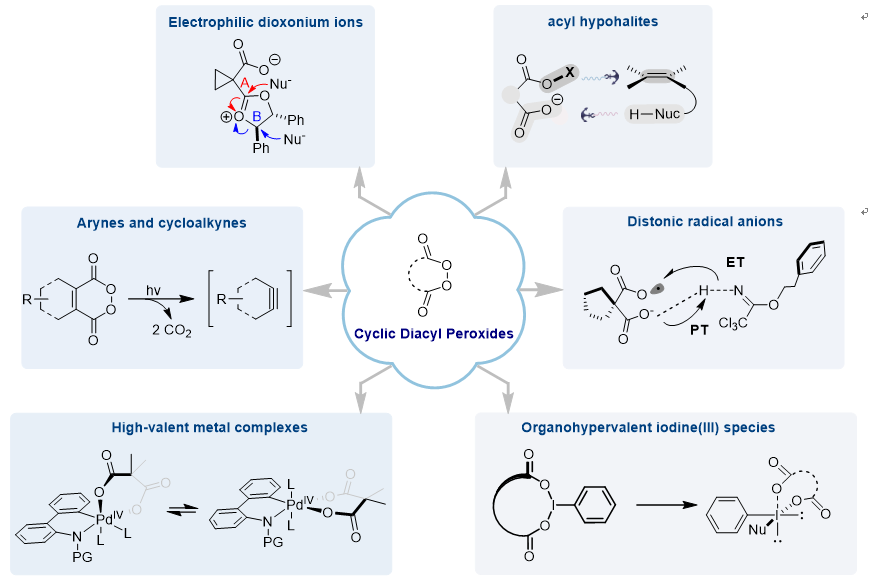
This review provides a comprehensive overview of the synthetic applications of five- and six-membered cyclic diacyl peroxides, organized according to the type of reactive intermediate generated. The structural features and stereoelectronic properties of these peroxides are first discussed to establish the mechanistic foundation for their reactivity. The subsequent sections systematically cover six classes of reactive intermediates. Electrophilic dioxonium ions, arising from ionic O-O bond cleavage, enable stereoselective dihydroxylation and oxidative cyclization of alkenes, with stereochemical outcomes switchable by simple additive variation. Photochemical decarboxylation provides a mild, clean route to arynes and cycloalkynes, which participate in cycloadditions with azides, tetrazines, and dienes under bioorthogonal-compatible conditions. Combination with halide salts generates covalently tethered acyl hypohalites, which serve as electrophilic halogenating agents for intramolecular halocyclization. Visible-light-induced O-X bond cleavage of these acyl hypohalites affords distonic radical anions, which engage in proton-coupled electron transfer (PCET) processes to enable remote C(sp³)-H functionalization, cyclization, and decarboxylative bromination. In transition metal catalysis, cyclic diacyl peroxides function as dual-role reagents—both as oxidants and as chelating dicarboxylate ligands—to stabilize high-valent Pd(IV), Ni(III), and Au(III) intermediates, enabling C-H acyloxylation, C-H functionalization, and oxidative alkyne coupling with unique selectivity profiles. In main-group redox catalysis, these peroxides serve as terminal oxidants to drive hypervalent iodine(III)-catalyzed nucleophilic fluorination of α-branched ketones.
Throughout this review, mechanistic details are emphasized, with experimental evidence and computational studies combined to elucidate reaction pathways, selectivity control, and the distinctive advantages of cyclic over acyclic diacyl peroxides. The challenges and future directions, including ligand design, asymmetric catalysis, and bioorthogonal applications, are also discussed.
[1] Brodie, B. C. Justus Liebigs Ann. Chem.1858, 108, 79.
[2] Peroxide chemistry: Mechanistics and preparative aspects of oxygen transfer; Adam W.; Wiley-VCH, 2000.
[3] Bach R. D.; Schlegel, H. B. J. Phys. Chem. A2020, 124, 4742.
[4] Name reactions: A collection of detailed mechanisms and synthetic applications; Li J. J.; Springer, 2009.
[5] Jin H.-X.; Wu, Y.-K. Chin. J. Org. Chem.2005, 25, 1372 (in Chinese). (金红霞, 伍贻康, 有机化学, 2005, 25, 1372.)
[6] Vacher M.; Galván I. F.; Ding B.-W.; Schramm S.; Berraud-Pache R.; Naumov P.; Ferré N.; Liu Y.-J.; Navizet I.; Roca-Sanjuán D.; Baader W. J.; Lindh R. Chem. Rev.2018, 118, 6927.
[7] Fujimori K.; Oshibe Y.; Hirose Y.; Oae S.J. Chem. Soc., Perkin Trans. 2 1996, 413.
[8] Yuan C.; Eliasen A. M.; Camelio A. M.; Siegel D. Nat. Protoc.2014, 9, 2624.
[9] Alabugin I. V.; Kuhn L.; Medvedev M. G.; Krivoshchapov N. V.; Vil′ V. A.; Yaremenko I. A.; Mehaffy P.; Yarie M.; Terent′ev A. O.; Zolfigol, M. A. Chem. Soc. Rev.2021, 50, 10253.
[10] Zhao R.; Chang D.; Shi L. Synthesis2017, 49, 3357.
[11] Griffith J. C.; Jones K. M.;Picon S.; Rawling M. J.; Kariuki B. M.; Campbell M.; Tomkinson, N. C. O. J. Am. Chem. Soc.2010, 132, 14409.
[12] Pellarin K. R.; McCready M. S.; Sutherland T. I.; Puddephatt R. J. Organometallics.2012, 31, 8291.
[13] Greene, F. D. J. Am. Chem. Soc.1956, 78, 2250.
[14] Zupancic J. J.; Horn K. A.; Schuster, G. B. J. Am. Chem. Soc.1980, 102, 5279.
[15] Bird, C. W. Tetrahedron.1980, 36, 535.
[16] Kolb H. C.; VanNieuwenhze M. S.; Sharpless, K. B. Chem. Rev.1994, 94, 2483.
[17] Griffith J. C.; Jones K. M.; Picon S.; Rawling M. J.; Kariuki B. M.; Campbell M.; Tomkinson, N. C. O. J. Am. Chem. Soc.2010, 132, 14409.
[18] Rawling M. J.; Rowley J. H.; Campbell M.; Kennedy A. R.; Parkinson J. A.; Tomkinson N. C.O.Chem. Sci. 2014, 5, 1777.
[19] Picon S.; Rawling M.; Campbell M.; Tomkinson, N. C. O. Org. Lett.2012, 14, 6250.
[20] Alamillo-Ferrer C.; Davidson S. C.; Rawling M. J.; Theodoulou N. H.; Campbell M.; Humphreys P. G.; Kennedy A. R.; Tomkinson, N. C. O. Org. Lett.2015, 17, 5132.
[21] Perret A.; Perrot, R. Helv. Chim. Acta.1945, 28, 558.
[22] Qian B.; Xiong H.; Zhu N.; Ye C.; Jian W.; Bao H. Tetrahedron Lett.2016, 57, 3400.
[23] Yuan C.; Axelrod A.; Varela M.; Danysh L.; Siegel D. Tetrahedron Lett.2011, 52, 2540.
[24] Eliasen A. M.; Christy M.; Claussen K. R.; Besandre R.; Thedford R. P.; Siegel D. Org. Lett.2015, 17, 4420.
[25] Alamillo-Ferrer C.; Karabourniotis-Sotti M.; Kennedy A. R.; Campbell M.; Tomkinson, N. C. O. Org. Lett.2016, 18, 3102.
[26] Alamillo-Ferrer C.; Curle J. M.; Davidson S. C.; Lucas S. C. C.; Atkinson S. J.; Campbell M.; Kennedy A. R.; Tomkinson, N. C. O. J. Org. Chem.2018, 83, 6728.
[27] Curle J. M.; Perieteanu M. C.; Humphreys P. G.; Kennedy A. R.; Tomkinson, N. C. O. Org. Lett.2020, 22, 1659.
[28] Terent’ev A. O.; Vil’ V. A.; Gorlov E. S.; Nikishin G. I.; Pivnitsky K. K.; Adam, W. J. Org. Chem.2016, 81, 810.
[29] Vil V. A.; Gorlov E. S.; Bityukov O. V.; Barsegyan Y. A.; Romanova Y. E.; Merkulova V. M.; Terent'ev, A. O. Adv. Synth. Catal.2019, 361, 3173.
[30] Yuan C.; Liang Y.; Hernandez T.; Berriochoa A.; Houk K. N.; Siegel D. Nature.2013, 499, 192.
[31] Camelio A. M.; Liang Y.; Eliasen A. M.; Johnson T. C.; Yuan C.; Schuppe A. W.; Houk K. N.; Siegel, D. J. Org. Chem.2015, 80, 8084.
[32] Dragan A.; Kubczyk T. M.; Rowley J. H.; Sproules S.; Tomkinson, N. C. O. Org. Lett.2015, 17, 2618.
[33] Gan S.; Yin J.; Yao Y.; Liu Y.; Chang D.; Zhu D.; Shi, L. Org. Biomol. Chem.2017, 15, 2647.
[34] Kim N.; Choi M.; Suh S.-E.; Chenoweth, D. M. Chem. Rev.2024, 124, 11435.
[35] Chang D.; Zhu D.; Shi, L. J. Org. Chem.2015, 80, 5928.
[36] Pradhan S.; Mohammadi F.; Bouffard, J. J. Am. Chem. Soc.2023, 145, 12214.
[37] Wei C.; Fu K.; Yu Z.; Zhan Z.; Chang D.; Shi, L. J. Am. Chem. Soc.2025, 147, 14299.
[38] Yang X.; Gao H.; Yan J.; Zhou J.; Shi L.Chem. Sci. 2024,15, 6130.
[39] Beng T. K.; Anosike I. S.; Kaur J. RSC Adv.2024, 14, 26913.
[40] Yates B. F.; Bouma W. J.; Radom, L. J. Am. Chem. Soc.1984, 106, 5805.
[41] Zhao R.; Yao Y.; Zhu D.; Chang D.; Liu Y.; Shi L. Org. Lett.2018, 20, 1228.
[42] Chang D.; Zhao R.; Wei C.; Yao Y.; Liu Y.; Shi, L. J. Org. Chem.2018, 83, 3305.
[43] Zhao R.; Fu K.; Fang Y.; Zhou J.; Shi, L. Angew. Chem. Int. Ed.2020, 59, 20682.
[44] Fu K.; Yang X.; Yu Z.; Song L.; Shi L. Chem. Sci.2024, 15, 12398.
[45] Wei C.; Chang D.; Feng N.; Zhan Z.; Shi L. Org. Lett.2025, 27, 2582.
[46] Yu Z.; Zhan Z.; Fu K.; Shi, L. Org. Chem. Front.2025, 12, 3568.
[47] Zhan Z.; Yu Z.; Shi L. Org. Lett.2025, 27, 12578.
[48] Wei C.; Zhao R.; Shen Z.; Chang D.; Shi, L. Org. Biomol. Chem.2018, 16, 5566.
[49] Hölter N.; Rendel N. H.; Spierling L.; Kwiatkowski A.; Kleinmans R.; Daniliuc C. G.; Wenger O. S.; Glorius F.,J. Am. Chem. Soc. 2025,147, 12908.
[50] Ma Z.; Mahmudov K. T.; Aliyeva V. A.; Gurbanov A. V.; Guedes da Silva, M. F. C.; Pombeiro, A. J. L. Coord. Chem. Rev.2021, 437, 213859.
[51] Dahiya A.; Patel, B. K. Chem. Rec.2021, 21, 3589.
[52] Zhu N.; Yao H.; Zhang X.; Bao, H. Chem. Soc. Rev.2024, 53, 2326.
[53] Yang C.-J.; Zhang C.; Gu Q.-S.; Fang J.-H.; Su X.-L.; Ye L.; Sun Y.; Tian Y.; Li Z.-L.; Liu X.-Y. Nat. Catal.2020, 3, 539.
[54] Mu X.; Wang B.; Qian H.; Iqbal N.; Abbas G.; Bäckvall, J.-E.; Yang, B.Org. Lett. 2026, 28, 9306.
[55] Mo F.; Jiang Y.; Qiu D.; Zhang Y.; Wang J.Angew. Chem. Int. Ed. 2010,49, 1846.
[56] Xu N.; Pu M.; Yu H.; Yang G.; Liu X.; Feng, X. Angew. Chem. Int. Ed.2024, 136, e202314256.
[57] Liu X.-M.; Li F.; Wang T.; Dai L.; Yang Y.; Jiang N.-Q.; Xue L.-Y.; Liu J.-Y.; Xue X.-S.; Xiao L.-J.; Zhou Q.-L.J. Am. Chem. Soc. 2024,147, 627.
[58] Vil' V. A.; Barsegyan Y. A.; Kuhn L.; Terent’ev A. O.; Alabugin I. V. Organometallics.2023, 42, 2598.
[59] Yuan T.; Fu K.; Shi, L. Org. Chem. Front.2024, 11, 4529.
[60] Fu K.; Shi L. ACS Catal.2024, 14, 17077.
[61] Yuan T.; Shi L. Adv. Sci.2026, 13, e22444.
[62] Vil' V. A.; Barsegyan Y. A.; Chabuka B. K.; Ilovaisky A. I.; Alabugin I. V.; Terent'ev, A. O. ACS Catal.2025, 15, 3636.
[63] Gao H.; Yan J.; Zeng C.; Shi, L. Chem. Eur. J.2026, 32, e71175.
[64] Zhong S.; Yu Z.; Zhu Y.; Shi L. Org. Lett.2025, 27, 3452.


