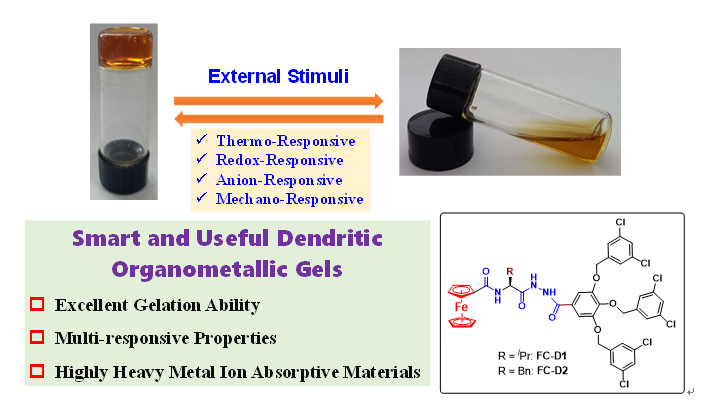
Developing supramolecular gels that effectively integrate multi-stimuli responsiveness with high-performance heavy metal adsorption remains a significant challenge, primarily due to the limited functionality and weak synergistic effects of conventional gelators. To address this issue, we have designed and synthesized two novel ferrocene-cored poly(aryl ether) dendritic organometallic gelators, designated as FC-D1 and FC-D2, which are functionalized with amide and acylhydrazide linkages. The chemical structures of both gelators were thoroughly characterized using standard spectroscopic techniques. Our experimental results demonstrate that both FC-D1 and FC-D2 exhibit outstanding gelation ability across a broad spectrum of pure organic solvents and binary solvent mixtures, forming highly stable organogels at remarkably low critical gelation concentrations (CGC). Mechanistic investigations employing Fourier-transform infrared (FT-IR) spectroscopy and variable-concentration proton nuclear magnetic resonance (¹H NMR) spectroscopy reveal that the self-assembly process is synergistically driven by two key non-covalent interactions: intermolecular hydrogen bonding originating from the acylhydrazone and amide moieties, and π-π stacking interactions among the aromatic rings of the dendritic branches. This cooperative assembly leads to the formation of robust three-dimensional network structures. The resulting metallogels exhibit excellent and reversible multi-stimuli-responsive properties, enabling reliable gel-to-sol transitions upon exposure to various external stimuli, including temperature changes, redox reactions (using ceric ammonium nitrate (CAN) and glutathione (GSH) as an oxidizing/reducing pair), chemical triggers (specifically fluoride ions), and mechanical thixotropic stimuli. Beyond their stimuli-responsive behavior, we also evaluated the potential of the FC-D1 dendron as an effective and recyclable adsorbent for the removal of toxic heavy metal ions from aqueous environments. The results show that FC-D1 achieves impressive removal efficiencies of 72%, 51%, and 73% for Hg2+, Pb2+, and Cd2+, respectively. Furthermore, the gel system maintains stable adsorption performance over four consecutive adsorption-desorption cycles, demonstrating good reusability. Overall, this work not only provides a new and effective molecular design strategy for constructing multifunctional dendritic organometallic gels but also significantly expands their potential applications in the fields of intelligent sensing and heavy metal wastewater remediation.
[1] Weiss R. G.Molecular gels: structure and dynamics.Royal Society of Chemistry, 2018.
[2] Jiao T.Supramolecular gels: materials and emerging applications. Wiley-VCH: Weinheim, Germany, 2022.
[3] Zhang J.; Hu Y.; Li Y. G.Gel chemistry: interactions, structures and properties.Springer: Singapore, 2018.
[4] Babu S. S.; Praveen V. K.; Ajayaghosh A.Chem. Rev. 2014, 114, 1973.
[5] Adams, D. J. J. Am. Chem. Soc.2022, 114, 11047.
[6] Zhang H.; Zhang H. K.; Feng Y. Supramol. Mater.2026, 5, 100124.
[7] Shao M.; Tian Y.; Wang J.; Miao R.; Fang Y.Acta Chim. Sinica 2026, 84, 484.
[8] Dastidar P.; Ganguly S.; Sarkar, K. Chem. Asian J.2016, 11, 2484.
[9] Tam Y.-Y.; Yam, V. W.-W. Chem. Soc. Rev.2013, 42, 1540.
[10] Wu H.; Zheng J.; Kjøniksen A.-L.; Wang W.; Zhang Y.; Ma J. Adv. Mater.2019, 31, 1806204.
[11] Kuosmanen R.; Rissanen K.; Sievänen E.Chem. Soc. Rev. 2020, 49, 1977.
[12] Alam N.; Mondal S.; Sarma, D. Coord. Chem. Rev.2024, 504, 215673.
[13] Fan W.; Chen L.; Yang, H. Chin. J. Org. Chem.2015, 35, 578.
[14] Liu Z.; Zhao X.; Chu Q.; Feng Y. Molecules2023, 28, 2274.
[15] Biradha K.; Das Dawn M.; Sultana S.; Paul, P. Coord. Chem. Rev.2026, 552, 217513.
[16] Liu Z.; Hou Y.; Zhang C.; Yang H.; Zhang M.; Feng, Y. Sci. Sin. Chim.2026, 56, 2214.
[17] Mahmoodi-Babolan N.; Nematollahzadeh A.; Shafiei, S. Coord. Chem. Rev.2026, 562, 217959.
[18] Wang X.; Wang Y.; Chen L.; Xie X. F.; Sun, J. Chem. Eng. J.2024, 499, 156241.
[19] Sui J.; Wang L.; Zhao W.; Hao J. Chem. Commun.2016, 52, 6993.
[20] Tchounwou P. B.; Ayensu W. K.; Ninashvili N.; Sutton D. Environ. Toxicol.2003, 18, 149.
[21] Riaz M.; Kamran M.; Fang Y.; Wang Q.; Cao H.; Yang G.; Deng L.; Wang Y.; Zhou Y.; Anastopoulos I.; Wang, X. J. Hazard. Mater.2021, 402, 123919.
[22] Cheng Q.; Zhang J.; Dai B.-Y.; Wang X.-Y.; Ji G.-Z.; Zhao, Y.-F. Comp. Biochem. Physiol. C2026, 299, 110346.
[23] Li J.; Wang X. X.; Zhao G.X.; Chen C. L.; Chai Z. F.; Alsaedi A.; Hayat T.; Wang, X. K. Chem. Soc. Rev.2018, 47, 2322.
[24] Das R.; Vecitis C.D.; Schulze A.; Cao B.; Ismail A. F.; Lu X.; Chen J.; Ramakrishna, S. Chem. Soc. Rev.2017, 46, 6946.
[25] Li X.; Bian C.; Meng X.; Xiao, F. J. Mater. Chem. A2016, 4, 5999.
[26] Wu Z.; Zhao D. Chem. Commun.2011, 47, 3332.
[27] Khajeh M.; Laurent S.; Dastafkan K. Chem. Rev.2013, 113, 7728.
[28] Wang S.; Yan Q.; Yang J.; Hu H.; Xiao S.; Gao Y.Green Energy Environ. 2025,10, 1235.
[29] Okesola B. O.; Smith, D. K. Chem. Soc. Rev.2016, 45, 4226.
[30] Muya F. N.; Sunday C. E.; Baker P.; Iwuoha, E. Water Sci. Technol.2016, 73, 983.
[31] Perumal S.; Atchudan R.; Edison T. N. J. I.; Babu R. S.; Karpagavinayagam P.; Vedhi C. Metals2021, 11, 864.
[32] Liu Z.; Zhang M.; Yang H.; Zhang C.; Hou Y.; Wang J.; Fei P.; Feng F.; Feng Y. Molecules2026, 31, 957.
[33] Feng Y.; He Y. M.; Fan, Q. H. Chem. Asian J.2014, 9, 1724.
[34] Feng Y.; Liu Z. X.; Chen H.; Fan, Q. H. Chem. Commun.2022, 58, 8736.
[35] Liu Z. X.; Chu Q.; Feng, Y. Acta Chim. Sinica2022, 80, 1424.
[36] Zhang H.; Fu D. Q.; Zhang H. K.; Feng, Y. Sci. Sin. Chim.2026, 56, 2259.
[37] Liu Z. X.; Feng Y.; Zhao Z. Y.; Yan Z. C.; He Y. M.; Luo X. J.; Liu C. Y.; Fan, Q. H. Chem. Eur. J.2014, 20, 533.
[38] Lakshmi N. V.; Mandal D.; Ghosh S.; Prasad, E. Chem. Eur. J.2014, 20, 9002.
[39] Jiang B.; Kong L.; Cheng X.; He M.; Zhang H.; Feng, Y. Chem. Asian J.2025, 20, e00426.
[40] Chen H.; Feng Y.; Deng G. J.; Liu Z.X.; He Y. M.; Fan, Q. H. Chem. Eur. J.2015, 21, 11018.
[41] Liu Z. X.; Sun Y.; Feng Y.; Chen H.; He Y. M.; Fan, Q. H. Chem. Commun.2016, 52, 2269.
[42] Kong L.-J.; Fu D.-Q.; Zhang H.; Luo R.; Zhang H.; Feng Y. Langmuir2026, 42, 7861.
[43] Fu D. Q.; Kong L. J.; Wu L. F.; Peng Z.; Zhang H. K.; Yi N.; Yi B.; Feng Y. Langmuir2026, 42, 13651.
[44] Fu D. Q.; Kong L. J.; Wang Q. Y.; Zhang H. K.; Feng, Y. J. Colloid Interface Sci.2026, 702, 138798.
[45] Wu L. F.; Li H. J.; Zhang T.; Tan J. P.; Sun Y. X.; Zhang H. K.; Feng, Y. J. Colloid Interface Sci.2026, 719, 140638.
[46] Rajamalli P.; Prasad E. Org. Lett.2011, 13, 3714.
[47] Liu J.; Feng Y.; Liu Z. X.; Yan Z.-C.; He Y.-M.; Liu C.-Y.; Fan, Q. H. Chem. Asian J.2013, 8, 572.
[48] Sui X.; Feng X.; Hempenius M. A.; Vancso, G. J. J. Mater. Chem. B2013, 1, 1658.
[49] Liu X.; Zhao L.; Liu F.; Astruc D.; Gu, H. Coord. Chem. Rev.2020, 419, 213406.
[50] Matsui H.; Morimoto M.; Horimoto K.; Nishimura, Y. Toxicol. in Vitro2007, 21, 1113.
[51] Barbier O.; Arreola-Mendoza L.; Del Razo, L. M. Chem. Biol. Interact.2010, 188, 319.
[52] Chakraborty, S. Results Chem. 2023, 6, 100994.
[53] Dutta S.; Sahana A. Anal. Methods2024, 16, 344.
[54] Cao X.; Gao A.; Hou J.; Yi, T. Coord. Chem. Rev.2021, 434, 213792.
[55] Percec V.; Peterca M.; Yurchenko M. E.; Rudick J. G.; Heiney, P. A. Chem. Eur. J.2008, 14, 909.
[56] Feng Y.; Liu Z. X.; Chen H.; Yan Z.-C.; He Y. M.; Liu C. Y.; Fan, Q. H. Chem. Eur. J.2014, 20, 7069.
[57] Liu Z. X.; Feng Y.; Yan Z. C.; He Y. M.; Liu C. Y.; Fan, Q. H. Chem. Mater.2012, 24, 3751.
[58] Zhang H. K.; Wu L. F.; Kong L. J.; Feng Y. Langmuir2026, 42, 22092.
[59] Zhang H. K.; Deng S. T.; Wu L. F.; Qiu H.; Feng, Y. Adv. Opt. Mater.2026, 14, e71543.
[60] Cheng X.; He M.; Wang Q.; Xiao Y.; Huo J.; Zhang H.; Feng Y. Langmuir2025, 41, 18257.


