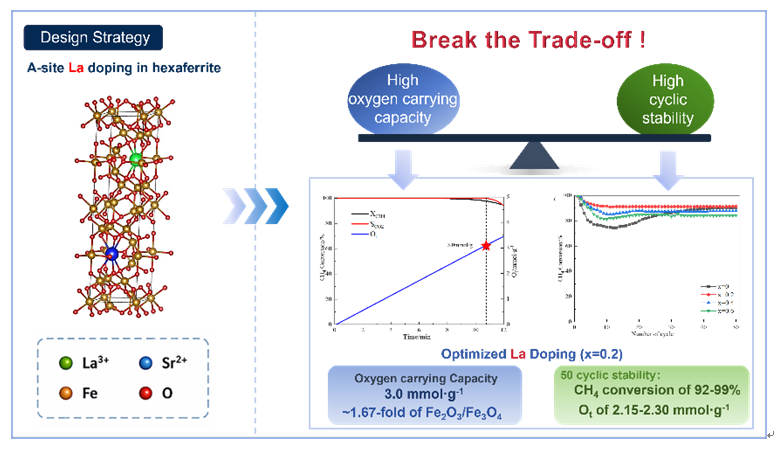
Chemical looping combustion of methane, as an emerging low-carbon combustion technology, employs solid oxygen carriers to transfer oxygen between the fuel reactor and the air reactor, enabling the temporal and spatial separation of the conventional fuel combustion process without the direct contact between fuel and air. This technology offers significant advantages such as inherent CO2 separation and near-zero NOx emissions, making it an important technological pathway for achieving carbon neutrality. As the medium for oxygen transfer, oxygen carriers are cyclically transported between the fuel reactor and the air reactor, where their oxygen carrying capacity and cyclic stability are critical. Iron-based oxygen carriers have attracted extensive attention due to their low cost and environmental friendliness. This paper proposes a strategy that utilizes both the high iron capacity characteristics of hexaferrites (AFe12O19) structure and A-site cation regulation to overcome the performance bottlenecks of conventional iron-based oxygen carriers. In this work, a series of La-doped LaxSr1-xFe12O19 (x = 0, 0.2, 0.4, and 0.6) oxygen carriers were synthesized via a coprecipitation method, and the effects of La substitution on phase structure, lattice oxygen mobility, redox activity, and cyclic stability were systematically investigated. The results of fixed-bed reactor evaluation show that, the oxygen carrier with an appropriate La doping (x = 0.2) achieves an Ot as high as 3.0 mmol g-1 while maintaining 100% CO2 selectivity, which is approximately 1.67 times the theoretical Ot of Fe2O3/Fe3O4 redox pair. After 50 redox cycles, the CH4 conversion remains between 92% and 99%, and the Ot is maintained at 2.13 mmol·g-1~2.30 mmol·g-1, achieving both high Ot and high cyclic stability. Characterization results including XRD, BET, H2-TPR, SEM, and XPS reveal that, the overall performance of the oxygen carriers was enhanced by La doping through the following mechanisms: (1) suppressing the formation of the SrFe2O5 impurity phase, increasing the specific surface area from 4.2 m2·g-1 to 6.2 m2·g-1~6.9 m2·g-1, and promoting lattice oxygen mobility; (2) altering the structural evolution pathway during reduction, thereby promoting the preferential formation of low-valence Sr4Fe6O12 with an average Fe valence state of +2.67, which breaks through the redox window limitation of the conventional Fe2O3/Fe3O4 system; and (3) enhancing the reversible regeneration capability and sintering resistance of the hexaferrite structure, thus enabling the Fe species to recover to a near-initial state even after 50 redox cycles. This study demonstrate that A-site La doping to regulate the structural evolution of hexaferrites provides an effective strategy to overcome the trade-off effect in iron-based oxygen carriers, which paves the way for rational design of high-performance iron-based oxygen carriers.
Jia Xinyao
,
Zhou Yumei
,
Song Zhe
,
Zhao Peijie
,
Wang Ruohan
,
Ding Yihao
,
Ren Shuoyuan
,
Zhu Yanyan
. Study on La-Induced Structural Evolution of Hexaferrite and Its Performance in Methane Chemical Looping Combustion[J]. Acta Chimica Sinica, 0
: 2
-2
.
DOI: 10.6023/A26040136
[1] Erlach B.; Schmidt M.; Tsatsaronis G. Energy 2011, 6, 3804-3815.
[2] Lyngfelt A.; Brink A.; Langørgen Ø.; Mattisson T.; Rydén M.; Linderholm C. Int.[J]. Greenh. Gas. Con. 2019, 88, 38-56.
[3] Obara, S. y. Energy 2023, 262, 125403.
[4] Qasim M.; Ayoub M.; Ghazali N. A.; Aqsha A.; Ameen M. Ind. Eng. Chem. Res. 2021, 24, 8621-8641.
[5] Zeng L.; Cheng Z.; Fan J. A.; Fan L.-S.; Gong J. Nat. Rev. Chem. 2018, 11, 349-364.
[6] Güleç F.; Okolie J. A. Environ. Chem. Lett. 2024, 1, 121-147.
[7] Li X.; Li J.; Wang L.; Liu L.; Lin Y.; Teng S.; Song Y.; Zeng D.; Qiu Y. Chem. Eng. J. 2026, 532, 174530.
[8] Fan L.-S.; Zeng L.; Luo S.AlChE J. 2015, 1, 2-22.
[9] Tang M.; Xu L.; Fan M. Appl. Energy 2015, 151, 143-156.
[10] Sun Z.; Russell C. K.; Whitty K. J.; Eddings E. G.; Dai J.; Zhang Y.; Fan M.; Sun Z. Prog.Energy Combust. Sci. 2023, 96, 101045.
[11] Hu J.; Galvita V. V.; Poelman H.; Marin G. B. Materials 2018, 7, 1187.
[12] Li F.; Sun Z.; Luo S.; Fan L.-S.Energy Environ. Sci. 2011, 3, 876-880.
[13] Cao Y.; Liu F.; Song C.; Yang L.; Zhai C. Chem. Eng. J. 2024, 480, 148285.
[14] Qiu Y.; Zeng D.; Xiao R. Energy Fuels 2024, 15, 13819-13836.
[15] Li R.; Du X.; Feng X.; Wang J.; Ta N.; Fu Q.; Bao X. Chin.[J]. Catal. 2026, 82, 327-336.
[16] Fang Y.; Liu Y.; Li Z.; Pan Y.; Liu Q.; Jin H. Appl. Energy 2026, 415, 127918.
[17] Rubel A. M.; Zhang Y.; Neathery J. K.; Liu K. Energy Fuels 2011, 10, 4271-4279.
[18] Qin L.; Cheng Z.; Guo M.; Xu M.; Fan J. A.; Fan, L.-S. ACS Energy Lett. 2017, 1, 70-74.
[19] Qin L.; Guo M.; Cheng Z.; Xu M.; Liu Y.; Xu D.; Fan J. A.; Fan L.-S.J. Mater. Chem. A 2017, 38, 20153-20160.
[20] Zong T.; Zhu X.; Tian M.; Wang C.; Wang N.; Yang J.; Liu S.; Wang X. J.Energy Chem. 2026, 116, 399-408.
[21] Wen L.; Li Z.; Chen N.; Yuan J.; Li Y.; Jiang L.; Wang H.; Li K.Green Energy Environ. 2026.
[22] Huang F.; Tian M.; Zhu Y.; Wang X.; Wang A.; Li L.; Lin J.; Wang J. J.Energy Chem. 2019, 29, 50-57.
[23] Galinsky N. L.; Huang Y.; Shafiefarhood A.; Li F.ACS Sustain Chem Eng. 2013, 3, 364-373.
[24] Aihara T.; Aoki W.; Ishikawa S.; Bae S.; Kiyohara S.; Kumagai Y.; Hara M.; Kamata K. ACS Appl.Nano Mater. 2025, 32, 15988-15998.
[25] Ha J.; Kim H. S.; Kim H.; Kim Y.; Asih S. A.N.; Lee, J. W. ChemSusChem 2025, 24, e202501667.
[26] Ma Z.; Liu G.; Lu Y.; Wang J.; Zhang H.Fuel Process. Technol. 2021, 224, 107030.
[27] Wang M.; Li W.; Wang S.; Shi Z. Langmuir 2023, 1, 285-294.
[28] Dai X.; Cheng J.; Li Z.; Liu M.; Ma Y.; Zhang X. Chem. Eng. Sci. 2016, 153, 236-245.
[29] He F.; Zhao K.; Huang Z.; Li, X. a.; Wei, G.; Li, H. Chin. [J]. Catal. 2013, 6, 1242-1249.
[30] Torrez-Herrera, J. J.; Korili, S. A.; Gil, A. Catal. Rev. Sci. Eng. 2022, 3, 592-630.
[31] Utsis N.; Landau M. V.; Erenburg A.; Herskowitz M. Catalysts 2020, 9, 1082.
[32] Kumar S.; Bastien G.; Colman R. H.; Savinov M.; Proschek P.; Vališka M.; Kempiński M.; Kempiński W.; Śliwińska-Bartkowiak, M.; Kamba, S. [J]. Alloy. Compd. 2026, 187535.
[33] Ha J.; Kim H. S.; Kim H.; Kim Y.; Asih S. A.N.; Lee, J. W. ChemSusChem 2025, 24, e202501667.
[34] Xia Y.; Pu G.; Wu J.; Yang Q.; Zhou R.; Wang J.; Gao J. J. Environ. Chem. Eng. 2025, 3, 116425.
[35] Zhu Y.; Zhou Y.; Chen L.; Zhu H.; Chen H.; Liu R.; He J.; Yang Q.; Hu J.; Huang C.; Wang X.AlChE J. 2025, 12, e70100.
[36] Kim T. K.; Kang M.; Choi Y. S.; Kim H. K.; Lee W.; Chang H.; Seung D. J. Power Sources 2007, 1, 1-8.
[37] Wang P.; Hong Q.; Shen L.; Song T. Energy Fuels 2022, 24, 15037-15046.
[38] Zhang S.; Feng Y.; Guo X. Energy Fuels 2021, 1, 626-635.
[39] Kang Y.; Tian M.; Wang Y.; Wang Y.; Huang C.; Zhu Y.; Li L.; Wang G.; Wang X. ACS Sustainable Chem.Eng. 2018, 10, 12884-12892.
[40] Tian M.; Wang C.; Li L.; Wang X.AlChE J. 2017, 7, 2827-2838.
[41] Deng G.; Li K.; Zhang G.; Gu Z.; Zhu X.; Wei Y.; Wang H. Appl. Energy 2019, 253, 113534.
[42] 张善超, 张. 王. 梁. 杨. 杨. 苏. 马. 朱. 化工进展 2025, 10, 5703-5716.
[43] He J.; Wang T.; Bi X.; Tian Y.; Huang C.; Xu W.; Hu Y.; Wang Z.; Jiang B.; Gao Y.; Zhu Y.; Wang X. Nat.Commun. 2024, 1, 5422.
[44] Song Z.; Hong J.; Yang Q.; Huang C.; Shao M.; Wang Z.; Su W.; Yang G.; Jiang B.; Zhu Y. Chem. Eng. J. 2025, 511, 162225.


