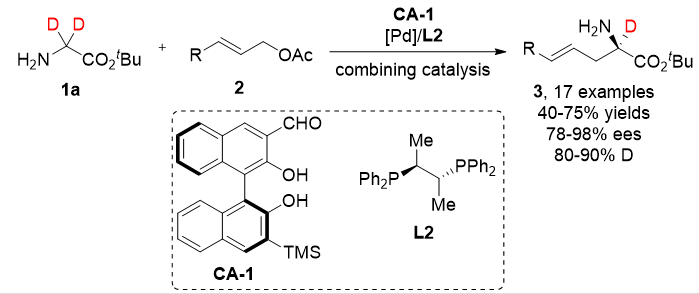
α-Deuterated amino acids hold exceptional significance in chemistry, biology, and medicine. Consequently, the development of highly efficient synthetic methodologies for their preparation has long been a central objective in synthetic chemistry. Over the past several decades, catalytic asymmetric deuteration of unsaturated bonds—particularly C=C and C=N—and catalytic asymmetric α-H/D exchange of readily accessible amino acid derivatives have emerged as the predominant strategies. In contrast, the catalytic asymmetric α-functionalization of α-deuterated glycine derivatives has received comparatively limited attention from the chemical community, despite its initial disclosure as early as 2002. In principle, this approach represents a highly promising route to chiral α-deuterated amino acids, owing to its broad functional group compatibility and versatility with diverse electrophilic reagents. Indeed, numerous catalytic asymmetric α-functionalization reactions of glycine derivatives have been successfully developed in recent years, laying a solid foundation for extending such transformations to α-deuterated substrates. Nevertheless, corresponding catalytic asymmetric methodologies remain scarce. Building upon our prior work on asymmetric α-functionalization of amino acid derivatives enabled by synergistic chiral aldehyde/palladium dual catalysis, we aim to revitalize research efforts toward the discovery of novel α-functionalization reactions of α-deuterated glycine derivatives. In this work, we employ NH₂-unprotected α-deuterated glycine esters and allylic alcohol derivatives as substrates, and a combining system comprising a chiral aldehyde, a palladium-phosphine complex and zinc chloride, as the synergistic catalyst. The reaction is conducted in toluene under a nitrogen atmosphere at ambient temperature for 10 hours, using DABCO as the base. This protocol affords a series of α-functionalized, α-deuterated amino acid derivatives in good yields, with high enantioselectivities and excellent deuterium retention. Through simple derivatization of the catalytic products, the construction of α-deuterated aspartic acid, asparagine, lysine, and arginine derivatives was successfully achieved. This work provides a good example for the preparation of α-deuterated α-amino acid esters in a step-economic manner.
Liu Jinlong
,
Wu Zhulian
,
Cai Tian
,
Guo Qixiang
. Synthesis of α-Deuterated α-Amino Acid Esters by Chiral Aldehyde/Palladium Combining Catalysis[J]. Acta Chimica Sinica, 0
: 26070246
-26070246
.
DOI: 10.6023/A26070246
[1] (a) Gant, T. G. J. Med. Chem.2014, 57, 3595.(b) Pirali T.; Serafini M.; Cargnin S.; Genazzani, A. A. J. Med. Chem.2019, 62, 5276.
[2] (a) Furuta T.; Takahashi H.; Kasuya, Y. J. Am. Chem. Soc.1990, 112, 3633.(b) Toney, M. D. Archives of Biochemistry and Biophysics.2014, 544, 119.
[3] Gardner K. H.; Kay, L. E. J. Am. Chem. Soc.1997, 119, 7599.
[4] Helfenbein J.; Lartigue C.; Noirault E.; Azim E.; Legailliard J.; Galmier M. J.; Madelmont, J. C. J. Med. Chem.2002, 45, 5806.
[5] Harbeson S. L.; Tung, R. D. The Pharmaceutical Society of Japan.2014, 24, 8.
[6] (a) T. Malmlöf D.; Rylander R.-G.; Alken F.; Schneider T. H.; Svensson M. A.; Cenci, B. Schilström. Exp. Neurol.2010, 225, 408.(b) Quan, B.-X.; Shuai, H.; Xia, A.-J.; Hou, Y.; Zeng, R.; Liu, X.-L.; Lin, G.-F.; Qiao, J.-X.; Li, W.-P.; Wang, F.-L.; Wang, K.; Zhou, R.-J.; Yuen, T. T.-T.; Chen, M.-X.; Yoon, C.; Wu, M.; Zhang, S.-Y.; Huang, C.; Wang, Y.-F.; Yang, W.; Tian, C.; Li, W.-M.; Wei, Y.-Q.; Yuen, K.-Y.; Chan, J. F.-W.; Lei, J.; Chu, H.; Yang, S. Nat Microbiol. 2022, 7, 716.(c) Darland, G. K.; Hajdu, R.; Kropp, H.; Kahan, F. M.; Walker, R. W.; Vandenheuvel, W. J. Drug Metabolism and Disposition. 1986, 14, 668. (d) DeWitt, S.; Czarnik, A. W.; Jacques, V. ACS Med. Chem. Lett. 2020, 11, 1789.(e) Maltais F.; Jung Y. C.; Chen M.; Tanoury J.; Perni R. B.; Mani N.; Laitinen L.; Huang H.; Liao S.; Gao H.; Tsao H.; Block E.; Ma C.; Shawgo R. S.; Town C.; Brummel C. L.; Howe D.; Pazhanisamy S.; Raybuck S.; Namchuk M.; Bennani, Y. L. J. Med. Chem.2009, 52, 7993.
[7] Di Martino, R. M. C.; Maxwell, B. D.; Pirali, T.Nat Rev Drug Discov, 2023, 22, 562.
[8] (a) Wang T.; Chen J.; Wang L.; Wang Z.; Fan, B. Chin. J. Org. Chem.2022, 42, 3693.(b) Li H.; Shabbir M.; Li W.; Lei, A. Chin. J. Chem.2024, 42, 1145.(c) Li, L.; Chen. X.; Pei, C.; Li, J.; Zou, D.; Wu, Y.; Wu, Y. Chin. J. Org. Chem. 2021, 41, 2319.
[9] Li A.; Song X.; Ren Q.; Bao P.; Long X.; Huang F.; Yuan L.; Zhou J. S.; Qin, X. Angew Chem Int Ed.2023, 62, e202301091.
[10] (a) Moozeh K.; So S. M.; Chin, J. Angew Chem Int Ed.2015, 54, 9381.(b) Doyon T. J.; Buller, A. R. J. Am. Chem. Soc.2022, 144, 7327.
[11] (a) Lygo B.; Humphreys, L. D. Tetrahedron. Letters,2002, 43, 667.(b) Fu, C.; Chang, X.; Xiao, L.; Wang, C.-J. Org. Lett, 2022, 24, 5562.
(c) Chang X.; Cheng X.; Wang C.-J. Chem. Sci.2022, 13, 4041.
[12] Cui R.; Teng H.; Huang X.; Zhang J. Chem. Commun.2025, 61, 15030.
[13] Chen L.; Luo M.-J.; Zhu F.; Wen W.; Guo, Q.-X. J. Am. Chem. Soc.2019, 141, 5159.