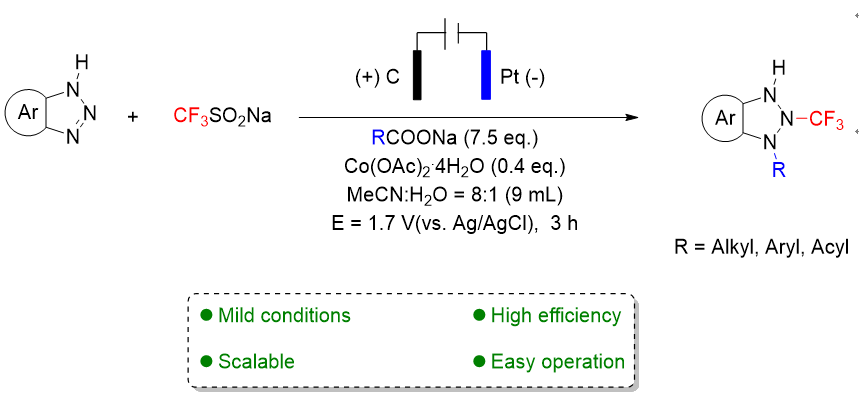
The conventional methods for constructing fluorinated nitrogen‑containing heterocycles often rely on the use of expensive fluorinating reagents, noble‑metal catalysts, or harsh reaction conditions, which significantly limit their practical utility in pharmaceutical and materials chemistry. To overcome these limitations, researchers have devoted considerable effort to developing more efficient and selective fluorination strategies, particularly those compatible with sustainable synthetic protocols. In recent years, electrochemistry has emerged as a powerful and environmentally benign platform for enabling challenging bond‑formation processes without the need for stoichiometric oxidants. Its ability to generate reactive intermediates—such as radicals and radical cations—directly at electrode surfaces offers unique opportunities for precise control over reaction pathways. Among various fluorinated motifs, the trifluoromethyl (CF3) group stands out due to its remarkable ability to modulate the physicochemical properties of bioactive molecules. Benzotriazole derivatives, as privileged nitrogen heterocycles, are widely present in pharmaceuticals, agrochemicals, and functional materials, yet their N-CF3 functionalization remains underdeveloped, especially under mild conditions. In this study, an electrochemical approach for the N-trifluoromethylation-N'-alkylation of benzotriazoles and related azoles under ambient conditions was developed. In a three-electrode electrochemistry system with carbon cloth as the anode, platinum plate as the cathode and Ag/AgCl as the reference electrode, the reaction proceeded smoothly with CF3SO2Na as the CF3 source and carboxylate salts as both the supporting electrolyte and alkyl source. The addition of Co(OAc)2·4H2O was essential for enhancing the reactivity, likely through facilitation of anodic oxidation processes. The reaction results revealed that a MeCN/H2O (8:1) solvent system and a constant applied potential of 1.7 V delivered optimal efficiency, affording up to 95% HPLC yield and 84% isolated yield for the model benzotriazole substrate within 3 h. The methodology demonstrated broad substrate scope, accommodating diverse benzotriazole derivatives, with product isomers dictated by the symmetry of the azole ring. Furthermore, variation of the carboxylate component enabled introduction of alkyl, aryl and acyl groups at the N'-position, showcasing good applicability. A possible mechanism involving anodic generation of alkyl radicals and CF3· radicals, followed by sequential addition to the azole framework was proposed. Gram-scale experiments with model substrate proceeded smoothly and afforded 77% yield of target product, demonstrating potential synthetic practicality of this strategy in the future. Overall, this electrochemical synthesis method provides a green and efficient synthesis route to construct N-CF3 functionalized heterocycles, without the use of stoichiometric oxidants or noble metal catalysts.
Shuping Zhu
,
Qianqian Wei
,
Yanhua Zhang
. Electrochemical N-Trifluoromethylation-N'-Alkylation of Benzotriazole compounds[J]. Acta Chimica Sinica, 0
: 26080296
-26080296
.
DOI: 10.6023/A26080296
[1] Umemiya S.; Nara S.; Terada M. Org. Lett.2025, 27, 6204-6210.
[2] Thi Chung N.; Vo Cong D.; Xuan Duc, D. Nat. Prod. Commun.2025, 20, 1-106.
[3] Dai J. H.; Cao Q. Y.; Yang D. L.; Chen G.; Du Z. T.; Wang S.; Li, F. K. Chin. J. Chem. Eng.2025, 78, 263-272.
[4] Ye G. D.; Li S. X.; Liang F.; Guan L.; Zhang M. Food Chem.2026, 504, 147774.
[5] Ignat’ev N. V.; Finze M. Chem. Rev.2025, 125, 9187-9255.
[6] Rosenbaum N.; Zippel C.; Bräse, S. Sci. China Chem.2019, 62, 923-924.
[7] Tong J. F.; Jiang X. F.; Li H. L.; An L. L.; Yang C. H.; Huang Y. B.; Guo P. Z.; Liang Z. Z.; Yang C. Y.; Li J. F.; Xia, Y. J. Opt. Mater.2021, 121, 111593.
[8] Chen X.; Xia R. Q.; Huang Y. C.; Zheng J.; Wang Y. M.; Jia X. L.; Han Y.; Chen Z. X.; Ning G. H.; Li, D. Natl. Sci. Rev.2026, 13, nwaf463.
[9] Scattolin T.; Bouayad-Gervais S.; Schoenebeck F. Nature2019, 573, 102-107.
[10] Allen L. J.; Lee S. H.; Cheng Y.; Hanley P. S.; Muhuhi J. M.; Kane E.; Powers S. L.; Anderson J. E.; Bell B. M.; Roth G. A.; Sanford M. S.; Bland, D. C. Org. Process Res. Dev.2014, 18, 1045-1054.
[11] Ryan S. J.; Schimler S. D.; Bland D. C.; Sanford, M. S. Org. Lett.2015, 17, 1866-1869.
[12] Nielsen M. K.; Ugaz C. R.; Li W. P.; Doyle, A. G. J. Am. Chem. Soc.2015, 137, 9571-9574.
[13] Cismesia M. A.; Ryan S. J.; Bland D. C.; Sanford, M. S. J. Org. Chem.2017, 82, 5020-5026.
[14] Hitt M.; Nagaretnam P.; Vedernikov, A. N. Org. Lett.2025, 27, 9460-9464.
[15] Yang L.; Zhang, C. P. ACS Omega2021, 6, 21595-21603.
[16] Neumann C. N.; Ritter, T. Acc. Chem. Res.2017, 50, 2822-2833.
[17] Qin H.; Wei G. L.; Xie W. G.; Mao X. H.; Wang F. W.; Bao M. H.; Zheng X. W.; Zhang Y. W.; Huang, P. Org. Biomol. Chem.2025, 23, 5390-5395.
[18] Liu J. Y.; Cui Z. W.; Bi J. J.; He X.; Ding Q. J.; Zhu H.; Ma, C. H. Front. Chem.2024, 12, 1481342.
[19] Moilliet, J. S. J. Fluor. Chem.2001, 109, 13-17.
[20] Jähnisch K.; Baerns M.; Hessel V.; Ehrfeld W.; Haverkamp V.; Löwe H.; Wille C.; Guber, A. J. Fluor. Chem.2000, 105, 117-128.
[21] Xu C. Z.; Liu Y.; Liu H.; Ma J. i.; He X.; Wu H. F.; Li Y. Q.; Sun Z. Z.; Chu, W. Y. Tetrahedron Lett.2020, 61, 152226.
[22] Yang X. Y.; Wang J. M.; Pei M. Y.; Wang S. Y.; Shang R.; Wei, X. F. Org. Lett.2024, 26, 10934-10939.
[23] Choi W. J.; Choi S.; Ohkubo K.; Fukuzumi S.; Cho E. J.; You Y. Chem. Sci.2015, 6, 1454-1464.
[24] Yin G. J.; Zhu M.; Fu, W. J. J. Fluor. Chem.2017, 199, 14-19.
[25] Shih H. W.; Vander Wal M. N.; Grange R. L.; MacMillan, D. W. C. J. Am. Chem. Soc.2010, 132, 13600-13603.
[26] Salma U.; Ahmad S.; Zafer Alam M.; Khan, S. A. J. Mol. Struct.2024, 1301.
[27] Loukopoulos E.; Kostakis, G. E. Coord. Chem. Rev.2019, 395, 193-229.
[28] Niedermann K.; Früh N.; Senn R.; Czarniecki B.; Verel R.; Togni, A. Angew. Chem. Int. Ed.2012, 51, 6511-6515.
[29] Horn E. J.; Rosen B. R.; Baran, P. S. ACS Cent. Sci.2016, 2, 302-308.
[30] Gao D. F.; Li H. F.; Wei P. F.; Wang Y.; Wang G. X.; Bao, X. H. Chin. J. Catal.2022 4, 1001-1016.
[31] Xu S. S.; Gao Y.; Liang T.; Zhang L. P.; Wang, B. Chin. Chem. Lett.2022, 12, 5152-5157.
[32] Zhu Z. L.; Li P. F.; Qiu, Y. A. Chin. J. Org. Chem.2024, 44, 871-891.
[33] Wei Z. D.; Huang X.; Duan H. H.; Shao M. F.; Li R. G.; Zhang J. L.; Li C.; Duan, X. Chin. J. Catal.2024, 58, 1-6.
[34] Huang J.; Zhang, W. Z. Chin. J. Org. Chem.2024, 44, 825-839.
[35] Song L.; Fu N. K.; Ernst B. G.; Lee W. H.; Frederick M. O.; DiStasio R. A.; Lin S. Nat. Chem.2020, 12, 747-754.
[36] Kim T.; Park D. I.; Kim S.; Yadav D.; Hong S.; Kim S. H.; Yoon H. J.; Jin K. Chem. Commun.2023, 59, 4818-4821.
[37] Rodrigo S.; Um C.; Mixdorf J. C.; Gunasekera D.; Nguyen H. M.; Luo L. Org. Lett.2020, 22, 6719-6723.
[38] Gong R. Q.; Zhou Y. C.; Sui D. D.; Chen Y.; Chen, W. B. Org. Process Res. Dev.2023, 28, 1430-1435.
[39] Yan Z. H.; Li W. C.; Wu Y. H.; Yan Q. B.; Wei Z. L.; Liao, W. W. Org. Chem. Front.2022, 9, 5912-5920.
[40] Chen R. N.; Yuan H. Y.; Wang Y. W.; Chen H. Y.; Zhang Y. H. Organometallics2023, 42, 1-5.