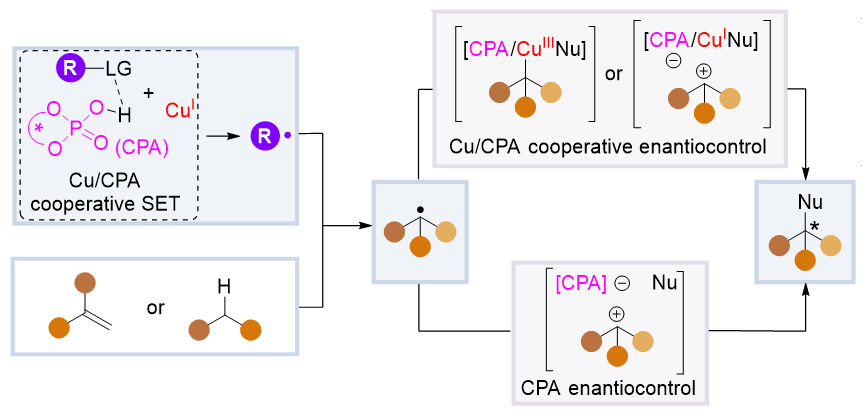
[1] (a) Hung, K.; Hu, X.-R.; Maimone, T. J. Nat. Prod. Rep. 2018, 35, 174. (b) Romero, K. J.; Galliher, M. S.; Pratt, D. A.; Stephenson, C. R. J. Chem. Soc. Rev. 2018, 47, 7851. (c) Zhang M.-A., Jin H.-R., Sun K., Zhu Y.-P., Wang X. Acta Chim. Sinica 2026, 84, 572 (in Chinese). (张蒙爱, 靳皓冉, 孙凯, 祝艳平, 王薪, 化学学报, 2026, 84, 572). (d) Liao W.-Q., Ding Q.-P, Zhang J., Wu J. Acta Chim. Sinica 2026, 84, 385 (in Chinese). (廖文权, 丁秋平, 张俊, 吴劼, 化学学报, 2026, 84, 385.) (e) Li K.-K., Long X.-Y., Huang Y., Zhu S.-F. Acta Chim. Sinica 2024, 82, 658 (in Chinese). (李康葵, 龙先扬, 黄岳, 祝诗发, 化学学报, 2024, 82, 658.
[2] (a) Gu, Q.-S.; Li, Z.-L.; Liu, X.-Y. Acc. Chem. Res. 2020, 53, 170. (b) Chen, J.-J.; Fang, J.-H.; Du, X.-Y.; Zhang, J.-Y.; Bian, J.-Q.; Wang, F.-L.; Luan, C.; Liu, W.-L.; Dong, X.-Y.; Li, Z.-L.; Dong, Z.; Liu, X.-Y. Nature 2023, 618, 294. (c) Zhang, Y.-F.; Wang, B.; Chen, Z.; Liu, J.-R.; Yang, N.-Y.; Xiang, J.-M.; Liu J.; Gu Q.-S.; Liu, X.-Y. Science 2025, 388, 283. (d) Dong, X.-Y.; Li, Z.-L.; Gu Q.-S.; Liu, X.-Y. J. Am. Chem. Soc. 2022, 144, 17319.
[3] Phipps, R. J. ; Hamilton, G. L.; Toste, F. D. Nat. Chem. 2012, 4, 603
[4] (a) Brak, K.; Jacobsen, E. N. Angew. Chem. Int. Ed. 2013, 52, 534. (b) Betinol, I. O.; Kuang, Y.-T.; Mulley, B. P.; Reid, J. P. Chem. Rev. 2025, 125, 4184.
[5] Lin, J.-S.; Dong, X.-Y.; Li, T.-T.; Jiang, N.-C.; Tan, B.; Liu, X.-Y. J. Am. Chem. Soc. 2016, 138, 9357.
[6] Zhao, B.-G.; Du, H.-F.; Shi, Y.-A. J. Org. Chem. 2009, 74, 8392.
[7] Lin, J.-S.; Wang, F.-L.; Dong, X.-Y.; He, W.-W.; Yuan, Y.; Chen, S.; Liu, X.-Y. Nat. Commun. 2017, 8, 14841.
[8] Wang, F.-L.; Dong, X.-Y.; Lin, J.-S.; Zeng, Y.; Jiao, G.-Y.; Gu, Q.-S.; Guo, X.-Q.; Ma, C.-L.; Liu, X.-Y. Chem. 2017, 3, 979
[9] Li, X.-F.; Lin, J.-S.; Wang, J.; Li, Z.-L.; Gu Q.-S.; Liu, X.-Y. Acta Chim. Sinica 2018, 76, 878 (in Chinese). (李雪飞, 林进顺, 王建, 李忠良, 顾强帅, 刘心元, 化学学报, 2018, 76, 878).
[10] Zeng, Y.; Liu, D.-X.; Guo, X.-Q.; Gu, Q.-S. Li, Z.-L.; Chang, X.-Y.; Liu, X.-Y. Sci China Chem. 2019, 62: 1529.
[11] Cheng, Y.-F.; Dong, X.-Y.; Gu Q.-S.; Liu, X.-Y. Angew. Chem. Int. Ed. 2017, 56, 8883.
[12] Zhong, J.; Li, M.-X.; Ma J.; Zhang, Z.-M.; Fang, H.; Gao, S.; Lin, A.-J.; Yao, H.-Q. Angew. Chem. Int. Ed. 2026, 65, e21476.
[13] Lin, J.-S.; Li, T.-T.; Liu, J.-R.; Jiao, G.-Y.; Gu, Q.-S.; Cheng, J.-T.; Guo, Y.-L.; Hong, X.; Liu, X.-Y. J. Am. Chem. Soc. 2019, 141, 1074.
[14] Wang, Z.; Cheng, J.-T.; Shi, Z.-C.; Wang. N.; Zhan, F.; Jiang, S.-P.; Lin, J.-S.; Jiang, Y.-Y.; Liu, X.-Y. ChemCatChem. 2021, 13, 185.
[15] Yu, P.; Lin, J.-S.; Li, L.; Zheng, S.-C.; Xiong, Y.-P.; Zhao, L.-J. Tan, B.; Liu, X.-Y. Angew. Chem. Int. Ed. 2014, 53, 11890.
[16] Li, T.-T.; Yu, P.; Du, Y.-M.; Lin, J.-S.; Zhi Y.-G.; Liu, X.-Y. J. Fluor. Chem. 2017, 203, 210.
[17] Shi, J.; Zhou, X.-T.; Yang, B.-Q.; Jiao, B.-B.; Wu, W.; Ren, H. Chin. Chem. Lett. 2026, 37, 111250
[18] Yang, C.-J.; Zhang, C.; Gu, Q.-S.; Fang, J.-H.; Su, X.-L.; Ye, L.; Sun, Y.; Tian, Y.; Li, Z.-L.; Liu, X.-Y. Nat. Catal. 2020, 3, 539.
[19] Ye, L.; Tian, Y.; Meng, X.; Gu, Q.-S.; Liu, X.-Y. Angew. Chem. Int. Ed. 2020, 59, 1129.
[20] Gao, A.; Ren, Y.-Q.; Luan, C.; Tian, Y.; Liu L.; Gu, Q.-S.; Li, Z.-L.; Yang, C.-J.; Liu, X.-Y. Asian J. Org. Chem. 2023, 12, e202300220.
[21] Xiao, T.-F.; Jian, K.-R.; Gu, Y.-C.; Xu, G.-Q.; Xu, P.-F. Chem. Sci. 2026, 17, 3240.
[22] Cheng, Y.-F.; Liu, J.-R.; Gu, Q.-S.; Yu, Z.-L.; Wang, J.; Li, Z.-L.; Bian, J.-Q.; Wen, H.-T.; Wang, X.-J.; Hong, X.; Liu, X.-Y. Nat. Catal. 2020, 3, 401.
[23] (a) Egami, H.; Sodeoka, M. Angew. Chem. Int. Ed. 2014, 53, 8294. (b) Li, Z.-L.; Fang, G.-C.; Gu, Q.-S.; Liu, X.-Y. Chem. Soc. Rev. 2020, 49, 32. (c) Crossley, S. W., Obradors, C.; Martinez, R. M.; Shenvi, R. A. Chem. Rev. 2016, 116, 8912.
[24] (a) Studer, A.; Curran, D. P. Angew. Chem. Int. Ed. 2016, 55, 58. (b) McCann, S. D.; Stahl, S. S. Acc. Chem. Res. 2015, 48, 1756.
[25] (a) Newhouse, T.; Baran, P. S. Angew. Chem. Int. Ed. 2011, 50, 3362. (b) Ackermann, L. Chem. Rev. 2011, 111, 1315.
[26] (a) Wang, Y.; Wen, X.; Cui, X.; X. Peter Zhang. J. Am. Chem. Soc. 2018, 140, 4792. (b) Paradine, S. M.; Griffin, J. R.; Zhao, J.-P.; Petronico, A. L.; Miller, S. M.; White M. C. Nat. Chem. 2015, 7, 987.
[27] (a) Zeng, X.-P.; Cao, Z.-Y.; Wang, Y.-H.; Zhou, F.; Zhou, J. Chem. Rev. 2016, 116, 7330. (b) Yang, C.-J.; Liu, L.; Gu, Q.-S.; Liu, X.-Y. CCS Chem. 2024, 6, 1612. (c) Yu, Z.-L.; Li, Z.-L.; Yang, C.-J.; Gu, Q.-S.; Liu, X.-Y. Acta Chim. Sinica 2023, 81, 955 (in Chinese). (鱼章龙, 李忠良, 杨昌江, 顾强帅, 刘心元, 化学学报, 2023, 81, 955).