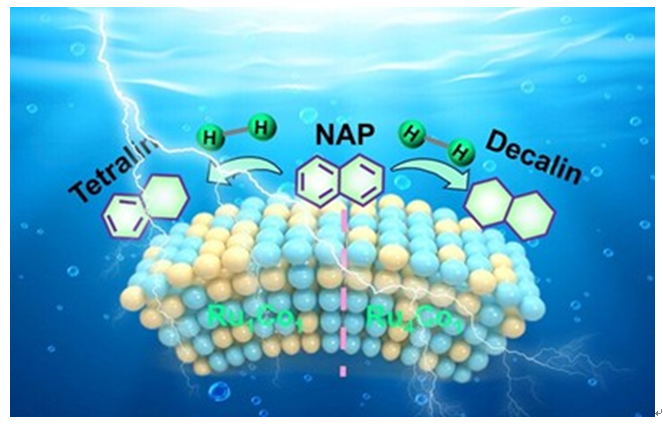
The selective hydrogenation of naphthalene (NAP) is of great significance in fields such as petroleum refining, organic liquid hydrogen storage, fine chemicals, and environmental protection. Not only is it an organic liquid hydrogen storage material with high hydrogen storage density, but in the petrochemical engineering sector, it can also be converted into light aromatic hydrocarbons with high cetane numbers through catalytic hydrogenation. To address the challenge of balancing activity and selectivity in the naphthalene hydrogenation reaction, this study involved the nitric acid modification of carbon fibres, which were then used as supports onto which metal nanoparticles were loaded. A series of Ru-Co bimetallic alloy catalysts with different metal molar ratios were prepared using a simple and versatile sol-gel method, and all samples underwent material characterisation testing. Inductively coupled plasma emission spectroscopy was employed to determine the actual elemental ratios; X-ray diffraction and X-ray photoelectron spectroscopy confirmed that all samples exhibited a single-phase hcp structure; N2 adsorption-desorption area measurements revealed the catalysts' pore structure and specific surface area; and transmission electron microscopy results demonstrated that the alloy catalysts were characterised by nanoscale particle sizes, uniform elemental distribution and high metal dispersion. By adjusting the catalyst composition and metal ratio, highly efficient selective conversion of naphthalene to tetralin and decalin was achieved. Under conditions of room temperature, 2 MPa H2, and a 30-minute reaction time, the decalin selectivity of Ru4Co1/CNFs reached 100%; whereas Ru1Co1/CNFs exhibited a tetralin selectivity as high as 99% under the same conditions, and even with extended reaction times, the reaction remained predominantly in the tetralin formation stage, demonstrating a significant suppression of deep hydrogenation. The key factor underlying this difference lies in the disparity in their apparent activation energies; the apparent activation energy of Ru4Co1/CNFs is significantly lower than that of Ru1Co1/CNFs. The component strategy regulates the d-band center and reaction rate, ultimately manifesting as selective hydrogenation. Furthermore, both Ru-Co catalysts exhibit good cycle stability and recoverability, providing key performance parameters for the industrial application of catalytic hydrogenation of polycyclic aromatic hydrocarbons.
Fu Taiping
,
Jing Zeikun
,
Niu Biye
,
Wu Wenfeng
,
Guo Yakun
,
Shuai Maobing
. Study on the Highly Selective Hydrogenation of Naphthalene Catalyzed by a Ru-Co Alloy Under Room Temperature and Solvent-Free Conditions[J]. Acta Chimica Sinica, 0
: 1010234
-1010234
.
DOI: 10.6023/A26070234
[1] Wang D; Li J; Ma H; Yang C; Pan Z; Qu W; Tian Z. J.Energy Chem. 2021, 63: 294-304.
[2] Kalenchuk A; Bogdan V; Dunaev S; Kustov L. Fuel, 2020, 280.
[3] Lamichhane S; Bal Krishna, K C; Sarukkalige, R. Chemosphere, 2016, 148: 336-53.
[4] Guo J-H; Li S-J; Su Y; Chen G. Int.[J]. Hydrogen Energy. 2020, 45(48): 25900-11.
[5] Liu H; Liu C; Yin C; Liu B; Li X; Li Y; Chai Y; Liu Y. Catal.Today. 2016, 276: 46-54.
[6] Su X; An P; Gao J; Wang R; Zhang Y; Li X; Zhao Y; Liu Y; Ma X; Sun M. Chin.[J]. Chem. Eng. 2020, 28(10): 2566-76.
[7] Qi S; Li Y; Yue J; Chen H; Yi C; Yang B. Chin.[J]. Catal. 2014, 35(11): 1833-9.
[8] Ma Y; Liu J; Chen M; Yang Q; Chen H; Guan G; Qin Y; Wang T. Adv. Funct. Mater. 2022, 32(25).
[9] Tian Z-W; Da W-M; Wang L; Yang Y; Wei M. Acta Chim Sinica, 2022, 80(9).
(in Chinese) (田钊炜,达伟民,王雷,杨宇森,卫敏,化学学报, 2022, 80(9).)
[10] Zhang M; Song Q; He Z; Wang Q; Wang L; Zhang X; Li G. Int.[J]. Hydrogen Energy. 2022, 47(48): 20881-93.
[11] Liu Z; Mei J; Wang D; Kong X; Yu K; Cao Z; Wang C; Gong Y; Duan A; Xu C; Wang X. Fuel, 2024, 368.
[12] Gong P; Li B; Kong X; Liu J; Zuo S. Appl. Surf. Sci. 2017, 423: 433-42.
[13] Cao Z; Zhang X; Guo R; Ding S; Mei J; Wang X; Zheng P; Fan J; Xu C; Duan A. ACS Catal. 2020, 10(21): 12342-53.
[14] Li J; Shi L; Feng G; Shi Z; Sun C; Kong D. Catalysts, 2020, 10(10).
[15] Zhang C; Cao J-P; Zhao X-Y; Xie J-X; Zhao L; Jiang W; He Z-M; Cong H-L; Bai, H-C. Ind. Eng. Chem.Res. 2023, 62(17): 6780-9.
[16] Nunes M P; Jawale D V; Delolo F G; Araujo M H; Gravel E; Doris E; Da Silva Junior, E N. Chem. Commun. 2023, 59(19): 2763-6.
[17] Zhang M; He Z; Zhang M; Wang L; Wang Q; Zhang X; Li G. Fuel, 2022, 316.
[18] Luo Q; Wang H; Xiang Q; Lv Y; Yang J; Song L; Cao X; Wang L; Xiao F-S.[J]. Am. Chem. Soc. 2024, 146(38): 26379-86.
[19] Zhu L; Zhu H; Shakouri M; Zeng L; Yang Z; Hu Y; Ye H; Wang H; Chen B H; Luque R. Appl. Catal. B Environ. 2021, 297.
[20] Woodhead A L; De Souza, M L; Church, J S. Appl. Surf. Sci. 2017, 401: 79-88.
[21] Hu Y; Guo Y; Huang P; Peng Y; Wu G; Du J; Wang J; Deng Q. ACS Catal. 2025, 15(19): 16851-62.
[22] Ling Z-P; Chen H-T; Gao H-X; Dai H-C; Zhao Z-C; Yang Q-H.Chemical journal of Chinese Universities. 2025, 46(8), 20250048.
(in Chinese) (凌宗鹏,陈海涛,高红霞,戴慧聪,赵侦超,杨启华,高等学校化学学报, 2025, 46(8), 20250048.)
[23] Zhao P; Cao Z; Liu X; Ren P; Cao D-B; Xiang H; Jiao H; Yang Y; Li Y-W; Wen X-D. ACS Catal. 2019, 9(4): 2768-76.
[24] Sun H; Guo W; Zhou X; Chen Z; Liu Z; Liu S.Progress in Chin.[J]. Catal. 2011, 32(1-2): 1-16.
[25] Mao J; Chen W; Sun W; Chen Z; Pei J; He D; Lv C; Wang D; Li Y. Angew. Chem. Int. Ed. 2017, 56(39): 11971-5.
[26] Zhu L; Zhang H; Zhong L; Zheng J; Yu C; Zhang N; Chen B H. Fuel, 2018, 216: 208-17.
[27] Deng X; Zhu L; Zhang H; Kroner A; Zheng J; Zhang N; He J; Chen B H. Int. J.Hydrogen Energy. 2018, 43(32): 15055-63.
[28] Zhou J; Li P; Xia X; Zhao Y; Hu Z; Xie Y; Yang L; Liu Y; Du Y; Zhou Q; Yu L; Yu Y. Appl. Catal. B Environ. 2024, 359.
[29] Wang Z; Yuan X; Guo H; Zhang X; Peng J; Pan Y.Energy Environ. Sci. 2024, 17(21): 8019-56.
[30] Quan H-L; Tang J-L; Zhang C-Z; Zhang Y-H; Li J-Q; Zhou T-G. Acta Chim Sinica, 2025, 83(11).
(in Chinese) (全洪林, 唐鋆磊, 张承志, 张恒溢, 李佳奇, 周太刚, 化学学报, 2025, 83(11).)
[31] Tan Z; Fan G; Zheng L; Li F. ACS Catal. 2024, 14(15): 11218-30.
[32] Jiang W; Cao J-P; Zhang C; Tang W; Chen C-X; He Z-M; Zhao X-Y; Bai H-C. Fuel, 2023, 351.
[33] Guo J; Wang L; Jin Z; Liu Z; Hao H; Gong J; Wang Z. Chem. Eng. J. 2024, 498.