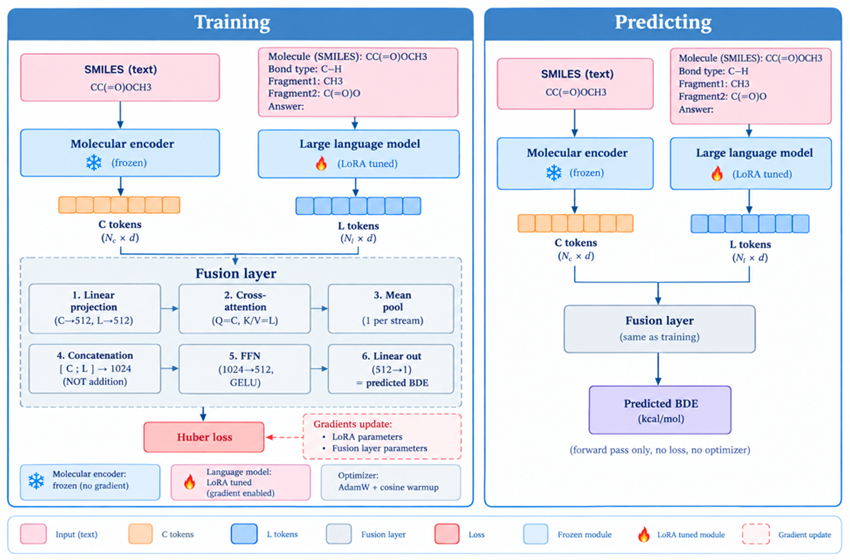
Bond dissociation energy (BDE) is a fundamental thermodynamic parameter that characterizes chemical bond strength and governs the reactivity and thermal behavior of organic molecules. Traditional experimental measurements and high-level quantum chemical calculations are time-consuming and resource-intensive, thus impractical for large-scale molecular screening. Although data-driven machine learning methods have emerged as efficient alternatives, existing approaches rely predominantly on single-modal representations such as molecular graphs or fingerprints, overlooking the chemical semantics embedded in natural language descriptions of bond types, functional group environments, and fragment structures. Here we propose a multimodal fusion framework that integrates molecular structure sequences with chemical natural language text for BDE prediction. The framework comprises three modules: a pre-trained molecular encoder (ChemBERTa or MolFormer) extracting structural features from SMILES, a large language model (DeepSeek-7B, Qwen2-7B or Mistral-7B) encoding chemical text semantics, and a cross-attention-based fusion layer that enables adaptive interaction between them. Low-Rank Adaptation (LoRA) fine-tuning updated only approximately 0.1% of the parameters. Six model combinations were evaluated on a dataset of 531244 BDE records from 65540 organic molecules; the optimal ChemBERTa+Qwen2-7B combination reached a mean absolute error (MAE) of 0.98 kcal mol-1 and a coefficient of determination (R2) of 0.9830 on the validation set. On the publicly released split, the model attains an MAE of 0.98 kcal mol-1 on the official test set, still above the 0.61-0.64 kcal mol-1 reported for bond-centred graph neural networks, with the gap concentrated on heteroatom-containing polar bonds. Scale ablation (Qwen2-0.5B/1.5B/7B: 1.15/1.04/0.98 kcal mol-1) and an output-head ablation (regression head 1.39 vs. generative 1.22 kcal mol-1) show that the fusion of molecular representations, not the output-head form, governs accuracy. The framework thus exploits the complementary strengths of molecular topology and chemical semantics, offering a general route to large-scale BDE prediction without three-dimensional geometries or quantum-chemical features.
Jiale Liu
,
Jia Zhou
. Specialized Large Language Models with Multiscale Fusion for Predicting Bond Dissociation Energies of Organic Compounds[J]. Acta Chimica Sinica, 0
: 60229
.
DOI: 10.6023/A26060229
[1] Luo Y.-R.Comprehensive Handbook of Chemical Bond Energies, CRC Press, Boca Raton, 2007.
[2] Warnatz J.; Maas U.; Dibble R.Combustion: Physical and Chemical Fundamentals, 4th ed., Springer, Berlin, 2006.
[3] Gugumus, F. Polym. Degrad. Stab.1990, 27, 19.
[4] Denisov E. T.; Afanas’ev I. B.Oxidation and Antioxidants in Organic Chemistry and Biology, CRC Press, Boca Raton, 2005.
[5] Schwarzenbach R. P.; Gschwend P. M.; Imboden D. M.Environmental Organic Chemistry, 3rd ed., Wiley, Hoboken, 2016.
[6] Blanksby S. J.; Ellison G. B.Acc.Chem. Res. 2003, 36, 255.
[7] Becke A. D.J. Chem. Phys. 1993, 98, 5648.
[8] Vaswani A.; Shazeer N.; Parmar N.; Uszkoreit J.; Jones L.; Gomez A. N.; Kaiser L.; Polosukhin I.In Advances in Neural Information Processing Systems 30, Eds.: Guyon, I.; Luxburg, U. V.; Bengio, S.; Wallach, H.; Fergus, R.; Vishwanathan, S.; Garnett, R., Curran Associates, Red Hook, 2017, pp. 5998-6008.
[9] Chithrananda S.; Grand G.; Ramsundar B.ChemBERTa: Large-Scale Self-Supervised Pretraining for Molecular Property Prediction, arXiv:2010.09885, 2020.
[10] Ross J.; Belgodere B. M.; Chenthamarakshan V.; Padhi I.; Mroueh Y.; Das, P. Nat. Mach. Intell.2022, 4, 1256.
[11] Weininger, D. J. Chem. Inf. Comput. Sci.1988, 28, 31.
[12] St. John P. C.; Guan Y.; Kim Y.; Kim S.; Paton, R. S. Nat. Commun.2020, 11, 2328.
[13] Liu Z.; Li S.; Luo Y.; Fei H.; Cao Y.; Kawaguchi K.; Wang X.; Chua T.-S.In Proceedings of the 2023 Conference on Empirical Methods in Natural Language Processing, Eds.: Bouamor, H.; Pino, J.; Bali, K., Association for Computational Linguistics, Singapore, 2023, pp. 16343-16359.
[14] Liu P.; Ren Y.; Tao J.; Ren, Z. Comput. Biol. Med.2024, 171, 108073.
[15] Anslyn E. V.; Dougherty D. A.Modern Physical Organic Chemistry, University Science Books, Sausalito, 2006.
[16] Hu E. J.; Shen Y.; Wallis P.; Allen-Zhu, Z.; Li, Y.; Wang, S.; Wang, L.; Chen, W. In Proceedings of the 10th International Conference on Learning Representations, OpenReview.net, 2022.
[17] Li W.; Luan Y.; Zhang Q.; Aires-de-Sousa J. Mol. Inform.2022, 41, 2200193.
[18] Bran A. M.; Cox S.; Schilter O.; Baldassari C.; White A. D.; Schwaller, P. Nat. Mach. Intell.2024, 6, 525.
[19] Boiko D. A.; MacKnight R.; Kline B.; Gomes G. Nature2023, 624, 570.
[20] Gao B.; Li P.; Zhang D.; Tan Q.; Liu W.; Wang X.; Li J.; Zhang S.; Zhou D.; Li Y.; Yin G. CCS Chemistry, 2026, 8, 2978-2986.
[21] Shree Sowndarya,S. V.; Kim, Y.; Kim, S.; St. John, P. C.; Paton, R. S. Digital Discovery, 2023, 2, 1900-1910.
[22] Liu Y.; Li Y.; Yang Q.; Yang J.-D.; Zhang L.; Luo S.Chinese Journal of Chemistry, 2024, 42, 1967-1974.
[23] Wen M.; Blau S. M.; Spotte-Smith E. W. C.; Dwaraknath S.; Persson, K. A. Chemical Science,2021, 12, 1858-1868.
[24] Gao P.; Zhang J.; Qiu H.; Zhao, S. Physical Chemistry Chemical Physics,2021, 23, 13242-13249.
[25] Jacobs R.; Polak M. P.; Schultz L. E.; Mahdavi H.; Honavar V.; Morgan, D. Regression with Large Language Models for Materials and Molecular Property Prediction arXiv:2409.06080, 2024.
[26] Huo Y. Y.; Jiang, J. Chin. J. Chem. Phys.,2024, 37 (1), 51. doi: 10.1063/1674-0068/cjcp2208128 [霍姚远, 江俊. 化学物理学报, 2024, 37(1), 51.]
[27] Song Z. L.; Lu S. H.; Zhou Q. H.; Wang, J. L. Acta Phys.-Chim. Sin.,2026, 42 (5), 100213. doi: 10.1016/j.actphy.2025.100213 [宋志龙, 陆帅华, 周跫桦, 王金兰. 物理化学学报, 2026, 42(5), 100213.]