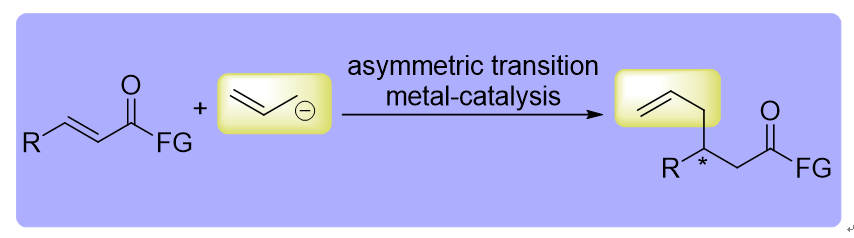
[1] (a) Wu, X.; Zhou, J.; Snider, B. B. Angew. Chem., Int. Ed. 2009, 48, 1283. (b) Cha, J. Y.; Yeoman, J. T. S.; Reisman, S. E. J. Am. Chem. Soc. 2011, 133, 14964. (c) Chen, Y.-J.; Cai, S.-L.; Wang, C.-C.; Cheng, J.-D.; Kramer, S.; Sun, X.-W. Chem.Asian. J. 2017, 12, 1309. (d) Yang, H.; Liu, X.; Li, X.; Shi, X.; Yang, F.; Jiao, X.; Xie, P. Org. Biomol. Chem. 2017, 15, 3728.
[2] (1) Williams, D. R.; Mullins, R.J.; Miller, N. A. Chem. Commun. 2003, 39, 2220. (2) Wu, M. J.; Wu, C. C.; Lee, P. C. Tetrahedron Lett. 1992, 33, 2547. (3) Schneider, C. Reese, O. Synthesis, 2000, 2000, 1689.
[3] (a) Vicario, J. L.; Reyes, E.; Carrillo, L.; Uria, U. In Comprehensive Organic Synthesis II, Vol. 4, Eds: Molander, G. A.; Knochel, P. Ed., Elsevier, Amsterdam, 2014, pp. 119—188. (b) Mauduit, M.; Baslé, O.; Clavier, H.; Crévisy, C.; DenicourtNowicki, A. In Comprehensive Organic Synthesis II, Vol. 4, Eds: Molander, G. A.; Knochel, P. Ed., Elsevier, Amsterdam, 2014, pp. 189—341.
[4] Li, H.; Yin, L. Acta Chim. Sinica 2024, 82,1274 (in Chinese). (李晖, 殷亮, 化学学报, 2024, 82, 1274.
[5] (a) Yamasaki, S.; Fujii, K.; Wada, R.; Kanai, M.; Shibasaki, M. J. Am. Chem. Soc. 2002, 124, 6536–6537. (b) Wada, R.; Oisaki, K.; Kanai, M.; Shibasaki, M. J. Am. Chem. Soc. 2004, 126, 8910–8911.
[6] (a) Tsai, E. Y.; Liu, R. Y.; Yang, Y.; Buchwald, S. L. J. Am. Chem. Soc. 2018, 140, 2007. (b) Liu, R. Y.; Zhou, Y.; Yang, Y.; Buchwald, S. L. J. Am. Chem. Soc. 2019, 141, 2251. (c) Yang, Y.; Perry, I. B.; Lu, G.; Liu, P.; Buchwald, S. L. Science 2016, 353, 144.
[7] (a) Wei, X.-F.; Xie, X.-W.; Shimizu, Y.; Kanai, M. J. Am. Chem. Soc. 2017, 139, 4647. (b) Zhong, F.; Pan, Z.-Z.; Zhou, S.-W.; Zhang, H.-J.; Yin, L. J. Am. Chem. Soc. 2021, 143, 4556. (c) Pan, Z.-Z.; Pan, D.; Li, J.-H.; Xue, X.-S.; Yin, L. J. Am. Chem. Soc. 2023, 145, 1749.
[8] Sieber, J. D.; Liu, S.; Morken, J. P. J. Am. Chem. Soc. 2007, 129, 2214.
[9] Sieber, J. D.; Morken, J. P. J. Am. Chem. Soc. 2008, 130, 4978.
[10] Yamamoto, Y.; Takada, S.; Miyaura, N. Chem. Lett. 2006, 35, 704.
[11] Brozek, L. A.; Sieber, J. D.; Morken, J. P. Org. Lett. 2011, 13, 995.
[12] Zhu, L.; Lauchli, R.; Loo, M.; Shea, K. J. Org Lett. 2007, 9, 2269.
[13] Shizuka, M.; Snapper, M. L. Angew. Chem., Int. Ed. 2008, 47, 5049.
[14] (a) Kumar, A.; Singh, B. K.; Tyagi, R.; Jain, S. K.; Sharma, S. K.; Prasad, A. K.; Raj, H. G.; Rastogi, R. C.; Watterson, A. C.; Parmar, V. S. Bioorg. Med. Chem. 2005, 13, 4300. (b) Menasria,F.; Azebaze, A. G. B.; Billard, C.; Faussat, A. M.; Nkengfack, A. E.; Meyer, M.; Kolb, J. P. Leuk. Res. 2008, 32, 1914.
[15] Kuang, Y.; Liu, X.; Chang, L.; Wang, M.; Lin, L.; Feng, X. Org. Lett. 2011, 13, 3814.
[16] Mee, S. P. H.; Lee, V.; Baldwin, J. E. Angew. Chem., Int. Ed. 2004, 43, 1132.
[17] Li, X.; Meng, F.; Torker, S.; Shi, Y.; Hoveyda, A. H. Angew. Chem., Int. Ed. 2016, 55, 9997.
[18] Meng, F.; Jung, B.; Haeffner, F.; Hoveyda, A. H. Org. Lett. 2013, 15, 1414.
[19] (a) Luo, Y.; Roy, I. D.; Madec, A. G. E.; Lam, H. W. Angew. Chem., Int. Ed. 2014, 53, 4186. (b) Wu, H.; Garcia, J. M.; Haeffner, F.; Radomkit, S.; Zhugralin, A. R.; Hoveyda, A. H. J. Am. Chem. Soc. 2015, 137, 10585.
[20] Meng, F.; Li, X.; Torker, S.; Shi, Y.; Shen, X.; Hoveyda, A. H. Nature 2016, 537, 387.
[21] Yoshikai, N.; Nakamura, E. Chem. Rev. 2012, 112, 2339.
[22] Yuki, K.; Shindo, M.; Shishido, K. Tetrahedr. Lett. 2001, 42, 2517.
[23] Chong, Q.; Zhang, S.; Cheng, F.; Wang, J.; Hong, X.; Meng, F. Org. Lett. 2018, 20, 6896.
[24] Krautwald, S.; Schafroth, M. A.; Sarlah, D.; Carreira, E. M. J. Am. Chem. Soc. 2014, 136, 3020.
[25] Huang, Y.; Torker, S.; Li, X.; del Pozo, J.; Hoveyda, A. H. Angew. Chem., Int. Ed. 2019, 58, 2685.
[26] Clasby, M. C.; Craig, D.; Marsh, A. Angew. Chem., Int. Ed. 1993, 32, 1444.
[27] Ng, S.; Howshall, C.; Ho, T. N.; Mai, B. K.; Zhou, Y.; Qin, C.; Tee, K. Z.; Liu, P.; Romiti, F.; Hoveyda, A. H. Science 2024, 386, 167.
[28] Mitsugi, K.; Takabayashi, T.; Ohyoshi, T.; Kigoshi, H. Org. Lett. 2022, 24, 4635.
[29] Yanagida, Y.; Yazaki, R.; Kumagai, N.; Shibasaki, M. Angew. Chem., Int. Ed. 2011, 50, 7910.
[30] (a) Curti, C.; Battistini, L.; Sartori, A.; Zanardi, F. Chem. Rev. 2020, 120, 2448–2612. (b) Li, H.; Yin, L. Chin. J. Org. Chem. 2022, 42, 1573–1585.
[31] Tang, Q.; Fu, K.; Ruan, P.; Dong, S.; Su, Z.; Liu, X.; Feng, X. Angew. Chem., Int. Ed. 2019, 58, 11846.
[32] Shi, C. Y.; Pan, Z. Z.; Tian, P.; Yin, L. Nat. Commun. 2020, 11, 5480.
[33] (a) Wei, X.-F.; Xie, X.-W.; Shimizu, Y.; Kanai, M. J. Am. Chem. Soc. 2017, 139, 4647. (b) Jiang, N.; Liu, P.-Z.; Pan, Z.-Z.; Wang, S.-Q.; Peng, Q.; Yin, L. Angew. Chem., Int. Ed. 2024, 63, e202402195. (c) Zhong, F.; Pan, Z.-Z.; Zhou, S.-W.; Zhang, H.-J.; Yin, L. J. Am. Chem. Soc. 2021, 143, 4556.
[34] Zhang, Q.; Shao, Y.-B.; Tian, H.; Wang, Y.-F.; Cai, Z.-X.; Jiang, J.-W.; Shi, C.-Y.; Meng, F.; Xue, X.-S.; Yin, L. J. Am. Chem. Soc. 2026, 148, 6674.
[35] (a) Yasuda, Y.; Ohmiya, H.; Sawamura, M. Angew. Chem., Int. Ed. 2016, 55, 10816. (b) Hojoh, K.; Ohmiya, H.; Sawamura, M. J. Am. Chem. Soc. 2017, 139, 2184. (c) Zhang, Q.; Zhou, S.-W.; Shi, C.-Y.; Yin, L. Angew. Chem., Int. Ed. 2021, 60, 26351.
[36] Chen, Y.-J.; Cai, S.-L.; Wang, C.-C.; Cheng, J.-D.; Kramer, S.; Sun, X.-W. Chem. Asian. J. 2017, 12, 1309.
[37] Yang, H.; Liu, X.; Li, X.; Shi, X.; Yang, F.; Jiao, X.; Xie, P. Org. Biomol. Chem. 2017, 15, 3728.