Communication

Synthesis and Properties of Poly(silyl ether)s Copolymers Based on Biomass Furan Derivatives

  • Zhang Chi ,
  • He Jialun ,
  • Zhu Zijie ,
  • Chen Rui ,
  • Zhao Wei ,
  • Zhou Hanting ,
  • Wu Jincai ,
  • Li Zhenhua ,
  • Pan Xiaobo
Expand
  • aCollege of Chemistry and Chemical Engineering, Lanzhou University, Lanzhou 730000;
    bCollege of Chemical Engineering, Northwest Minzu University, Lanzhou, 730030

Received date: 2026-06-18

  Online published: 2026-10-15

Supported by

National Key R&D Program of China (2023YFA1506804, Special Project of Gansu Provincial Natural Science Foundation (Excellent Doctoral Student Program) (26JRRA266), Fundamental Research Fund for the Central Universities, Northwest Minzu University (No, 31920260069).

Abstract

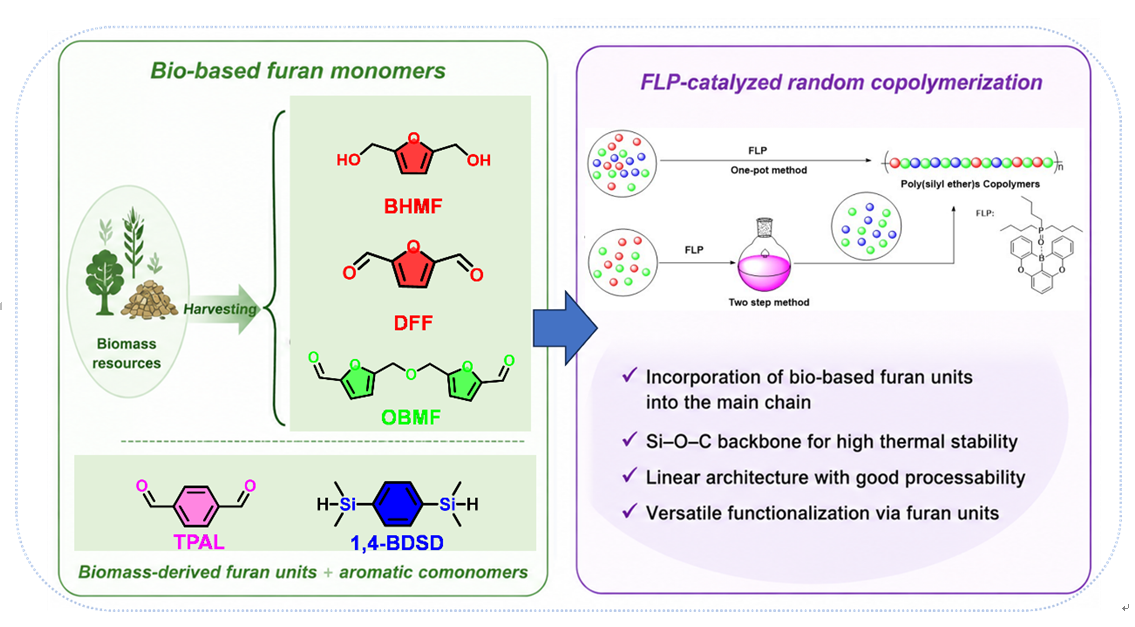
Poly(silyl ether)s (PSEs) are a class of polymers with Si-C-O linkages in the main chain. They feature high thermal stability, low glass transition temperature, flame retardancy and degradability, and thus hold broad application prospects in elastomers, gas-permeable films, and biocompatible coatings. The degradation behavior and functional properties of poly(silyl ether)s can be tailored by adjusting the sequence of structural units and molecular packing of the main chain. Therefore, the development of efficient catalytic systems for the mild synthesis of bio-based PSEs is highly desirable. In this work, a frustrated Lewis pair (FLP) catalytic system composed of an oxygen-bridged constrained planar arylborane (DOBA) as a weak Lewis acid and tri-n-butylphosphine oxide (TBPO) as a weak Lewis base was employed for the synthesis of bio-based PSEs under mild conditions. A series of biomass-derived furan monomers, including 2,5-diformylfuran (DFF), 2,5-bis(hydroxymethyl)furan (BHMF), and bis(5-formylfurfuryl) ether (OBMF), together with terephthalaldehyde (TPAL), were copolymerized with 1,4-bis(dimethylsilyl)benzene (1,4-BDSB) through stepwise method and one-pot method under mild conditions to efficiently synthesize furan-based poly(silyl ether) copolymers. The obtained polymers exhibited number-average molecular weights (Mn) ranging from 5.95 to 18.99 kDa, with dispersities (Đ) of 1.33-2.41. Thermal analysis revealed low glass-transition temperatures (Tg = -29.8 to -21.1 °C) and good thermal stability, with 5% weight-loss temperatures (Td, 5%) ranging from 275.3 to 310.1 °C. Comparative analysis further indicated that the molecular structures of the monomers strongly influenced the thermal and thermomechanical properties of the resulting polymers: the incorporation of rigid aromatic units enhanced thermal stability, whereas flexible furan-derived ether segments favored lower Tg values. These results demonstrate that the structural diversity of biomass-derived monomers can be exploited to regulate the properties of PSEs. This work establishes an efficient metal-free FLP-catalyzed strategy for the synthesis of bio-based linear poly(silyl ether)s under mild conditions and provides a viable approach for integrating renewable furan-derived building blocks into sustainable silicon-containing polymeric materials.

Cite this article

Zhang Chi , He Jialun , Zhu Zijie , Chen Rui , Zhao Wei , Zhou Hanting , Wu Jincai , Li Zhenhua , Pan Xiaobo . Synthesis and Properties of Poly(silyl ether)s Copolymers Based on Biomass Furan Derivatives[J]. Acta Chimica Sinica, 2026 : 26060205 . DOI: 10.6023/A26060205

References

[1] Hao Zhou, Y. J. Y. W. Acta Physico-Chimica Sinica, 2022, 38(10), 2203016.
[2] Cai Z.; Liu Y.; Tao Y.; Zhu J.-B.Acta Chim. Sinica 2022, 80, 1165 (in Chinese).
(蔡中正, 刘野, 陶友华, 朱剑波, 化学学报, 2022, 80, 1165.)
[3] Wang, L., Chen, E. Y.X. ACS Catalysis, 2015, 5(11), 6907-6917.
[4] Duan Zhi-Yong, Z. J.-Z. X. U. X.-X. Acta Chimica Sinica, 2004, 62(8), 811-817.
[5] Qian He, J. L. S. Y. D. W. J. Y. P. H. Acta Chimica Sinica, 2023, 81(10), 1265-1270.
[6] Wang Z.; Xiao Y.; Jin H.; Tan T.; Wang S.; Li X.Acta Chim. Sinica 2014, 72, 731 (in Chinese).
(王志强, 肖殷, 金会义, 谈廷风, 王世荣, 李祥高, 化学学报, 2014, 72, 731.)
[7] Cheng C., Watts A., Hillmyer M. A., Hartwig J. F. Angewandte Chemie International Edition, 2016, 55(39), 11872-11876.
[8] Miller S. A. ACS Macro Letters, 2013, 2(6), 550-554.
[9] Rücker, C., Kümmerer, K. Chemical Reviews, 2015, 115(1), 466-524.
[10] Sahmetlioglu, E., Nguyen, H. T.H., Nsengiyumva, O., Göktürk, E., Miller, S. A. ACS Macro Letters, 2016, 5(4), 466-470.
[11] Wu Y.; Fan H.; Zhang W.; Wang M.; Cai Z.; Zhu J. Macromolecules (2022) 55(20): 9232-9241.
[12] Wu Y.; Fan H.; Shan S.; Wang S.; Cai Z.; Zhu J. Chem.Res. Chinese Universities, 2023, 39, 809-815
[13] Curry, J. E., Byrd, J. D. Journal of Applied Polymer Science, 1965, 9(1), 295-311.
[14] Liu X., Bekmirzaev J., Robert C., Gauvin R. M., Thomas C. M. Green Chemistry, 2025, 27(39), 12002-12028.
[15] Upitak, K., Thomas, C. M. Angewandte Chemie International Edition, 2025, 64(19), e202418908.
[16] Ware T., Jennings A. R., Bassampour Z. S., Simon D., Son D. Y., Voit W. RSC Advances, 2014, 4(75), 39991-40002.
[17] Yang F., Sun F., Thomas C. M. Angewandte Chemie International Edition, 2026, 65(8), e21137.
[18] Wang Q., Wu X., Hao X., Wang Z., Zhang C., Wu J., Pan X. ACS Catalysis, 2026, 16(9), 7998-8007.
[19] Hada R., Kanazawa A., Aoshima S. Macromolecules, 2022, 55(13), 5474-5484.
[20] Li Y.; Wang X.; Tang Y.Acta Chim. Sinica 2024, 82, 213 (in Chinese).
(李雅宁, 王晓艳, 唐勇, 化学学报, 2024, 82, 213.)
[21] Wang Y.; Wang C.; Ma H.Acta Chim. Sinica 2025, 83, 25 (in Chinese).
(王玉娜, 王超, 马海燕, 化学学报, 2025, 83, 25.)
[22] Wang Y.; Yan J.Acta Chim. Sinica 2023, 81, 275 (in Chinese).
(汪阳, 阎敬灵, 化学学报, 2023, 81, 275.)
[23] Huang H.; Xie M.; Huang Y.; Cui J.; Cai Z.; Zhu J.-B.Acta Chim. Sinica 2025, 83, 810 (in Chinese).
(黄皓毅, 谢敏, 黄玉婷, 崔嘉豪, 蔡中正, 朱剑波, 化学学报, 2025, 83, 810.)
[24] Shi L.; Dai Y. Wu,W.; Li, S. Mou, Z. Acta Chim. Sinica 2025, 83, 1488 (in Chinese).
(石力双, 戴雅男, 伍伟豪, 李世辉, 牟泽怀, 化学学报, 2025, 83, 1488.)
[25] Xu T, Chen E Y. J Am Chem Soc, 2014, 136(5): 1774-1777.
[26] He J, Zhang Y, Falivene L. Macromolecules, 2014, 47(22): 7765-7774.
[27] Hong M, Chen J, Chen E Y.Chem. Rev, 2018, 118, 10551-10616.
Outlines

/

〈 〉