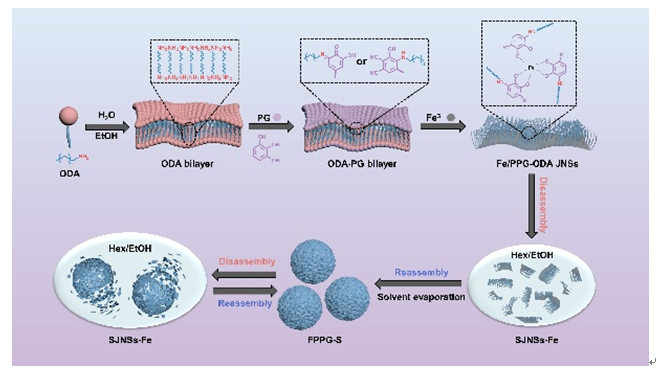
The development of recyclable and stimuli-regulated interfacial coatings with tunable wettability remains a significant challenge in surface and materials chemistry. Herein, we report a facile and controllable strategy for constructing two-dimensional (2D) metal-polyphenol Janus nanosheets (Fe/PPG-ODA JNSs) with tunable cross-linking degrees and demonstrate their application in dynamic assembly and reversible superhydrophobic coatings. The Janus nanosheets were fabricated using an octadecylamine (ODA) bilayer dispersed in the bulk EtOH/H2O medium as a soft template, where pyrogallol (PG) molecules were first adsorbed and subsequently underwent oxidative polymerization to form a poly(pyrogallol) (PPG) network. Fe3+ ions were then introduced to coordinate with phenolic hydroxyl groups, forming a metal-polyphenol cross-linked structure. By precisely regulating the FeCl3 concentration (0.05-0.25 mmol/L), a series of Fe/PPG-ODA JNSs with different cross-linking densities were obtained.
The chemical structure, morphology, and elemental composition of the nanosheets were systematically characterized by scanning electron microscopy (SEM), atomic force microscopy (AFM), Fourier transform infrared spectroscopy (FT-IR), and X-ray photoelectron spectroscopy (XPS). The spectroscopic results support covalent coupling between PG-derived quinone intermediates and ODA through Schiff-base and Michael-addition pathways, together with the formation of Fe3+-polyphenol coordination networks. AFM analysis reveals a gradual increase in nanosheet thickness with increasing Fe3+ content, indicating enhanced network rigidity. Thermogravimetric analysis (TGA) further demonstrates improved thermal stability with increasing cross-linking degree.
Upon ultrasonication in an n-hexane/ethanol mixed solvent, the Janus nanosheets undergo controllable disassembly into secondary nanosheet-like building units (SJNSs-Fe). The lateral size of these disassembled units increases with increasing cross-linking degree, indicating that metal coordination significantly enhances structural integrity against solvent-induced fragmentation. During solvent evaporation-induced self-assembly on solid substrates (including silicon wafers, glass, copper, stainless steel, and PTFE), these building units reassemble into hierarchical supraparticles. The assembly behavior is strongly dependent on multiple parameters, including Fe3+ cross-linking degree, solvent polarity (hexane/ethanol ratio from 6:1 to 1:1), particle concentration, and evaporation temperature (-20 to 50 °C). As a result, a variety of morphologies including flower-like aggregates, spherical supraparticles, helical nanowires, and dense films are obtained.
Small-angle X-ray scattering (SAXS) analysis reveals ordered hierarchical packing with characteristic lamellar spacing, supporting the formation of ordered supraparticle architectures. Importantly, the macroscopic wettability of the resulting coatings can be tuned by adjusting the cross-linking degree. The water contact angle decreases continuously from 153.4° to 117.5° with increasing Fe3+ content, accompanied by a transition from a superhydrophobic low-adhesion state displaying Cassie-Baxter-like composite wetting behavior to a hydrophobic high-adhesion state. The wettability variation is attributed to the combined effects of reduced hierarchical roughness and changes in surface chemical composition/polarity associated with Fe-polyphenol coordination.
Furthermore, the coatings exhibit excellent substrate universality and mechanical robustness. More importantly, they possess reversible disassembly-reassembly capability: the coatings can be disassembled into nanosheet building units under ultrasonic treatment in mixed solvent and subsequently reassembled into functional coatings upon solvent evaporation, with negligible loss in morphology or wettability after repeated cycles. This work demonstrates that metal coordination cross-linking provides an effective strategy to regulate the balance between structural stability and dynamic assembly in 2D Janus systems, offering a general platform for designing recyclable, adaptive, and functionally tunable interfacial materials.
Danya Li
,
Meizhou Sun
,
Xin Jia
. Crosslinking-Degree-Regulated Two-Dimensional Metal-Polyphenol Janus Nanosheets for Dynamic Assembly and Reversible Superhydrophobic Coatings[J]. Acta Chimica Sinica, 2026
: 26060203
.
DOI: 10.6023/A26060203
[1] Ku K. H.; Lee Y. J.; Yi G.-R.; Jang S. G.; Schmidt B. V.; Liao K.; Klinger D.; Hawker C. J.; Kim B. J.,Shape-tunable biphasic Janus particles as pH-responsive switchable surfactants.Macromolecules 2017, 50 (23), 9276-9285.
[2] Liu F.; Li Y.; Huang Y.; Tsyrenova A.; Miller K.; Zhou L.; Qin H.; Jiang S.,Activation and assembly of plasmonic-magnetic nanosurfactants for encapsulation and triggered release.Nano Lett. 2020, 20 (12), 8773-8780.
[3] Kim J. W.; Lee D.; Shum H. C.; Weitz D. A.,Colloid surfactants for emulsion stabilization.Adv. Mater. 2008, 20 (17), 3239-3243.
[4] Yang J.; Wang J.; Liu Y.; Li H.; Lin Z.,Stimuli-responsive Janus mesoporous nanosheets towards robust interfacial emulsification and catalysis.Materials Horizons 2020, 7 (12), 3242-3249.
[5] Duan Y.; Zhao X.; Sun M.; Hao H.,Research advances in the synthesis, application, assembly, and calculation of Janus materials.Ind. Eng. Chem. Res. 2021, 60 (3), 1071-1095.
[6] Cao J.; Zhou T.; Xu Y.; Qi Y.; Jiang W.; Wang W.; Sun P.; Li A.; Zhang Q.,Oriented assembly of anisotropic nanosheets into ultrathin flowerlike superstructures for energy storage.ACS Nano 2021, 15 (2), 2707-2718.
[7] Zhang Y.; Li L.; Wang R.; Liu J.; Lin Z.; Li G.; Liu H.; Lei Y.; Xiong Y.; Zhao Y.; Xue L.Fish Skin‐Inspired Janus Hydrogel Coating for Drag Reduction Chin. J. Chem. 2024, 42, 867-872.
[8] Bravo L.,Polyphenols: chemistry, dietary sources, metabolism, and nutritional significance.Nutr. Rev. 1998, 56 (11), 317-333.
[9] Zhou J.; Lin Z.; Ju Y.; Rahim M. A.; Richardson J. J.; Caruso F.,Polyphenol-mediated assembly for particle engineering.Acc. Chem. Res. 2020, 53 (7), 1269-1278.
[10] Guan X.; Zhang B.; Wang Z.; Han Q.; An M.; Ueda M.; Ito Y.,Natural polyphenol tannin-immobilized composites: rational design and versatile applications. Journal of Materials Chemistry B 2023, 11 (21), 4619-4660.
[11] Shin M.; Park E.; Lee H.,Plant-inspired pyrogallol-containing functional materials.Adv. Funct. Mater. 2019, 29 (43), 1903022.
[12] Li D.; Xiong Y.; Liu Z.; Liu X.; Wang Y.; Sun M.; Zhao N.; Jia X.,Solvent-mediated biomimetic reversible assembly of supraparticles from polyphenol Janus nanosheets.Journal of Colloid and Interface Science 2026, 715, 140264.
[13] Jin B.; Shen J.; Gou X.; Peng R.; Chu S.; Dong H.,Synthesis, Characterization, thermal stability and sensitivity properties of new energetic polymers-PVTNP-g-GAPs crosslinked polymers.Polymers 2016, 8 (1), 10.
[14] Nair K. P.; Breedveld V.; Weck M.,Complementary hydrogen-bonded thermoreversible polymer networks with tunable properties.Macromolecules 2008, 41 (10), 3429-3438.
[15] Podsiadlo P.; Kaushik A. K.; Arruda E. M.; Waas A. M.; Shim B. S.; Xu J.; Nandivada H.; Pumplin B. G.; Lahann J.; Ramamoorthy A.,Ultrastrong and stiff layered polymer nanocomposites.Science 2007, 318 (5847), 80-83.
[16] Ritchie R. O.,The conflicts between strength and toughness.Nat. Mater. 2011, 10 (11), 817-822.
[17] Giesa T.; Buehler M. J.,Nanoconfinement and the Strength of Biopolymers.Annual Review of Biophysics 2013, 42 (1), 651-673.
[18] Wang H.-C.; Grolman J. M.; Rizvi A.; Hisao G. S.; Rienstra C. M.; Zimmerman S. C., pH-triggered release from polyamide microcapsules prepared by interfacial polymerization of a simple diester monomer.ACS macro letters 2017, 6 (3), 321-325.
[19] Sanchez-Ballester, N. M.; Soulairol, I.; Bataille, B.; Sharkawi, T., Flexible heteroionic calcium-magnesium alginate beads for controlled drug release.Carbohydr. Polym. 2019, 207, 224-229.
[20] Lobel B. T.; Baiocco D.; Al-Sharabi, M.; Routh, A. F.; Zhang, Z.; Cayre, O. J., Current challenges in microcapsule designs and microencapsulation processes: a review.ACS Appl. Mater. Interfaces 2024, 16 (31), 40326-40355.
[21] Yan G.; Chen G.; Peng Z.; Shen Z.; Tang X.; Sun Y.; Zeng X.; Lin L.,The Cross-Linking Mechanism and Applications of Catechol-Metal Polymer Materials.Advanced Materials Interfaces 2021, 8 (19), 2100239.
[22] Kim S.; Regitsky A. U.; Song J.; Ilavsky J.; McKinley, G. H.; Holten-Andersen, N., In situ mechanical reinforcement of polymer hydrogels via metal-coordinated crosslink mineralization.Nat. Commun. 2021, 12 (1), 667.
[23] Cheng Z.; Yan M.; Cao L.; Huang J.; Cao X.; Yuan D.; Chen Y.,Design of nitrile rubber with high strength and recycling ability based on Fe3+-catechol group coordination.Ind. Eng. Chem. Res. 2019, 58 (9), 3912-3920.
[24] Liu Y.; Li Z.; Zhang Z.; Wang J.; Sun L.; Xie T.,Thermal-driven self-healing waterborne polyurethane with robust mechanical properties based on reversible phenol-carbamate network and Fe3+-catechol coordination bond.Prog. Org. Coat. 2021, 153, 106153.
[25] Zhou Z.; Liu T.; Zhou W.; Chen H.; Bian Y.; Gong S.; Shi S. Q.; Li J.,A strong and biodegradable wood particles-based bioplastic modified by synergistically dynamic cross-linking with tannic acid and Fe3+.Composites Part B: Engineering 2022, 247, 110349.
[26] Li D.; Zhang S.; Sheng W.; Zhang Q.; Liu Z.; Li R.; Liu X.; Meng C.; Li C.; Li M.; Jia, X. ACS Appl. Nano Mater.2023, 6, 8290-8301.
[27] Soyekwo F.; Zhang Q.; Gao R.; Qu Y.; Lv R.; Chen M.; Zhu A.; Liu Q.,Metal in situ surface functionalization of polymer-grafted-carbon nanotube composite membranes for fast efficient nanofiltration.Journal of Materials Chemistry A 2017, 5 (2), 583-592.
[28] Deng Y.; Dong Y.; Wang G.; Sun K.; Shi X.; Zheng L.; Li X.; Liao S.,Well-defined ZIF-derived Fe-N codoped carbon nanoframes as efficient oxygen reduction catalysts.ACS Appl. Mater. Interfaces 2017, 9 (11), 9699-9709.
[29] Xu J.; Cao S.; Zhong M.; Ren S.; Chen X.; Li W.; Wang C.; Wang Z.; Lu X.; Lu X.,Rational design of bimetal phosphide embedded in carbon nanofibers for boosting oxygen evolution.J. Colloid Interface Sci. 2024, 657 (000), 8.
[30] Heeley E. L.; Hughes D. J.; El Aziz, Y.; Taylor, P. G.; Bassindale, A. R., Linear long alkyl chain substituted POSS cages: the effect of alkyl chain length on the self-assembled packing morphology.Macromolecules 2013, 46 (12), 4944-4954.
[31] Man T.; Wang Z.; Xing Y.; Ma K.; Nong Z.; Lu S.Multifunctional Integrated Composite Coatings Based on both Grafted-ZnO and Single-walled Carbon Nanotubes. Acta Chim. Sinica 2024, 82, 1142-1149.
[32] Yang Q.-M.; Liu Y.-C.; Chen L.-X.; Yang P.,Study on the Amyloid-like Fibrinogen-based Nanofilm. Acta Polym. Sin. 2020, 51(8), 890-900.
[33] Yang F.; Li M.; Xiong J.; Lv X.; Ma X.; Chen W.; Yang P.,Amyloid-Like Protein Coating as a Barrier Against Plasticizer Leaching. CCS Chem. 2025, 7(2), 493-506.
[34] Bai J.-W.; Liu W.; Wen B.; Lei Z.-L.; Li C.; Ren H.; Yang P.,Synergistic Functional Group Interactions for Stable Interfacial Adhesion: Insights from Amyloid-inspired Polymers. Chinese J. Polym. Sci. 2025, 43(7), 1096-1104.