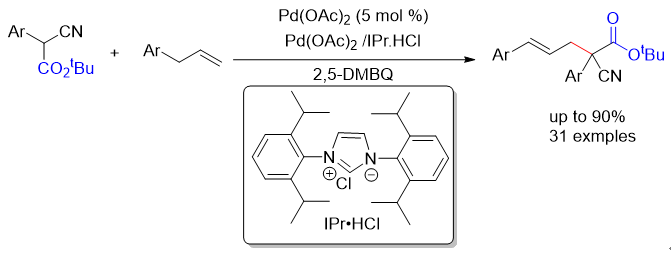
A palladium/N-heterocyclic carbene (NHC)-catalyzed direct allylic C-H alkylation has been developed for the efficient construction of tetrasubstituted β-amino acid derivatives bearing a quaternary carbon center. The reaction employs readily available tert-butyl α-cyanoacetates and allylarenes as coupling partners, avoiding prefunctionalization of the allylic substrates and thus offering high step and atom economy. After systematic screening of ligands, bases, solvents, oxidants, temperatures, catalyst loadings, and reaction times, the optimal conditions were identified as Pd(OAc)₂ (5 mol%), IPr·HCl (5 mol%), 2,5-dimethyl-1,4-benzoquinone (2,5-DMBQ, 1.0 equiv), and K₂CO₃ (1.0 equiv) in dichloromethane (DCM) at 80 °C under argon for 24 h. Under these conditions, a broad range of tert-butyl 2-cyano-2-arylacetates reacted smoothly with allylbenzenes to afford the corresponding allylic alkylation products in moderate to excellent yields (up to 90%) with exclusive E-selectivity. The protocol showed good functional group tolerance, accommodating electron-donating and electron-withdrawing substituents, halogens, trifluoromethoxy, aryl, naphthyl, indolyl, and pyridyl groups. Various allylic substrates, including substituted allylbenzenes, eugenol derivatives, naphthyl-substituted alkenes, and an estrone-derived alkene, were also compatible, delivering the desired products in moderate to good yields. Control experiments confirmed that the palladium catalyst, NHC ligand, base, and oxidant are all essential for efficient conversion. Mechanistically, the strong σ-donating ability of the IPr ligand increases the electron density at the palladium center, stabilizing the π-allylpalladium intermediate and slowing syn/anti conformational interconversion. The bulky 2,6-diisopropylphenyl groups further favor the syn-π-allylpalladium species, and nucleophilic attack from the opposite face of the metal followed by stereospecific reductive elimination accounts for the exclusive E-selectivity. The synthetic utility of this method was demonstrated by a two-step transformation of a representative product: NiCl₂/NaBH₄-mediated reduction of both the alkene and cyano groups, followed by Boc protection and TFA deprotection, provided the free β-amino acid bearing a quaternary carbon center. This protocol thus offers a practical and selective route to valuable tetrasubstituted β-amino acid derivatives.
[1] Juaristi E., Soloshonok V. A., Eds. 2nd ed.; John Wiley & Sons, Inc., 2005.
[2] Kudo F.; Miyanaga A.; Eguchi, T. Nat. Prod. Rep.2014, 31, 1056-1073.
[3] Drawz S. M.; Bonomo R. A.Clin. Microbiol. Rev. 2010, 23, 160-201.
[4] Cabrele C.; Martinek T. A.; Reiser O.; Berlicki Ł.J. Med. Chem. 2014, 57, 9718-9739.
[5] Seebach D.; Gardiner J.Acc. Chem. Res. 2008, 41, 1366-1375.
[6] a) Tsuji J.; Takahashi H.; Morikawa, M. Tetrahedron Lett. 1965, 6 (49), 4387-4388. b) Tsuji, J. Acc. Chem. Res. 2002, 2, 144-152. c) Trost, B. M.; Fullerton, T. J. J. Am. Chem. Soc. 2002, 95, 292-294. d) Trost, B. M.; Van Vranken, D. L. Chem. Rev. 1996, 96, 395-422. e) Trost, B. M.; Crawley, M. L. Chem. Rev. 2003, 103, 2921-2944. f) Kvasovs, N.; Fang, J.; Kliuev, F.; Gevorgyan, V. J. Am. Chem. Soc. 2023, 145, 18497-18505.
[7] a) Kazerouni, A. M.; McKoy, Q. A.; Blakey, S. B.Chem. Commun. 2020, 56, 13287-13300. b) Jingming Zhang, Z. H. Chin. J. Org. Chem. 2025, 45, 592-601. c) Yuan She, S. Z., Le Wang. Chin. J. Org. Chem. 2025, 45, 531-545.
[8] a) Park, Y.; Kim, Y.; Chang, S.Chem. Rev. 2017, 117, 9247-9301.b) Dong, Z.; Ren, Z.; Thompson, S. J.; Xu, Y.; Dong, G. Chem. Rev. 2017, 117, 9333-9403. c) Wang, P.-S.; Shen, M.-L.; Wang, T.-C.; Lin, H.-C.; Gong, L.-Z. Angew. Chem., Int. Ed. 2017, 56, 16032-16036. d) Pak Shing Cheung, K.; Fang, J.; Mukherjee, K.; Mihranyan, A.; Gevorgyan, V. Science 2022, 378, 1207-1213. e) Ma, R.; White, M. C. J. Am. Chem. Soc. 2018, 140, 3202-3205. f) Wang, H.; Xu, Y.; Zhang, F.; Liu, Y.; Feng, X. Angew. Chem., Int. Ed. 2022, 61, e202115715. g) Lasky, M. R.; Liu, E.-C.; Remy, M. S.; Sanford, M. S. J. Am. Chem. Soc. 2024, 146, 14799-14806. h) Yamada, K.; Cheung, K. P. S.; Gevorgyan, V. J. Am. Chem. Soc. 2024, 146, 18218-18223. i) Ren, Y.-F.; Chen, J.-K.; Yu, Q.; Shu, W. Sci China Chem. 2025, 68, 5733-5739. j) Wang, L.; She, Y.; Xiao, J.; Li, Z.-H.; Zhang, S.-Y.; Lian, P.-F.; Ding, T.-M.; Zhang, S.-Y. Nature Commun. 2025, 16, 870. k) Wu, F.; Wang, H.; Wu, Z.; Liu, Y.; Feng, X. J. Am. Chem. Soc. 2025, 147, 16237-16247. l) Pradhan, S.; Prakash, G.; Gevorgyan, V. J. Am. Chem. Soc. 2025, 147, 43213-43222. m) Kuroda, Y.; Chiba, T.; Kawajiri, M.; Takasu, K. Org. Lett. 2025, 27, 1517-1523. n) Shi, Z.-P.; Lin, Z.-H.; Xu, Y.-X.; Fan, L.-F. J. Am. Chem. Soc. 2025, 147, 42559-42571. o) Nong, Z.-S.; Zhu, L.; Wang, T.-C.; Fan, L.-F.; Wang, P.-S.; Gong, L.-Z. Nat. Synth. 2022, 1, 487-496. p) 汤淏溟, 霍小红, 孟庆华, 张万斌. 化学学报, 2016, 74(3): 219-233. q) 周霄乐, 苏永亮, 汪普生, 龚流柱. 化学学报, 2018, 76(11): 857-861.
[9] a) Hoffmann M. E.; Kühn, F. E. Chem. Soc. Rev. 2025, 54, 10326-10343. b) Bera S. S.; Utecht-Jarzyńska G.; Yang S.; Nolan S. P.; Szostak, M. Chem. Rev. 2025, 125,5349-5435. c) Ray, S.; Kumar, S.; Mandal, P.; Choudhury, J. Coord. Chem. Rev. 2026, 551, 217444.
[10] a) Hu R.-B.; Wang C.-H.; Ren W.; Liu Z.; Yang, S.-D. ACS Catal. 2017, 7,7400-7404. b) Ren, W.; Jin, M.; Zuo, Q.-M.; Yang, S.-D.Org. Chem. Front. 2020, 7, 298-302. c) 张高鹏, 江阳杰, 丁昌华, 侯雪龙,钯催化α-取代苄腈与支链烯丙基碳酸酯的烯丙基烷基化反应. 有机化学 2020, 40 (10), 3399-3409.
[11] a) Liu, J.; Cao, W.-B.; You, S.-L.Chem 2024, 10, 1295-1305.