

Chinese Journal of Organic Chemistry ›› 2026, Vol. 46 ›› Issue (9): 3546-3558.DOI: 10.6023/cjoc202603007 Previous Articles Next Articles
REVIEW
成东婷a,b, 朱能波b,*( ), 鲍红丽a,b,c,d,*()
收稿日期:2026-03-05
修回日期:2026-04-18
发布日期:2026-05-18
通讯作者:
朱能波, 鲍红丽
基金资助:
Dongting Chenga,b, Nengbo Zhub,*(), Hongli Baoa,b,c,d,*()
Received:2026-03-05
Revised:2026-04-18
Published:2026-05-18
Contact:
Nengbo Zhu, Hongli Bao
About author:Dedicated to the 100th anniversary of the birth of Professor Xikui Jiang.
Supported by:Share
Dongting Cheng, Nengbo Zhu, Hongli Bao. Recent Advances in the Double Hydrophosphination and Hydrophosphinylation of Alkynes[J]. Chinese Journal of Organic Chemistry, 2026, 46(9): 3546-3558.


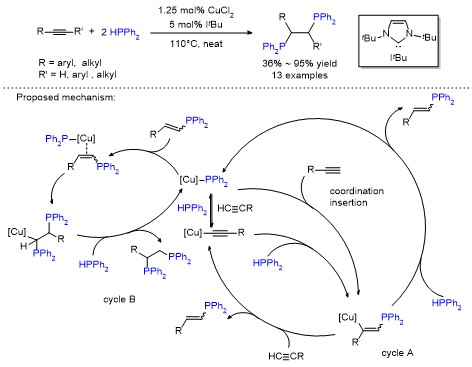
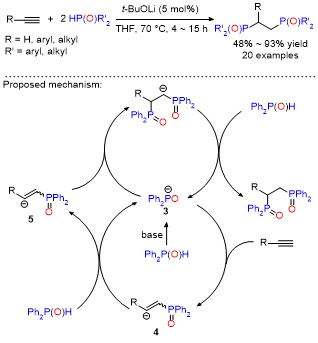
| [1] |
doi: 10.1016/j.ccr.2014.01.006 |
| [2] |
doi: 10.1055/s-00000083 |
| [3] |
doi: 10.1021/ar400071v |
| [4] |
doi: 10.1039/C1CS15247E |
| [5] |
doi: 10.1002/chem.201204056 pmid: 23325542 |
| [6] |
doi: 10.1039/c5dt00280j pmid: 25803322 |
| [7] |
doi: 10.1039/b806211k |
| [8] |
doi: 10.1021/ja211649a pmid: 22324763 |
| [9] |
doi: 10.1021/cs300541m |
| [10] |
doi: 10.1016/0022-328X(94)05173-9 |
| [11] |
|
| [12] |
doi: 10.1021/acscatal.6b02692 |
| [13] |
|
| [14] |
doi: 10.1016/j.tetlet.2003.09.117 |
| [15] |
|
| [16] |
doi: 10.1080/10426500490262261 |
| [17] |
doi: 10.3762/bjoc.10.106 pmid: 24991257 |
| [18] |
doi: 10.2174/1385272033372761 |
| [19] |
doi: 10.1002/anie.v44:11 |
| [20] |
doi: 10.1021/acs.orglett.0c02521 |
| [21] |
doi: 10.1021/acscatal.2c03144 |
| [22] |
doi: 10.1021/cr0201068 |
| [23] |
doi: 10.1016/j.tetlet.2017.10.018 |
| [24] |
doi: 10.1021/cs400685c |
| [25] |
doi: 10.1039/C6GC00903D |
| [26] |
|
| [27] |
doi: 10.1016/j.tetlet.2016.06.079 |
| [28] |
doi: 10.1021/ja0261978 |
| [29] |
doi: 10.1021/ja304818c |
| [30] |
doi: 10.1002/cctc.201900220 |
| [31] |
doi: 10.6023/cjoc202405046 |
|
(孙婷珈, 孙国银, 孙威, 彭雪松, 廖娟, 游勇, 袁伟成, 有机化学, 2024, 44, 3647.)
doi: 10.6023/cjoc202405046 |
|
| [32] |
doi: 10.1039/C4CY00497C |
| [33] |
doi: 10.1039/C5CC09156J |
| [34] |
doi: 10.2174/138527208785909592 |
| [35] |
doi: 10.1016/S0040-4039(02)00609-3 |
| [36] |
|
| [37] |
doi: 10.1016/j.tetlet.2008.01.066 |
| [38] |
doi: 10.1021/acscatal.6b01850 |
| [39] |
|
| [40] |
doi: 10.1039/c3dt52941j |
| [41] |
doi: 10.1039/C8CC00847G |
| [42] |
|
| [43] |
doi: 10.1039/C7CC00891K |
| [44] |
|
| [45] |
|
| [46] |
|
| [47] |
doi: 10.1016/0022-328X(91)86141-C |
| [48] |
doi: 10.1016/S0022-328X(98)01078-X |
| [49] |
doi: 10.1002/adsc.v350:9 |
| [50] |
doi: 10.1039/C8CC05890C |
| [51] |
doi: 10.1002/ejic.201900164 |
| [52] |
doi: 10.1016/j.tet.2019.03.042 |
| [53] |
doi: 10.1002/chem.v31.25 |
| [54] |
doi: 10.1002/ejic.201900610 |
| [55] |
doi: 10.1021/om201223j |
| [56] |
doi: 10.1021/acscatal.9b01538 |
| [57] |
|
| [58] |
doi: 10.1002/chem.201600512 pmid: 26934571 |
| [59] |
doi: 10.1039/C6GC03240K |
| [60] |
|
| [61] |
|
| [1] | Ming Lü, Bodi Zhao, Minghao Xu, Xiaotian Qi. Diastereoselectivity Control in Stepwise [2+2] Cycloadditions of Oxazolones with Alkenes: A Theoretical Study of Non-covalent Interactions [J]. Chinese Journal of Organic Chemistry, 2026, 46(9): 3731-3736. |
| Viewed | ||||||
|
Full text |
|
|||||
|
Abstract |
|
|||||
