Chinese Journal of Organic Chemistry ›› 2026, Vol. 46 ›› Issue (9): 3630-3639.DOI: 10.6023/cjoc202605030 Previous Articles Next Articles
ARTICLE
李家圆, 陈品红, 刘国生*( )
)
收稿日期:2026-05-30
修回日期:2026-07-13
发布日期:2026-07-23
通讯作者:
刘国生
基金资助:
Jiayuan Li, Pinhong Chen, Guosheng Liu*()
Received:2026-05-30
Revised:2026-07-13
Published:2026-07-23
Contact:
Guosheng Liu
About author:Dedicated to the 100th anniversary of the birth of Professor Xikui Jiang.
Supported by:Share
Jiayuan Li, Pinhong Chen, Guosheng Liu. Copper-Catalyzed Enantioselective Oxidation of Allylic C—H Bonds[J]. Chinese Journal of Organic Chemistry, 2026, 46(9): 3630-3639.
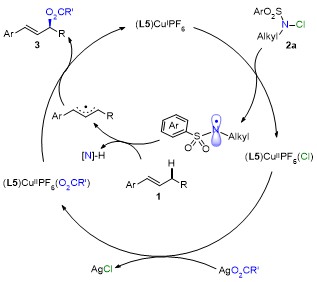
| Entry | Ligand | Salt | Yieldb/% | eec/% | r.r.d |
|---|---|---|---|---|---|
| 1 | L1 | AgOPiv | 10 | 0 | n.d. |
| 2 | L1 | NaOPiv | 0 | — | — |
| 3 | L1 | KOPiv | 0 | — | — |
| 4 | L2 | AgOPiv | 0 | — | — |
| 5 | L3 | AgOPiv | 0 | — | — |
| 6 | L4 | AgOPiv | 4 | n.d. | n.d. |
| 7 | L5 | AgOPiv | 55 | 89 | 11∶1 |
| 8 | L6 | AgOPiv | 25 | 60 | 10∶1 |
| 9e | L5 | AgOPiv | 40 | 71 | 10∶1 |
| 10f | L5 | AgOPiv | 16 | 80 | 11∶1 |
| 11g | L5 | AgOPiv | 73 | 90 | 11∶1 |
| Entry | Ligand | Salt | Yieldb/% | eec/% | r.r.d |
|---|---|---|---|---|---|
| 1 | L1 | AgOPiv | 10 | 0 | n.d. |
| 2 | L1 | NaOPiv | 0 | — | — |
| 3 | L1 | KOPiv | 0 | — | — |
| 4 | L2 | AgOPiv | 0 | — | — |
| 5 | L3 | AgOPiv | 0 | — | — |
| 6 | L4 | AgOPiv | 4 | n.d. | n.d. |
| 7 | L5 | AgOPiv | 55 | 89 | 11∶1 |
| 8 | L6 | AgOPiv | 25 | 60 | 10∶1 |
| 9e | L5 | AgOPiv | 40 | 71 | 10∶1 |
| 10f | L5 | AgOPiv | 16 | 80 | 11∶1 |
| 11g | L5 | AgOPiv | 73 | 90 | 11∶1 |
| [1] |
doi: 10.1039/c5cs00628g pmid: 26507237 |
| [2] |
doi: 10.1038/s41570-021-00300-6 pmid: 37117588 |
| [3] |
doi: 10.1021/cr00013a016 |
| [4] |
doi: 10.1039/b816707a |
| [5] |
doi: 10.1021/cr100198w |
| [6] |
doi: 10.1021/acscentsci.6b00032 |
| [7] |
doi: 10.1021/jacs.8b05195 |
| [8] |
doi: 10.1002/cjoc.v40.23 |
| [9] |
doi: 10.1039/D5SC08653A |
| [10] |
doi: 10.1039/D0CS00440E |
| [11] |
doi: 10.1038/s41570-022-00388-4 pmid: 35965690 |
| [12] |
doi: 10.1039/c0cs00142b |
| [13] |
doi: 10.1021/acs.accounts.8b00231 |
| [14] |
doi: 10.1126/science.1183602 |
| [15] |
doi: 10.1021/acs.chemrev.6b00657 |
| [16] |
doi: 10.1007/s11426-025-2757-1 |
| [17] |
doi: 10.1126/science.1193478 |
| [18] |
doi: 10.6023/A20030086 |
|
(王曦翎, 陈杰, 马娜娜, 丛志奇, 化学学报, 2020, 78, 490.)
doi: 10.6023/A20030086 |
|
| [19] |
doi: 10.1021/acs.accounts.0c00591 |
| [20] |
doi: 10.1021/acs.accounts.5b00062 |
| [21] |
doi: 10.1021/jacs.8b00350 pmid: 29542921 |
| [22] |
doi: 10.1002/anie.v58.39 |
| [23] |
doi: 10.1021/acs.chemrev.7b00373 |
| [24] |
doi: 10.1016/S0040-4020(97)00322-0 |
| [25] |
doi: 10.1021/acs.accounts.8b00265 |
| [26] |
doi: 10.1039/D1CS00727K |
| [27] |
doi: 10.1038/s44160-021-00016-x |
| [28] |
doi: 10.6023/cjoc202406042 |
|
(令天鹏, 秦海涛, 刘峰, 有机化学, 2025, 45, 498.)
doi: 10.6023/cjoc202406042 |
|
| [29] |
|
| [30] |
|
| [31] |
doi: 10.1021/ja01530a067 |
| [32] |
doi: 10.1016/S0040-4020(01)01172-3 |
| [33] |
doi: 10.1016/j.tetlet.2013.03.046 |
| [34] |
|
| [35] |
doi: 10.1021/jacs.4c11145 |
| [36] |
doi: 10.1021/jacs.4c12544 |
| [37] |
doi: 10.1038/s41929-024-01276-4 |
| [38] |
doi: 10.1021/jacs.5c05382 |
| [39] |
doi: 10.1021/jacs.5c06136 |
| [40] |
doi: 10.1038/s41586-019-1655-8 |
| [41] |
doi: 10.1021/jacs.0c05373 |
| [42] |
doi: 10.1021/jacs.3c11368 |
| [43] |
doi: 10.1016/j.ica.2004.05.022 |
| [44] |
doi: 10.1021/jacs.6c05474 |
| [1] | Tianqing Zeng, Yuyang Ni, Yao Yuan, Gangguo Zhu. Visible-Light-Driven Tertiary Amine-Promoted Acylfluoroalkylation of Alkenes [J]. Chinese Journal of Organic Chemistry, 2026, 46(9): 3737-3747. |
| [2] | Xiaolong Chen, Lin Gao, Kuiling Ding, Xiaoming Wang. Progress in Copper-Catalyzed Asymmetric Propargylic Substitution/Cyclization Cascades [J]. Chinese Journal of Organic Chemistry, 2026, 46(9): 3506-3522. |
| [3] | Ruinan Zhang, Qizhi Zheng, Shengyi Lai, Wenjun Luo, Bing Xu, Zhan-Ming Zhang, Junliang Zhang. Applications of Sadphos in Earth-Abundant Metal Catalysis [J]. Chinese Journal of Organic Chemistry, 2026, 46(9): 3390-3398. |
| [4] | Zhijie Wu, Chao Zhou, Jinshan Li, Jiaxin Xu, Yicheng Zhang, Jie Liu, Lei Wang. Visible-Light-Induced Synthesis of 1,4-Dicarbonyl Derivatives via Hydrogen Atom Transfer Process [J]. Chinese Journal of Organic Chemistry, 2026, 46(8): 3158-3168. |
| [5] | Yinsong Han, Dongwei Wang, Jiayi Xiao, Ruokun Feng. Amide-Oxazoline-Directed Copper-Catalyzed C—H Acyloxylation of [2.2]Paracyclophanes [J]. Chinese Journal of Organic Chemistry, 2026, 46(8): 3147-3157. |
| [6] | Haoyu Zheng, Chuan-Ying Li, You-Yun Zhou. Progress on Transition-Metal-Catalyzed Asymmetric Synthesis of Chiral Tertiary Alkyl Ethers via C—O Bond Formation [J]. Chinese Journal of Organic Chemistry, 2026, 46(8): 2892-2925. |
| [7] | Fengkai Yu, Xianjin Zhu, Zihan Xu, Lingyu Shi, Yongjia Shi, Xufeng Li, Daoshan Yang. Copper-Catalyzed Three-Component Synthesis of Triazoles Containing Thioether Fragments [J]. Chinese Journal of Organic Chemistry, 2026, 46(7): 2825-2834. |
| [8] | Yingpeng Gao, Linjun Zhang, Jiyi Song, Pinyong Zhong, Jinbiao Liu. Catalytic Synthesis of 2-Aminobenz-1,3-oxazin-4-ketone by Copper-Catalyzed Desulfurization and Cyclization of 2-Aminobenzoic Acid and Isothiocyanate [J]. Chinese Journal of Organic Chemistry, 2026, 46(7): 2808-2815. |
| [9] | Song-Yao Chen, Xue Feng, Man-Su Tu, Wen-Juan Hao, Bo Jiang. Ni(II)/Bisimidazoline-Catalyzed Asymmetric Higher-Order (5+3) Annulation for the Construction of Saddle-Shaped Eight-Membered Bridged Biaryls with Concurrent Central and Axial Chirality [J]. Chinese Journal of Organic Chemistry, 2026, 46(7): 2796-2807. |
| [10] | Wenyu Zhang, Xingyu Liu, Qi Xue, Yang Li, Weihang Wang, Jinheng Li. Recent Advances in Copper-Catalyzed C(sp3)—H Bond Functionalization of N-Fluorosulfonamides via Hydrogen Atom Transfer [J]. Chinese Journal of Organic Chemistry, 2026, 46(7): 2529-2543. |
| [11] | Kangyu Xiong, Zhan Lu. Research Progress in Transition Metal-Catalyzed Asymmetric Hydroboration of 1,1-Disubstituted Alkenes [J]. Chinese Journal of Organic Chemistry, 2026, 46(7): 2493-2510. |
| [12] | Hongyi Wang, Weiyi Zhou, Lingzi Peng, Chang Guo. Enantioselective Synthesis of (S)-BIRT-377 via Copper-Catalyzed Asymmetric Alkylation of α-Imino Esters [J]. Chinese Journal of Organic Chemistry, 2026, 46(7): 2779-2788. |
| [13] | Leilei Wang, Juanjuan Wu, Yi Hou, Jinghe Wang, Yan Sun, Jing Liu, Jialei Guo, Xiao Qi, Chao Zhu, Qiang Liu, Leiyang Lv. Copper-Catalyzed Cross-Dehydrogenative Coupling of 6-Azauracils with Cycloalkanes [J]. Chinese Journal of Organic Chemistry, 2026, 46(7): 2770-2778. |
| [14] | Hairui Jin, Jie Qin, Yating Zhao, Wujiong Xia. Copper(I)-Promoted Aromatic C(sp2)—H Nitration [J]. Chinese Journal of Organic Chemistry, 2026, 46(7): 2733-2742. |
| [15] | Peiwen Liu, Fu Ye, Weiming Yuan. Recent Advances in Visible-Light-Mediated Copper-Catalyzed Difunctionalization of 1,3-Enynes [J]. Chinese Journal of Organic Chemistry, 2026, 46(7): 2563-2580. |
| Viewed | ||||||
|
Full text |
|
|||||
|
Abstract |
|
|||||