
Chinese Journal of Organic Chemistry >
Synthesis and Self-assembly of Poly(ethylene oxide)-b- poly(lactic acid)-b-poly(2-hydroxyethyl methacrylate) Amphiphilic Triblock Copolymer
Received date: 2012-06-09
Revised date: 2012-07-09
Online published: 2012-07-17
Supported by
Project supported by the National Natural Science Foundation of China (Nos. 50873029, 51073042, 51103026), the Shanghai Scientific and Technological Innovation Project (No. 11JC1400600), the Natural Science Foundation of Shanghai City (No. 11ZR1403100), and the Specialized Research Fund for the Doctoral Program of Higher Education (No. 20110071120006).
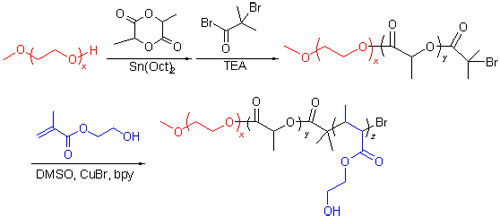
Amphiphilic copolymers that can assemble into core-shell micelles in aqueous media have potential application as drug carriers for controlled-release. In this article an amphiphilic triblock copolymer poly(ethylene oxide)-block-poly(lactic acid)-block-poly(2-hydroxyethyl methacrylate) (PEG-b-PLA-b-PHEMA) was synthesized by ring-opening reaction and atom transfer radical polymerization. The polymers were characterized by 1H NMR, FT-IR and gel permeation chromatography. In aqueous solution, PEG-b-PLA-b-PHEMA can self-assemble into micelles. Characterized by DLS and TEM, micelles are found to be spherical with uniform size. Large numbers of hydroxyl groups on the PHEMA chain offer reaction sites for subsequent functional modification, which make it a promising platforms for drug delivery systems.
Key words: amphiphilic; ATRP; PLA; PHEMA; micelle
Xi Chenbin , Yang Dong , Li Jing , Yan Jianjun , Hu Jianhua . Synthesis and Self-assembly of Poly(ethylene oxide)-b- poly(lactic acid)-b-poly(2-hydroxyethyl methacrylate) Amphiphilic Triblock Copolymer[J]. Chinese Journal of Organic Chemistry, 2012 , 32(11) : 2166 -2170 . DOI: 10.6023/cjoc201206009
/
| 〈 |
|
〉 |

