Notes

Synthesis of New Donor-Acceptor Copolymer and Its Application in Organic Bulk Hetero-junction Solar Cells

  • Zou Wenwu ,
  • Liu Ying ,
  • Jia Qingming ,
  • Ge Ziyi
Expand
  • a Faculty of Chemical Engineering, Kunming University of Science and Technology, Kunming Yunnan Province, Kunming 650500;
    b Ningbo Institute of Materials Technology & Engineering, Chinese Academy of Sciences, Ningbo 315201

Received date: 2012-12-12

  Revised date: 2013-02-23

  Online published: 2013-03-01

Supported by

Project supported by the National Natural Science Foundation of China (No. 21074144).

Abstract

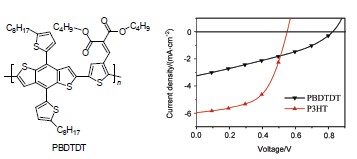
Alternative copolymer (PBDTDT) was synthesized from acceptor unit with strong electro-withdrawing structure of dibutyl malonate in branch chain and donor unit based on benzo[1,2-b:4,5-b']dithiophene. And its thermal, optical, electrochemical properties and photovoltaic properties blending with[6,6]-phenyl-C71 butyric acid methyl ester as the active layer in the bulk hetero-junction devices of organic solar cells were investigated. The influence of different ratio of polymer PBDTDT and PC71BM on the photovoltaic properties was also studied. And the open voltage reached 0.82 V, when the weight ratio of PBDTDT and PC71BM is 1:3, and its power conversion efficiency (PCE) was 0.90%, with Voc of 0.82 V, Jsc of 3.25 mA/cm2 and FF of 33.8%. Comparing with the poly(3-hexylthiophene) (P3HT) in the same method, the solar cells with P3HT blending with PC71BM as the active layer can only get 0.55 V, which can be lower about 0.29 V than that of the PBDTDT. And the possible factors resulting in low PCE and the higher open voltage than that of P3HT were analyzed.
Cite this article

Zou Wenwu , Liu Ying , Jia Qingming , Ge Ziyi . Synthesis of New Donor-Acceptor Copolymer and Its Application in Organic Bulk Hetero-junction Solar Cells[J]. Chinese Journal of Organic Chemistry, 2013 , 33(07) : 1522 -1526 . DOI: 10.6023/cjoc201212017

References

[1] Chu, T.; Lu, J.; Beaupré, S.; Zhang, Y.; Pouliot, J.; Wakim, S.; Zhou, J.; Leclerc, M.; Li, Z.; Ding, J.; Tao, Y. J. Am. Chem. Soc. 2011, 133, 4250.
[2] Li, W.; Roelofs, W. S. C.; Wienk, M. M.; Janssen, R. A. J. J. Am. Chem. Soc. 2012, 134, 13787.
[3] Hou, J.; Chen, H.; Zhang, S.; Chen, R. I.; Yang, Y.; Wu, Y.; Li, G. J. Am. Chem. Soc. 2009, 131, 15586.
[4] Peng, Q.; Huang, Q.; Hou, X.; Chang, P.; Xu, J.; Deng, S. Chem. Commun. 2012, 48, 11452.
[5] Burkhart, B.; Khlyabich, P. P.; Thompson, B. C. Macromolecules 2012, 45, 3740.
[6] He, Y.; Chen, H.; Hou, J.; Li, Y. J. Am. Chem. Soc. 2010, 132, 1377.
[7] Zhang, M.; Guo, X.; Li, Y. Macromolecules 2011, 44, 8798.
[8] Huo, L.; Ye, L.; Wu, Y.; Li, Z.; Guo, X.; Zhang, M.; Zhang, S.; Hou, J. Macromolecules 2012, 45, 6923.
[9] Saadeh, H. A.; Lu, L.; He, F.; Bullock, J. E.; Wang, W.; Carsten, B.; Yu, L. ACS Macro Lett. 2012, 1, 361.
[10] Chen, J., Cao, Y. Acc. Chem. Res. 2009, 42, 1709.
[11] Qin, R.; Li, W.; Li, C.; Du, C.; Veit, C.; Schleiermacher, H.; Andersson, M.; Bo, Z.; Liu, Z.; Inganäs, O.; Wuerfel, U.; Zhang, F. J. Am. Chem. Soc. 2009, 131, 14612.
[12] Hong, Y.; Wong, H.; Moh, L.; Tan, H. Chem. Commun. 2011, 47, 4920.
[13] Wang, B.; Tsang, S.; Zhang, W.; Tao, Y. Chem. Commun. 2011, 47, 9471.
[14] Jiang, Z.; Zhang, W.; Yao, H.; Yang, C., Cao, Y.; Qin, J.; Yu, G.; Liu, Y. J. Polym. Sci. Part A: Polym. Chem. 2009, 47, 3651.
[15] Wang, A. Chin. J. Mater. Res. 2012, 26(3), 327 (in Chinese). (王爱芬, 材料研究学报, 2012, 26(3), 327.)
[16] Cai, W.; Gong, X.; Cao, Y. Solar Energy Mater. Solar Cells 2010, 94, 114.
[17] Wang, E.; Ma, Z.; Zhang, Z.; Henriksson, P.; Inganäs, O.; Zhang, F.; Andersson, M. R. Chem. Commun. 2011, 47, 4908.
[18] Du, C.; Li, C.; Li, W.; Chen, X.; Bo, Z.; Veit, C.; Ma, Z.; Wuerfel, U.; Zhu, H.; Hu, W.; Zhang, F. Macromolecules 2011, 44, 7617.
[19] Zhang, Y.; Murphy, C. B.; Jones, W. E.; Jr. Macromolecules 2002, 35, 630.
[20] Qu, S.; Qin, C.; Islam, A.; Wu, Y.; Zhu, W.; Hua, J.; Tian, H.; Han, L. Chem. Commun. 2012, 48, 6972.
[21] Huo, L.; Zhang, S.; Guo, X.; Xu, F.; Li, Y.; Hou, J. Angew. Chem., Int. Ed. 2011, 50, 9697.
Outlines

/

