Notes

Synthesis and Properties of Pyridine-4-carboxamide-1,3,4-oxadiazoles

  • Zheng Juan ,
  • Chen Yu ,
  • Wu Kongli ,
  • Ran Chunling ,
  • Xu Yan ,
  • Song Maoping
Expand
  • a College of Chemistry and Molecular Engineering, Zhengzhou 450001;
    b College of Basic Medicine, Zhengzhou University, Zhengzhou 450001

Received date: 2013-01-16

  Revised date: 2013-03-07

  Online published: 2013-03-15

Supported by

Project supported by the National Natural Science Foundation of China (No. 21171149).

Abstract

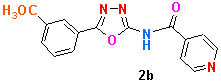
Four new 2,5-disubstituted 1,3,4-oxadiazole derivative N-(5-aromatic-1,3,4-oxadiazol-2-yl)picolinamides 2a2d were obtained by condensation, oxidization and acylation reactions, with isonicotinic acid and single substituted aromatic aldehydes as raw materials. These compounds were characterized by IR, 1H NMR and elemental analysis. Fluorescence test results indicated that Cu2+ could make this series compounds fluorescence quenching, and Zn2+could only enhance the fluorescence intensity of N-[5-(4-methoxyphenyl)-1,3,4-oxadiazol-2-yl]isonicotinamide (2b). Furthermore, those compounds all showed good fungicidal activity against the tested bacteria, and among them, N-(5-p-tolyl-1,3,4-oxadiazol-2-yl)isonicotinamide (2d) against Gibberella zeae was reached 100%.
Cite this article

Zheng Juan , Chen Yu , Wu Kongli , Ran Chunling , Xu Yan , Song Maoping . Synthesis and Properties of Pyridine-4-carboxamide-1,3,4-oxadiazoles[J]. Chinese Journal of Organic Chemistry, 2013 , 33(07) : 1536 -1539 . DOI: 10.6023/cjoc201301039

References

[1] Marina, I.; Salomao, D. J.; Alex, A. D. O.; Fanny, P. B.; Ieda, Y. S.; Kerly, F. M. P.; Leoberto, C. T. Bioorg. Med. Chem. 2011, 19, 6292.
[2] Jayashankar, B.; Lokanath Rai, K. M.; Baskaran, N.; Sathish, H. S. Eur. J. Med. Chem. 2009, 44, 3898.
[3] Chen, H. S.; Li, Z. M.; Han, Y. F. J. Agric. Food Chem. 2000, 48, 5312.
[4] (a) Holla, B. S.; Gonsalves, R.; Shenoy, S. Eur. J. Med. Chem. 2000, 35, 267. (b) Brown, P.; Best, D. J.; Broom, N. J. P.; Cassels, R.; O'Hanlon, P. J.; Mitchell, T. J.; Osborne, N. F.; Wilson, J. M. J. Med. Chem. 1997, 40, 2563. (c) Palaska, E.; Sahin, G.; Kelicen, P.; Durlu, N. T.; Altintok, G. Farmaco 2002, 57, 101. (d) Lokanatha Rai, K. M.; Linganna, N. Farmaco 2000, 55, 389. (e) Adelstein, G. W. J. Med. Chem. 1973, 16, 309. (f) Zheng, X.; Li, Z.; Wang, Y.; Chen, W.; Huang, Q.; Liu, C.; Song, G. J. Fluorine Chem. 2003, 123, 163.
[5] Ramya, V. S.; Kallappa, M. H.; Rangappa, S. K.; Mallinath, H. H. Eur. J. Med. Chem. 2010, 45, 1753.
[6] Pan, J. F.; Zhu, W. H.; Lia, S. F.; Zeng, W. J.; Cao, Y.; Tian, H. Polymer 2005, 46, 7658.
[7] Tao, Y. T.; Wang, Q.; Shang, Y.; Yang, C. L.; Ao, L.; Qin, J. G.; Ma, D. G.; Shuai, Z. G. Chem. Commun. 2009, 3, 77.
[8] Brown, A. R.; Bradley, D. D. C.; Burroughs, J. H.; Friend, R. H. Greenham, N. C.; Burn, P. L.; Kraft, A. Appl. Phys. Lett. 1992, 61, 2793.
[9] Wang, H.-W.; Zhu, W. J.; Yu, Z. R.; Li, J.; Dong, B. D.; Liao, X. C. Chin. J. Org. Chem. 2012, 32, 1888 (in Chinese). (王海卫, 朱文娟, 于知冉, 李静, 董保东, 廖新成, 有机化学, 2012, 32, 1888.)
[10] Wu, X.-L.; Zhu, C. F.; Lv, Z. D; Wei, C. S.; Liao, X. C. Chin. J. Org. Chem. 2011, 31, 824 (in Chinese). (武现丽, 朱春风, 吕志丹, 魏成事, 廖新成, 有机化学, 2011, 31, 824.)
[11] Hwang, M. Y.; Hua, M. Y.; Chen, S. A. Polymer 1999, 40, 3233.
[12] Lv, H. S.; Zhao, B. X.; Li, J. K.; Xia, Y.; Lian, S.; Liu, W. Y.; Gong, Z. L. Dyes Pigm. 2010, 86, 25.
[13] Fisher, A. L.; Linton, K. E.; Kamtekar, K. T.; Pearson, C.; Bryce, M. R.; Petty, M. C. Chem. Mater. 2011, 23, 1640.
[14] (a) Barry, A. L. In The Antimicrobial Susceptibility Test: Principle and Practices, Eds.: Lea, I.; Febiger, H. C., CBS Publishers and Distributors, Philadelphia, PA, USA, 1976, p. 180. (b) Barry, A. L. Biol. Abstr. 1976, 64, 25183.
[15] Zhang, F. L.; Hou, Y. H.; Du, C. X.; Wu, Y. J. Dalton Trans. 2009, 7359.
Outlines

/

