Articles

Synthesis and Anti-tumor Activities of Resveratrol Derivatives on Cervical Cancer HeLa Cells

  • Du Cheng ,
  • Ren Yujie ,
  • Wang Qingwei ,
  • Jin Lu
Expand
  • a School of Chemical and Environmental Engineering, Shanghai Institute of Technology, Shanghai 201418;
    b Key Laboratory Synthetic Chemistry of Natural Substances, Shanghai Institute of Organic Chemistry, Chinese Academy of Sciences, Shanghai 200032

Received date: 2013-03-23

  Revised date: 2013-04-26

  Online published: 2013-05-06

Supported by

Project Supported by the Innovation Program of Shanghai Municipal Education Commission (No.12ZZ188), the Science and Technology Commission of Shanghai Municipal (No.11430502500), the Professor of Special Appointment (Eastern Scholar) at Shanghai Institutions of Higher Learning (No.405ZK110060002).

Abstract

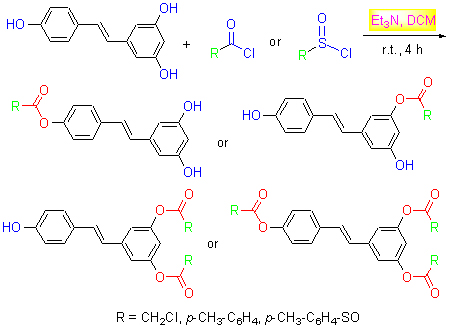
Nine novel resveratrol derivatives were synthesized from resveratrol, chloroacetyl chloride, p-toluenesulfonyl chloride and p-methyl benzoyl chloride.These structures were confirmed by IR, 1H NMR, 13C NMR and HR-MS techniques.The target compounds were evaluated for their anti-tumor activities against cervical cancer HeLa cells by 3-(4,5-dimethylthi- azol-2-yl)-2,5-diphenyltetrazolium bromide (MTT) method, and the results indicated that compounds 4a, 6a, 7b, 8b and 11c of all the derivatives displayed better activities than resveratrol against HeLa cells, the compounds 6a and 8b displayed excellent inhibition effect, with IC50 values of 22.7 and 18.0 μmol/L, respectively, even higher than that of resveratrol (IC50=114 μmol/L).The inhibitory ratio of compounds 6a and 8b were 95.5% and 87.7% against HeLa cells at the concentration of 150 μmol/L.
Cite this article

Du Cheng , Ren Yujie , Wang Qingwei , Jin Lu . Synthesis and Anti-tumor Activities of Resveratrol Derivatives on Cervical Cancer HeLa Cells[J]. Chinese Journal of Organic Chemistry, 2013 , 33(06) : 1279 -1283 . DOI: 10.6023/cjoc201303035

References

[1] Pan, M.H.; Lin, C.L.; Tsai, J.H.; Ho, C.T.; Chen, W.J.J.Agric.Food Chem.2010, 58, 226.
[2] Juan, M.E.; Wenzel, U.; Daniel, H.; Planas, J.M.J.Agric.Food Chem.2008, 56, 4813.
[3] Kundu, J.K.; Surh, Y.J.Cancer Lett.2008, 269, 243.
[4] Selvaraj, S.; Mohan, A.; Narayanan, S.; Sethuraman, S.; Krishnan, U.M.J.Med.Chem.2013, 56, 970.
[5] Agrawal, M.; Kumar, V.; Singh, A.K.; Kashyap, M.P.; Khanna, V.K.; Siddiqui, M.A.; Pant, A.B.ACS Chem.Neurosci.2013, 4, 285.
[6] Udenigwe, C.C.; Ramprasath, V.R.; Aluko, R.E.; Jones, P.J.H.Nutr.Rev.2008, 66, 445.
[7] Li, L.; Henry, G.E.; Seeram, N.P.J.Agric.Food Chem.2009, 57, 7282.
[8] Yap, S.; Qin, C.X.; Woodman, O.L.Biofactors 2010, 36, 350.
[9] Albani, D.; Polito, L.; Signorini, A.; Forloni, G.Biofactors 2010, 36, 370.
[10] Bishayee, A.; Darvesh, A.S.; Politis, T.; McGory, R.Liver Int.2010, 30, 1103.
[11] Joseph, J.A.Fisher D.R.; Cheng, V.; Rimando, A.M.; Shukitt-Hale, B.J.Agric.Food Chem.2008, 56, 10544.
[12] Mouchiroud, L.; Molin, L.; Dallière, N.; Solari, F.Biofactors 2010, 36, 377.
[13] Chen, W.P.; Hung, L.M.; Hsueh, C.H.; Lai, L.P.; Su, M.J.Br.J.Pharmacol.2009, 157, 381.
[14] Zhu, Z.Q.; Zhang, X.Y.; Chen, J.W.; Xia, J.; Zhai, W.G.; Hu, T.X.J.East China Normal Univ.(Nat.Sci) 2002, 2, 98 (in Chinese).(朱振勤, 张小轶, 陈季武, 夏晶, 翟万垠, 胡天喜, 华东师范大学学报(自然科学版), 2002, 2, 98.)
[15] Liu, S.J.; Hu, Y.L.; Wang, X.L.; Zhong, J.; Lin, Z.P.J.Agric.Food Chem.2006, 54, 8082.
[16] Reddy, M.A.; Jain, N.; Yada, D.; Kishore, C.; Vangala, J.R.; P.Surendra R.; Addlagatta, A.; Kalivendi, S.V.; Sreedhar, B.J.Med.Chem.2011, 54, 6751.
[17] Lv, Y.J.; Zhou, N.; Meng, Q.G.J.Int.Pharm.Res.2008, 35, 377.(in Chinese).(吕玉健, 周宁, 孟庆国, 国际药学杂志, 2008, 35, 377.)
[18] Liu, H.C.; Dong, A.J.; Gao, C.M.; Jiang, Y.Y.Prog.Chem.2009, 21, 1500 (in Chinese).(刘华臣, 董爱君, 高春梅, 蒋宇扬, 化学进展, 2009, 21, 1500.)
Outlines

/

