Chinese Journal of Organic Chemistry >
Reaction Mechanism of Terephthaloyl Chloride/N-Methyl-2-pyrrolidone and the Effect on Poly(p-phenylene terephthalamide) Polymerization
Received date: 2013-12-06
Revised date: 2014-01-17
Online published: 2014-03-03
Supported by
Project supported by the National Basic Research Program of China (973 Program, No. 2011CB606102).
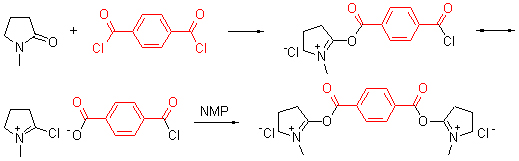
Stable synthesis of high molecular weight of poly(p-phenylene terephthalamide) (PPTA) resin is the basis for the production of high-performance aramid fibers. In PPTA polymerization process, the feeding method of the monomer terephthaloyl chloride (TPC) has important influence on the molecular weight. In theory, using TPC/N-methyl-2-pyrrolidone (NMP) solution and monomer p-phenylene diamine (PPD)/NMP solution for solution polycondensation is the most ideal and effective way, but in real polymerization process, it is difficult to synthesize high molecular weight PPTA due to some unknown interaction between TPC and NMP. This article combines experiments and molecular stimulation together, using Frontier infrared spectroscopy (FTIR), 1H NMR, the time of flight mass spectrometer (TOF-MS) and differential scanning calorimetric analysis (DSC), analyzing the reaction between TPC and NMP, and verified that TPC and NMP has obvious reaction similar to Vilsmeier-Haack reaction through molecular stimulation, which may cause the chloride group on the TPC deactivating, and seriously influence its reactivity. And the conclusion is verified through PPTA polymerization experiments, and the longer TPC/NMP solution is prepared, the worse of the polymerization effect is. These observations and experiments suggest that it is not feasible to synthesize high molecular weight PPTA in industry using TPC/NMP solution feeding method.
Key words: PPTA; TPC/NMP; Vilsmeier-Haack reaction; molecular simulation
Guo Chenglong , Xu Jia , Wang Lihui , Tuo Xinlin , Wang Luoxin . Reaction Mechanism of Terephthaloyl Chloride/N-Methyl-2-pyrrolidone and the Effect on Poly(p-phenylene terephthalamide) Polymerization[J]. Chinese Journal of Organic Chemistry, 2014 , 34(6) : 1132 -1137 . DOI: 10.6023/cjoc201312006
[1] Kwolek, S. L. US 3671542, 1972 [Chem. Abstr. 1970, 72, 122796]
[2] Yang, H. H. Kevlar Aramid Fiber, Wiley-Interscience, New York, 1992.
[3] Chae, H. G.; Kumar, S. J. Appl. Polym. Sci. 2006, 100(1), 791.
[4] Tanner, D.; Fitzgerald, J. A.; Phillips, B. R. Angew. Chem., Int. Ed. Engl. 1989, 28, 649. [5] Rao, Y.; Waddon, A. J.; Ferris, R. J. Polymer 2001, 42, 5937.
[6] Morgan, P. W. Condensation Polymers: By Interfacial and Solution Method, Interscience, New York, 1965.
[7] Yamazaki, N.; Matsumoto, M.; Higashi, F. J. Polym. Sci., Polym. Chem. 1975, 13, 1373.
[8] Hearle, J. W. S. High Performance Fiber, Woodhead Press, Cambridge, 2001.
[9] Yotsumoro, T.; Imai, I. JP 62131804, 1987 [Chem. Abstr. 1988, 108, 23200].
[10] Shin, H.; Del, W. US 4009153, 1977 [Chem. Abstr. 1977, 86, 141532].
[11] Pan, Y. Y.; Cai, B. L.; Zhou, Z. S.; Xu, J. S. CN 1048710, 1991 [Chem. Abstr. 1991, 115, 161123].
[12] Cao, Y. T.; Zhou, Z. S.; You, X. L.; Liu, Z. F. CN 101220148, 2008 [Chem. Abstr. 2008, 149, 224768].
[13] Panar, M.; Beste, L. F. Macromolecules 1977, 10(6), 1401.
[14] Sun, L. L.; Xu, J.; Luo, W.; Guo, C. L.; Tuo, X. L.; Wang, X. G. Acta Polym. Sinica 2012, 1, 70 (in Chinese).
(孙力力, 许甲, 罗文, 郭澄龙, 庹新林, 王晓工, 高分子学报, 2012, 1, 70.)
[15] Frisch, M. J.; Trucks, G. W.; Schlegel, H. B.; Scuseria, G. E. Gaussian 03, Revision E.01, Gaussian, Inc., Wallingford, CT, 2005.
[16] Zhang, S. F.; Han, B. Z.; Bao, J. S. Polym. Commun. 1983, 2, 88 (in Chinese).
(张树范, 韩宝珍, 宝净生, 高分子通讯, 1983, 2, 88.)
[17] Campaigne, E.; Archer, W. L. Org. Synth. Coll. 1963, 4, 331.
[18] Meth-Cohn, O.; Stanforth, S. P. Compd. Org. Synth. 1991, 2, 777.
[19] Higashi, F.; Nishi, T. J. Polym. Sci. 1986, 24, 701.
[20] Özp?nar, G. A.; Kaufmann, D. E.; Clark, T. J. Mol. Model 2011, 17, 3209.
[21] Guo, X.; Cheng, Y. W.; Li, X. Acta Crystallogr. 2005, 61, 3410.
/
| 〈 |
|
〉 |