
Chinese Journal of Organic Chemistry >
3-Arylfuran-2(5H)-one-fluoroquinolone Hybrids as Multi-target Antibacterial Agents: Design, Synthesis and Its Mechanistic Implication
Received date: 2014-04-26
Revised date: 2014-06-04
Online published: 2014-07-01
Supported by
Project supported by the National Natural Science Foundation of China (No. 21262013), the Hunan Provincial Natural Science Foundation (No. 13JJ2030), and the Science and Technology Innovative Research Team in Higher Educational Instituions of Hunan Province.
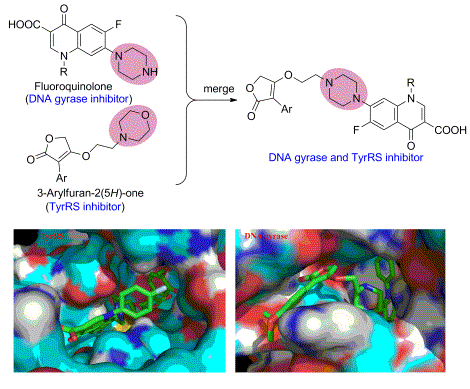
Based on the multi-target drug design and hybrid strategy for drug research and development, seven new 3-arylfuran-2(5H)-one-fluoroquinolone hybrids have been designed and synthesized, in which the 3-aryl-4-(2-morpholino- ethoxy)furan-2(5H)-one (targeting tyrosyl-tRNA synthetase, TyrRS) and fluoroquinolone (targeting DNA gyrase) were merged. In the antibacterial assay, most of the tested compounds displayed a broad spectrum of activity against microorganisms including Gram-negative bacteria, Gram-positive bacteria and fungi. Furthermore, the enzyme assay and molecular docking revealed that 3-arylfuran-2(5H)-one-fluoroquinolone is a potent antibacterial agent by disturbing the processes of bacterial DNA replication and protein synthesis. These excellent results strongly suggest that 3-arylfuran-2(5H)-one-fluoroquinolone hybrid deserves to further research as a novel antibiotic.
Key words: 3-arylfuran-2(5H)-one; fluoroquinolone; hybrid; multi-target; inhibitor
Wang Xudong , Wei Wei , Deng Ruicheng , Zhou Shasha , Zhang Lei , Lin Xiaoyi , Xiao Zhuping . 3-Arylfuran-2(5H)-one-fluoroquinolone Hybrids as Multi-target Antibacterial Agents: Design, Synthesis and Its Mechanistic Implication[J]. Chinese Journal of Organic Chemistry, 2014 , 34(9) : 1773 -1779 . DOI: 10.6023/cjoc201404042
[1] Philip, H.EMBO Reports 2012, 13, 680.
[2] Yang, J.Q; Hu, Y.W.; Gu, Q.; Li, M.G.; Li, M.Q.; Song, B.A.Chin.J.Org.Chem.2014, 34, 829 (in Chinese).(杨家强, 胡月维, 谷晴, 李明刚, 李明强, 宋宝安, 有机化学, 2014, 34, 829.)
[3] Zhang, C.F.; Wu, X, G.; Li, Y.; Liang, C.R.; Che, Y.Z.; Gu, L.L.; Ren, J., H, K., Sun, X.Q.; Yang, C.H.; Cheng, X.Chin.J.Org.Chem.2013, 33, 1309 (in Chinese).(张成芳, 吴小刚, 李燕, 梁翠荣, 车亦舟, 顾玲玲, 任杰, 胡昆, 孙小强, Ching-Hong Yang, 陈新, 有机化学, 2013, 33, 1309.)
[4] Zhang, L.; Huang, L.Y.Chin.J.Nosocomoil.2008, 18, 897 (in Chinese).(张玲, 黄留玉, 中华医院感染学杂志, 2008, 18, 897.)
[5] Karen, B.; Michael, J.Biochem.Pharmacol.2011, 82, 1528.
[6] Nat.Rev.Microbiol.2010, 8, 836.
[7] Laxminarayan, R.; Powers, J.H.Nat.Rev.Drug Discovery 2011, 10, 727.
[8] Wang, J.Y.; Zheng, W.Chin.J.Antibiotic.2011, 36(3) 165 (in Chinese).(王娇艳, 郑卫, 中国抗生素杂志, 2011, 36(3) 165.)
[9] Aminake, M.N.; Mahajan, A.; Kumar, V.; Hans, R.; Wiesner, L.; Taylor, D.; de Kock, C.; Grobler, A.; Smith, P.J.; Kirschner, M.; Rethwilm, A.; Pradel, G.; Chibale, K.Bioorg.Med.Chem.2012, 20, 5277.
[10] Aziz, M.A.; Park, S.E.; Rahma, G.E.D.A.A.A.; Sayed, M.A.; Kwon, Y.Eur.J.Med.Chem.2013, 69, 427.
[11] Plech, T.; Wujec, M.; Kosikowska, U.; Malm, A.; Rajtar, B.; Dacewicz, M.P.Eur.J.Med.Chem.2013, 60, 128.
[12] Garudachari, B.; Isloor, A.M.; Satyanarayana, M.N.; Fun, H.K.; Pavithra, N.; Kulal, A.Eur.J.Med.Chem.2013, 68, 422.
[13] Chai, Y.; Wan, Z.L.; Wang, B.; Guo, H.Y.; Liu, M.L.Eur.J.Med.Chem.2009, 44, 4063.
[14] Parcej, D.; Tampé, R.Nat.Chem.Biol.2010, 6, 572.
[15] Kumar, S.; Varela, M.F.Int.J.Mol.Sci.2012, 13, 4484.
[16] Poirel, L.; Bonnin, R.A.; Nordmann, P.IUBMB Life 2011, 63, 1061.
[17] Liu, G.Z.; Xu, H.W.; Sun, K.; Wang, J.; Liu, H.M.Chin.J.Org.Chem.2008, 28, 201 (in Chinese).(徐海伟, 孙凯, 王君, 刘宏民, 有机化学, 2008, 28, 201.)
[18] Xiao, Z.P.; Ouyang, H.; Wang, X.D.; Lv, P.C.; Huang, Z.J.; Yu, S.R.; Yi, T.F.; Yang, Y.L.; Zhu, H.L.Bioorg.Med.Chem.2011, 19, 3884.
[19] Xiao, Z.P.; Ma, T.W.; Liao, M.L.; Feng, Y.T.; Peng, X.C.; Li, J.L.; Li, Z.P.; Wu, Y.; Luo, Q.; Deng, Y.; Liang, X.; Zhu, H.L.Eur.J.Med.Chem.2011, 46, 4904.
[20] Xiao, Z.P.; He, X.B.; Peng, Z.Y.; Xiong, T.J.; Peng, J.; Chen, L.H.; Zhu, H.L.Bioorg.Med.Chem.2011, 19, 1571.
[21] Fostel, M.J.; Montgomery, D.A.; Shen, L.L.Antimicrob.Agents Chemother.1992, 36, 2131.
[22] Sugar, A.M.; Liu, X.P.; Chen, R.J.Antimicrob.Agents Chemother.1997, 41, 2518.
[23] Srinivasan, S.; Beema, S.R.M.; Nithyanand, P.; Manisankar, P.; Pandian, S.K.Eur.J.Med.Chem.2010, 45, 6101.
[24] Shen, L.L.; Baranowski, J.; Fostel, J.; Montgomery, D.A.; Lartey, P.A.Antimicrob.Agents Chemother.1992, 36, 2778.
[25] Park, S.G.; Schimmel, P.; Kim, S.Proc.Natl.Acad.Sci.U.S.A.2008, 105, 11043.
[26] Van de Vijver, P.; Vondenhoff, G.H.; Kazako, T.S.; Semenova, E.; Kuznedelov, K.; Metlitskaya, A.; Van Aerschot, A.; Severinov, K.J.Bacteriol.2009, 191, 6273.
/
| 〈 |
|
〉 |

