
Chinese Journal of Organic Chemistry >
Development of Efficient Asymmetric Suzuki-Miyaura Cross-Coupling and Applications in Synthesis
Received date: 2014-06-19
Revised date: 2014-07-22
Online published: 2014-08-11
Supported by
Project supported by the National Natural Science Foundation of China (No. 21272254), the Science and Technology Commission of Shanghai Municipality (No. 13PJ1410900), and the “Thousand Plan” Youth Program.
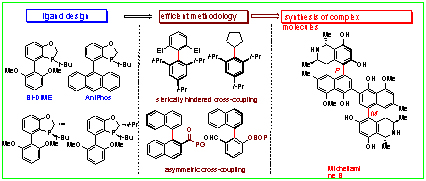
A series of structurally rigid, sterically bulky biaryl monophosphorus ligands were designed and synthesized to investigate the reactivity and stereoselectivity of asymmetric Suzuki-Miyaura cross-coupling reaction. High efficiencies were achieved in sterically demanding cross-couplings for the synthesis of tetra-ortho-substituted biaryls with various functionalities. Sterically demanding aryl-alkyl Suzuki-Miyaura couplings between di-ortho-substituted aryl halides and secondary alkylboronic acids were also successful. In achieving efficient asymmetric Suzuki-Miyaura coupling, we implemented a new concept by employment of a chiral biaryl monophosphorus ligand developed in the group as well as utilization of a secondary interaction between two coupling partner. Using a π-π interaction of a benzooxazolidinone substituent with one aryl partner, we developed enantioselective biaryl couplings containing ortho-carbonyl substituents. High enantioselectivities were also achieved in biaryl coupling containing ortho-oxy substituents by utilizing a polar-π interaction between a polar bis(2-oxo-3-oxazolidinyl)phosphonic (BOP) substituent and one aryl partner. The methodology enabled us for the first time to implement efficient asymmetric Suzuki-Miyaura coupling in total synthesis and accomplish the syntheses of chiral biaryl natural products korupensamines A and B, ultimately a concise and stereoselective synthesis of michellamine B.
Xu Guangqing , Zhao Qing , Tang Wenjun . Development of Efficient Asymmetric Suzuki-Miyaura Cross-Coupling and Applications in Synthesis[J]. Chinese Journal of Organic Chemistry, 2014 , 34(10) : 1919 -1940 . DOI: 10.6023/cjoc201406030
[1] (a) Bringmann, G.; Gulder, T.; Gulder, T. A. M.; Breuning, M. Chem. Rev. 2011, 111, 563.
(b) Bringmann, G.; Mortimer, A. J. P.; Keller, P. A.; Gresser, M. J.; Garner, J.; Breuning, M. Angew. Chem., Int. Ed. 2005, 44, 5384.
(c) Wang, R. W.-J.; Rebhun, L. I.; Kupchan, S. M. Cancer Res. 1977, 37, 3071.
(d) Allock, Y. F.; Manfredi, K. P.; Blunt, J. W.; Cardellina, J. H., II; Schäffer, M.; Gulden, K.-P.; Bringmann, G.; Lee, A. Y.; Clardy, J.; Francois, G.; Boyd, M. R. J. Org. Chem. 1994, 59, 6349.
(e) Boyd, M. R.; Hallock, Y. F.; Cardellina, J. H.; Manfredi, K. P.; Blunt, J. W.; McMahon, J. B.;Buckheit, R. W.; Bringmann, G.; Schäffer, M.; Cragg, G. M.; Thomas, D. W.; Jato, J. G. J. Med. Chem. 1994, 37, 1740.
[2] (a) Hayashi, T.; Hayashizaki, K.; Kiyoi, T.; Ito, Y. J. Am. Chem. Soc. 1988, 110, 8153.
(b) Genov, M.; Fuentes, B.; Espinet, P.; Pelaz, B. Tetrahedron: Asymmetry 2006, 17, 2593
[3] (a) Liu, Z.; Zhang, Y.; Wang, J. Chin. J. Org. Chem. 2013, 33, 687 (in Chinese).
(刘振兴, 张艳, 王剑波, 有机化学, 2013, 33, 687.)
(b) Xie, W.; Zuo, Z.; Zi, W.; Ma, D. J. Chin. J. Org. Chem. 2013, 33, 869 (in Chinese).
(谢卫青, 左智伟, 资伟伟, 马大为, 有机化学, 2013, 33, 869.)
[4] (a) Yin, J. J.; Buchwald, S. L. J. Am. Chem. Soc. 2000, 122, 12051.
(b) Shen, X.; Jones, G. O.; Watson, D. A.; Bhayana, B.; Buchwald, S. L. J. Am. Chem. Soc. 2010, 132, 11278.
(c) Cammidge, A. N.; Crépy, K. V. L. Chem. Commun. 2000, 1723.
(d) Cammidge, A. N.; Crépy, K. V. L. Tetrahedron 2004, 60, 4377.
(e) Bermejo, A.; Ros, A.; Fernández, R.; Lassaletta, J. M. J. Am. Chem. Soc. 2008, 130, 15798.
(f) Uozumi, Y.; Matsuura, Y.; Arakawa, T.; Yamada, Y. M. A. Angew. Chem., Int. Ed. 2009, 48, 2708.
(g) Sawai, K.; Tatumi, R.; Nakahodo, T.; Fujihara, H. Angew. Chem., Int. Ed. 2008, 47, 6917.
(h) Zhang, S.-S.; Wang, Z. Q.; Xu, M.-H.; Lin, G.-Q. Org. Lett. 2010, 12, 5546.
(i) Genov, M.; Almorin, A.; Espinet, P. Chem. Eur. J. 2006, 12, 9346.
(j) Yamamoto, T.; Akai, Y.; Nagata, Y.; Suginome, M. Angew. Chem., Int. Ed. 2011, 50, 8844.
(k) Wang, S.; Li, J.; Miao, T.; Wu, W.; Li, Q.; Zhuang, Y.; Zhou, Z.; Qiu, L. Org. Lett. 2012, 14, 1966
[5] (a) Dai, C.; Fu, G. C. J. Am. Chem. Soc. 2001, 123, 2719.
(b) Yin, J. J.; Rainka, M. P.; Zhang, X.-X.; Buchwald, S. L. J. Am. Chem. Soc. 2002, 124, 1162.
(c) Barder, T. F.; Walker, S. D.; Martinelli, J. R.; Buchwald, S. L. J. Am. Chem. Soc. 2005, 127, 4085.
[6] Tang, W.; Capacci, A. G.; Wei, X.; Li, W.; White, A.; Patel, N. D.; Savoie, J.; Gao, J. J.; Rodriguez, S.; Qu, B.; Haddad, N.; Lu, B. Z.; Krishnamurthy, D.; Yee, N. K.; Senanayake, C. H. Angew. Chem., Int. Ed. 2010, 49, 5879
[7] Zhao, Q.; Senanayake, C. H.; Tang, W. Chem. Eur. J. 2013, 19, 2261
[8] Martin, R.; Buchwald, S. L. Acc. Chem. Res. 2008, 41, 1461
[9] Jana, R.; Pathak, T. P.; Sigman, M. S. Chem. Rev. 2011, 111, 1417.
[10] (a) Dreher, S. P.; Dormer, P. G.; Sandrock, D. C.; Molander, G. A. J. Am. Chem. Soc. 2008, 130, 9257.
(b) Han, C.; Buchwald, S. L. J. Am. Chem. Soc. 2009, 131, 7532
[11] Li, C.; Xiao, G.; Zhao, Q.; Liu, H.; Wang, T.; Tang, W. Org. Chem. Front. 2014, 1, 225
[12] Liu, G.; Xu, G.; Luo, R.; Tang, W. Synlett 2013, 2465
[13] Tang, W.; Patel, N. D.; Xu, G.; Xu, X.; Savoie, J.; Ma, S.; Hao, M.-H.; Keshipeddy, S.; Capacci, A. G.; Wei, X.; Zhang, Y.; Gao, J. J.; Li, W.; Rodriguez, S.; Lu, B. Z.; Yee, N. K.; Senanayake, C. H. Org. Lett. 2012, 14, 2258
[14] Xu, G.; Fu, W.; Liu, G.; Senanayake, C. H.; Tang, W. J. Am. Chem. Soc. 2014, 136, 570
[15] (a) Cozzi, F.; Cinquini, M.; Annuziata, R.; Siegel, J. S. J. Am. Chem. Soc. 1993, 115, 5330.
(b) Chen, C.-T.; Siegel, J. S. J. Am. Chem. Soc. 1994, 116, 5959.
(c) Pace, C. J.; Gao, J. Acc. Chem. Res. 2013, 46, 907
[16] Liu, G.; Liu, X.; Cai, Z.; Jiao, G.; Xu, G.; Tang, W. Angew. Chem., Int. Ed. 2013, 52, 4235.
/
| 〈 |
|
〉 |

