Chinese Journal of Organic Chemistry >
Investigation on the Mechanism for N-Methylindole and Keto Ester Catalyzed by InX3 (X=F, Br)
Received date: 2015-08-26
Revised date: 2015-10-21
Online published: 2015-11-06
Supported by
Project supported by the Natural Science Foundation of Sichuan Province Department of Education (No. 13ZA0150) and the Natural Science Foundation of Sichuan Province (No. 2014JY0099).
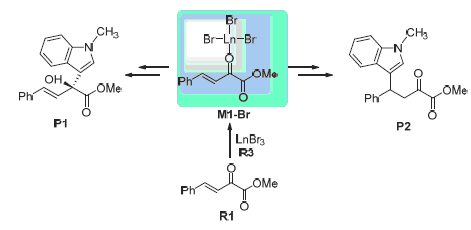
The reaction mechanism for N-methylindole and keto ester catalyzed by InX3 (X=F, Br) was studied by the density functional theory (DFT). The geometries and the frequencies of reactants, intermediates, transition states, and products have been calculated at the B3LYP/6-31+G(d, p) level, dichloroethane (DCE) is used as a solvent and the LanL2DZ basis has been used for In atom. Transition states have been confirmed by the corresponding vibration analysis and intrinsic reaction coordinate (IRC). In addition, nature bond orbital (NBO) and atoms in molecules (AIM) theories have been used to analyze orbital interactions and bond natures. The results showed that the activation energies of rate-determining steps in which N-methylindole reacted with keto ester to form 1,2-adduct and 1,4-adduct were 25.62 and 12.52 kcal/mol catalyzed by InF3 while those were 26.87 and 13.95 kcal/mol when the reaction was catalyzed by InBr3 under the same conditions. Comparing the results of our research, InF3 can effectively catalyze the reaction, and the 1,4-adduct was more likely to be produced. The final result of our theory study agreed with the experimental data, meanwhile, self-consistent reaction field (SCRF) was carried out using the polarized continuum model (PCM) at the same theoretical level for geometry optimizations and frequency calculations in five different salvations. We predicted that the productivity to form 1,4-adduct was more higher catalyzed by InF3 in the solvent of dimethyl sulfoxide (DMSO).
Key words: density functional theory; N-methylindole; reaction mechanism; solvation
Wang Wei , Mao Shuang , Peng Dan , Li Laicai . Investigation on the Mechanism for N-Methylindole and Keto Ester Catalyzed by InX3 (X=F, Br)[J]. Chinese Journal of Organic Chemistry, 2016 , 36(3) : 613 -621 . DOI: 10.6023/cjoc201508026
[1] Marckwald, W.; Desch, B. Chem. Res. 1904, 37, 1368.
[2] Qi, L.; Jiang, B. Acta Acad. Med. Zunyi 2004, 2, 188 (in Chinese). (企兰, 江波, 遵义医学院学报, 2004, 2, 188.)
[3] Zhang, W. H.; Yang, C. L.; Wang, M. H. Chin. J. Org. Chem. 2003, 23, 741 (in Chinese). (章维华, 杨春龙, 王鸣华, 有机化学, 2003, 23, 741.)
[4] Liu, S. M. J. Southwest Univ. Sci. Technol. 2005, 20, 68 (in Chinese). (刘思曼, 西南科技大学学报, 2005, 20, 68.)
[5] Wang, Y. F.; Wang, K.; Zhang, W.; Zhang, B. B.; Zhang, C. X.; Xu, D. Q. Eur. J. Org. Chem. 2012, 19, 3691.
[6] Wang, Y. F.; Chen, R. X.; Wang, K.; Zhang, B. B.; Li, Z. B.; Xu, D. Q. Green Chem. 2012, 14, 893.
[7] Terrasson, V.; de Figueiredo, R. M.; Campagne, J. M. Eur. J. Org. Chem. 2010, 14, 2635.
[8] Jensen, K. B.; Thorhauge, J.; Hazell, R. G.; Jorgensen, K. A. Angew. Chem., Int. Ed. 2001, 40, 160.
[9] Zhou, J.; Tang, Y. J. Am. Chem. Sco. 2002, 124, 9030..
[10] Bandini, M.; Fagioli, M.; Melchiorre, P.; Melloni, A.; Umani-Ronchi, A. Tetrahedron Lett. 2003, 44, 5843.
[11] Blay, G.; Fernández, I.; Pedro, J. R.; Vila, C. Org. Lett. 2007, 9, 2601.
[12] Desimoni, G.; Faita, G.; Toscanini, M.; Boiocchi, M. Chem.-Eur. J. 2008, 14, 3630.
[13] Zhang, L.; Zheng, Y.; Pan, X. X. Chin. J. Org. Chem. 2014, 34, 1595 (in Chinese). (张林, 郑妍, 潘晓晓, 有机化学, 2014, 34, 1595.)
[14] Reddi, Y.; Sunoj, R. B. ACS Catal. 2015, 5, 1596.
[15] McKeown, B. A.; Gonzalez, H. E.; Friedfeld, M. R.; Gunnoe, T. B.; Cundari, T. R.; Sabat, M. J. Am. Chem. Soc. 2011, 133, 19131.
[16] Yuan, Q. L.; Zhou, X. T.; Ji, H. B. Catal. Commun. 2010, 37, 785.
[17] Becke, A. D. J. Phys. Chem. C 1993, 98, 5648.
[18] Lee, C.; Yang, W.; Parr, R. G. Phys. Rev. B 1988, 37, 785.
[19] Miehlich, B.; Savin, A.; Stoll, H.; Preuss, H. Chem. Phys. Lett. 1989, 157, 200.
[20] Baron, V.; Cossi, M. J. Phys. Chem. A 1998, 102, 1995.
[21] Gonzalez, C.; Schlegel, H. B. J. Phys. Chem. C 1989, 90, 2154.
[22] Gonzalez, C.; Schlegel, H. B. J. Phys. Chem. C 1990, 94, 5523.
[23] Reed, A. E.; Weinhold, F.; Curtiss, L. A. Chem. Rev. 1988, 88, 899.
[24] Bader, R. F. W. Chem. Rev. 1991, 91, 893.
[25] Frisch, M. J.; Trucks, G. W.; Schlegel, H. B.; Scuseria, G. E.; Robb, M. A.; Cheeseman, J. R.; Scalmani, G.; Barone, V.; Mennucci, B.; Petersson, G. A.; Nakatsuji, H.; Caricato, M.; Li, X.; Hratchian, H. P.; Izmaylov, A. F.; Bloino, J.; Zheng, G.; Sonnenberg, J. L.; Hada, M.; Ehara, M.; Toyota, K.; Fukuda, R.; Hasegawa, J.; Ishida, M.; Nakajima, T.; Honda, Y.; Kitao, O.; Nakai, H.; Vreven, T.; Montgomery, J. J. A; Peralta, J. E.; Ogliaro, F.; Bearpark, M.; Heyd, J. J.; Brothers, E.; Kudin, K. N.; Staroverov, V. N.; Kobayashi, R.; Normand. J.; Raghavachari, K.; Rendell, A.; Burant, J. C.; Iyengar, S. S.; Tomasi, J.; Cossi, M.; Rega, N.; Millam, J. M.; Klene, M.; Knox, J. E.; Cross, J. B.; Bakken, V.; Adamo, C.; Jaramillo, J.; Gomperts, R.; Stratmann, R. E.; Yazyev, O.; Austin, A. J.; Cammi, R.; Pomelli, C.; Ochterski, J. W.; Martin, R. L.; Morokuma, K.; Zakrzewski, V. G.; Voth, G. A.; Salvador, P.; Dannenberg, J. J.; Dapprich, S.; Daniels, A. D.; Farkas, Ö.; Foresman, J. B.; Ortiz, J. V.; Cioslowski, J.; Fox, D. J. Gaussian 09, Revision A.02, Gaussian, Inc., Wallingford CT, 2009.
[26] Lv, J.; Zhang, L.; Zhou, Y. Angew. Chem. 2011, 123, 6740.
[27] Serr, A.; Netz, R. R. Int. J. Quantum Chem. 2006, 106, 2960.
[28] Jaequemin, D.; Preat, J.; Wathelet, V.; Perpete, E. A. Chem. Phys. 2006, 328, 324.
[29] Lin, S. T.; Hsieh, C. M. J. Chem. Phys. 2006, 125, 124103.
[30] Lalevee, J.; Allonas, X.; Jacques, P. J. Mol. Struct: THEOCHEM 2006, 767, 143.
[31] Jiang, H.; Wu, T.; Li, H. R. Acta Phys-Chim. Sin. 2006, 22, 1047 (in Chinese). (姜辉, 吴韬, 李浩然, 物理化学学报, 2006, 22, 1047.)
/
| 〈 |
|
〉 |