
Chinese Journal of Organic Chemistry >
Synthesis and Antiproliferative Activity Studies on 2-Substitued Aniline Quinazoline Derivatives
Received date: 2015-10-16
Revised date: 2016-01-03
Online published: 2016-01-29
Supported by
Project supported by the National Natural Science Foundation of China (No. 81373281).
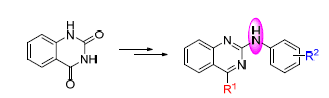
A series of 2-substituted aniline quinazoline derivatives were prepared with the starting material of quinazoline-2,4(1H,3H)-dione, and then followed by the reaction of chlorination, Suzuki reaction and nucleophilic substitution. The structures of target compounds were identified by 1H NMR, 13C NMR and HRMS. The preliminary biological evaluations were performed using thiazolyl blue tetrazolium bromide (MTT) method to test their antiproliferative activities against some tumor cell lines. The results suggest that some compounds have the abilities to inhibit the growth of Hela tumor cell lines, and most potent compounds 4u and 4v alsoexhibit good antiproliferative activities against A549 and MCF-7 tumor cell lines.
Key words: quinazoline derivatives; antitumor activity; synthesis
Pan Xiaole , Wang Lei , Dun Yanyan , Fang Hao . Synthesis and Antiproliferative Activity Studies on 2-Substitued Aniline Quinazoline Derivatives[J]. Chinese Journal of Organic Chemistry, 2016 , 36(5) : 1044 -1050 . DOI: 10.6023/cjoc201510018
[1] Jatav, V.; Mishra, P.; Kashaw, S. Eur. J. Med. Chem. 2008, 43, 1945.
[2] Goyal, M.; Sasmal, D. J. Ethnopharmacol. 2014, 151, 536.
[3] Smits, R. A.; Adami, M.; Istyastono, E. P. J. Med. Chem. 2010, 53, 2390.
[4] Jain, K. S.; Bariwal, J. B.; Kathiravan, M. K. Bioorg. Med. Chem. 2008, 16, 4759.
[5] Alagarsamy, V.; Pathak, U. S. Bioorg. Med. Chem. 2007, 15, 3457.
[6] Ismail, M. A.; Barker, S.; Abou El Ella, D. A. J. Med. Chem. 2006, 49, 1526.
[7] Verhaeghe, P.; Azas, N.; Gasquet, M. Bioorg. Med. Chem. Lett. 2008, 18, 396.
[8] Pandey, S. K.; Singh, A.; Singh, A. Eur. J. Med. Chem. 2009, 44, 1188.
[9] Grover, G.; Kini, S. G. Eur. J. Med. Chem. 2006, 41, 256.
[10] Maggio, B.; Daidone, G.; Raffa, D. Eur. J. Med. Chem. 2001, 36, 737.
[11] Li, D.-D.; Hou, Y.-P.; Wang, W. Curr. Med. Chem. 2012, 19, 871.
[12] Khan, I.; Ibrar, A.; Abbas, N.; Saeed, A. Eur. J. Med. Chem. 2014, 76, 193.
[13] Connolly, D. J.; Cusack, D.; O'sullivan, T. P. Tetrahedron. 2005, 61, 10153.
[14] Hwang, D.-F.; Shiu, Y.-C.; Hwang, P.-A. J. Food Prot. 2002, 65, 1341.
[15] Hwang, D.-F.; Hsieh, Y.-W.; Shiu, Y.-C. J. Food Prot. 2002, 65, 389.
[16] Pao, W.; Miller, V.; Zakowski, M. Proc. Natl. Acad. Sci. 2004, 101, 13306.
[17] Raymond, E.; Faivre, S.; Armand, J. P. Drugs 2000, 60, 15.
[18] Wells, S. A.; Robinson, B. G.; Gagel, R. F. J. Clin. Oncol. 2012, 30, 134.
[19] Backes, A.; Zech, B.; Felber, B. Expert Opin. Drug Discovery 2008, 12, 1409.
[20] Backes, A.; Zech, B.; Felber, B. Expert Opin. Drug Discovery 2008, 12, 1427.
[21] Mclaughlin, N. P.; Evans, P. J. Org. Chem. 2009, 75, 518.
[22] Asghar, U; Witkiewicz, A. K.; Turner, N. C. Nat. Rev. Drug Discovery 2015, 14, 130.
[23] Wang, J. H.; Wang, Q. D.; Dun, Y. Y. Chem. J. Chin. Univ. 2014, 35, 1189 (in Chinese).
(王军华, 王泉德, 顿艳艳, 高等学校化学学报, 2014, 35, 1189.)
[24] Sun, Z.; Wang, H.; Wen, K. J. Org. Chem. 2011, 76, 4149.
[25] Jiang, N.; Zhai, X.; Zhao, Y. Eur. J. Med. Chem. 2012, 54, 534.
[26] Harden, D. B. J. Org. Chem. 1988, 53(17), 4137.
/
| 〈 |
|
〉 |

