Chinese Journal of Organic Chemistry >
Synthesis and Antibacterial Activity Evaluation of (2-Chloroquinolin- 3-yl)methyleneamino Guanidine Derivatives
Received date: 2016-04-19
Revised date: 2016-05-31
Online published: 2016-06-08
Supported by
Project supported by the National Natural Science Foundation of China (No.21562028), and the Doctoral Foundation of Jinggangshan University (No.JZB1317).
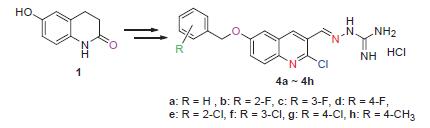
In order to find new antibacterial agent with wide spectra and high activities, 8 new (2-chloroquinolin-3-yl)meth- yleneamino guanidine derivatives were synthesized based on combination principles, whose structures were then identified by spectral methods. All of the compounds provided exhibited good inhibitory activities against the strains chosen, except Salmonella typhimurium 2421 and Pseudomonas aeruginosa 2742, of which MICs were mostly in the range of 2.0~16 μg/mL. The compound 4h showed the best broad-spectrum antibacterial activities, whose MIC value was 2.0 μg/mL against six strains. The inhibitory activities of 4h, against Staphylococcus aureus KCTC 503 and two drug-resistance bacterias (Methicillin-resistant Staphylococcus aureus CCARM 3167 and Quinolone-resistant Staphylococcus aureus CCARM 3505), were superior or equal to positive controls gatifloxacin, moxifloxacin, norfloxacin and oxacillin.
Gao Zhimin , Wang Tiantian , Li Shenzhen , Wan Huiqi , Wang Gang , Wu Yinbin , Deng Xianqing , Song Mingxia . Synthesis and Antibacterial Activity Evaluation of (2-Chloroquinolin- 3-yl)methyleneamino Guanidine Derivatives[J]. Chinese Journal of Organic Chemistry, 2016 , 36(10) : 2484 -2488 . DOI: 10.6023/cjoc201604041
[1] Livermore, D. M. J. Antimicrob. Chemother. 2009, 64(Suppl. 1), i29.
[2] Azeredo da Silveira, S.; Perez, A. Expert Rev. Anti-Infect. Ther. 2015, 13, 531.
[3] Hvistendahl, M. Science 2012, 336, 795.
[4] Yezli, S.; Li, H. Int. J. Antimicrob. Agents 2012, 40, 389.
[5] Xu, Z. Q.; Xu, Z. Y. Acta Pharmaceutica Sinica 2013, 48, 993(in Chinese). (徐泽奇, 徐泽宇, 药学学报, 2013, 48, 993.)
[6] Kofteridis, D. P.; Alexopoulou, C.; Valachis, A.; Maraki, S.; Dimopoulou, D.; Georgopoulos, D.; Samonis, G. Clin. Infect. Dis. 2010, 51, 1238.
[7] Velkov, T.; Thompson, P. E.; Nation, R. L.; Li, J. J. Med. Chem. 2010, 53, 1898.
[8] Thomas K. D.; Adhikari, A. V.; Telkar, S.; Chowdhury, I. H.; Mahmood, R.; Pal, N. K.; Row, G.; Sumesh, E. Eur. J. Med. Chem. 2011, 46, 5283.
[9] Eswaran, S.; Adhikari, A. V.; Shetty, N. S. Eur. J. Med. Chem. 2009, 44, 4637.
[10] Kategaonkar, A. H.; Shinde, P. V.; Kategaonkar, A. H.; Pasale, S. K.; Shingate, B. B.; Shangare, M. S. Eur. J. Med. Chem. 2010, 45, 3142.
[11] Lilienkampf, A.; Mao, J.; Wan, B.; Wang, Y.; Franzblau, S. G.; Kozikowski, A. P. J. Med. Chem. 2009, 52, 2109.
[12] Denny, W. A.; Wilson, W. R.; Ware, D. C.; Atwell, G. J.; Milbank, J. B.; Stevenson, R. J. WO 2002059122, 2002[Chem. Abstr. 2002, 137, 149339].
[13] Strekowski, L.; Mokrosz, J. L.; Honkan, V. A.; Czarny, A.; Cegla, M. T.; Patterson, S. E.; Wydra, R. L.; Schinazi, R. F. J. Med. Chem. 1991, 34, 1739.
[14] Nasveld, P.; Kitchener, S. Trans. R. Soc. Trop. Med. Hyg. 2005, 99, 2.
[15] Ferreira, E. G.; Wilke, D. V.; Jimenez, P. C.; de Oliveira, J. R.; Pessoa O. D.; Silveira, E. R.; Viana, F. A.; Pessoa, C.; de Moraes, M. O.; Hajdu, E.; Costa-Lotufo L. V. Chem. Biodiversity 2011, 8, 1433.
[16] Ren, S.; Wang, R.; Komatsu, K.; Bonaz-Krause, P.; Zyrianov, Y.; McKenna C. E.; Csipke C.; Tokes Z. A.; Lien E. J. J. Med. Chem. 2002, 45, 410.
[17] Mourer, M.; Dibama, H. M.; Fontanay, S.; Grare, M.; Duval, R. E.; Finance, C.; Regnouf-de-Vains, J. B. Bioorg. Med. Chem. 2009, 17, 5496.
[18] Guo, M.; Zheng, C.J.; Song, M.X.; Wu, Y.; Sun, L.P.; Li, Y.J.; Liu, Y.; Piao, H.R. Bioorg. Med. Chem. Lett. 2013, 23, 4358.
/
| 〈 |
|
〉 |