
Chinese Journal of Organic Chemistry >
Efficient Synthetic Approaches to Uric Acid Transporter 1 Inhibitors Bearing Alkoxyl Group-Substituted Triazoles
Received date: 2017-01-19
Revised date: 2017-02-22
Online published: 2017-03-17
Supported by
Project supported by the Key Projects of Tianjin Science and Technology Support Plan (No.16YFZCSY00910) and the Natural Science Foundation of Shandong Province (No.ZR2015BM028).
Uric acid transporter 1 (URAT1) inhibitors bearing alkoxy group-substituted triazoles 3-(4-(4-cyclopropylnaphthalen-1-yl)-5-methoxy-4H-1,2,4-triazol-3-yl)propanoic acid (1a) and 3-(4-(4-cyclopropylnaphthalen-1-yl)-5-ethoxy-4H-1,2,4-triazol-3-yl)propanoic acid (1b) are structurally interesting lead compounds in drug design. The current synthetic approach to them suffers from quite low overall yields (3.3% and 3.0% for 1a and 1b, respectively). In order to explore the structure-activity relationship (SAR) of 1a and 1b, synthetic approach with higher overall yield is urgently needed. In the present study, two efficient synthetic approaches to 1a and 1b were developed (approaches A and B), with CuCl-catalyzed nucleophilic aromatic substitution (SNAr) reaction of bromotriazole with sodium alkoxides and SNAr reaction of methylsulfonyltriazole with sodium alkoxides as key steps, and the conditions for important steps were fully optimized. The two synthetic approaches are characterized by dramatically higher yields, and not only valuable to the further SAR exploration of 1a and 1b but also very helpful to the synthesis of heterocycles with alkoxyl groups.
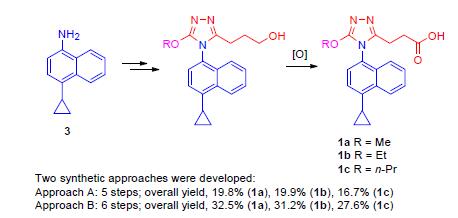
Key words: URAT1 inhibitor; gout; hyperuricemia; synthetic route; SNAr; CuCl catalysis
Tian He , Wu Jingwei , Liu Yuqiang , Xie Yafei , Wang Jianwu , Zhao Guilong . Efficient Synthetic Approaches to Uric Acid Transporter 1 Inhibitors Bearing Alkoxyl Group-Substituted Triazoles[J]. Chinese Journal of Organic Chemistry, 2017 , 37(7) : 1748 -1756 . DOI: 10.6023/cjoc201701038
[1] Richette, P.; Bardin T. Lancet 2010, 375, 318.
[2] Pillinger, M. H.; Rosenthal, P.; Abeles, A. M. Bull. NYU Hosp. Jt. Dis. 2007, 65, 215.
[3] Punzi, L.; Scanu, A.; Ramonda, R.; Oliviero, F. Autoimmun. Rev. 2012, 12, 66.
[4] Choi, H. K.; Mount, D. B.; Reginato, A. M. Ann. Intern. Med. 2005, 143, 499.
[5] Miao, Z.; Li, C.; Chen, Y.; Zhao, S.; Wang, Y.; Wang, Z.; Chen, X.; Xu, F.; Wang, F.; Sun, R.; Hu, J.; Song, W.; Yan, S.; Wang, C. J. Rheumatol. 2008, 35, 1859.
[6] Dubchak, N.; Falasca, G. F. Int. J. Nephrol. Renovasc. Dis. 2010, 3, 145.
[7] Enomoto, A.; Kimura, H.; Chairoungdua, A.; Shigeta, Y.; Jutabha, P.; Cha, S. H.; Hosoyamada, M.; Takeda, M.; Sekine, T.; Igarashi, T.; Matsuo, H.; Kikuchi, Y.; Oda, T.; Ichida, K.; Hosoya, T.; Shimokata, K.; Niwa, T.; Kanai, Y.; Endou, H. Nature 2002, 417, 447.
[8] Adams, J. U. Nat. Biotechnol. 2009, 27, 309.
[9] Hoy, S. M. Drugs 2016, 76, 509.
[10] Miner, J. N.; Tan, P. Ann. Rheum. Dis. 2013, 71, 446.
[11] Tian, H.; Liu, W.; Zhou, Z.; Shang, Q.; Liu, Y.; Xie, Y.; Liu, C.; Xu, W.; Tang, L.; Wang, J.; Zhao, G. Molecules 2016, 21, 1543.
[12] Zhao, M.; Li, J.; Mano, E.; Song, Z.; Tschaen, D. M.; Grabowski, E, J. J.; Reider, P. J. J. Org. Chem. 1999, 64, 2564.
[13] Hirata, K.; Kotoku, M.; Seki, N.; Maeba, T.; Maeda, K.; Hirashima, S.; Sakai, T.; Obika, S.; Hori, A.; Hase, Y.; Yamaguchi, T.; Katsuda, Y.; Hata, T.; Miyagawa, N.; Arita, K.; Nomura, Y.; Asahina, K.; Aratsu, Y.; Kamada, M.; Adachi, T.; Noguchi, M.; Doi, S.; Crowe, P.; Bradley, E.; Steensma, R.; Tao, H.; Fenn, M.; Babine, R.; Li, X.; Thacher, S.; Hashimoto, H.; Shiozaki, M. ACS Med. Chem. Lett. 2016, 7, 23.
[14] Ragan, J. A.; Makowski, T. W.; Castaldi, M. J.; Hill, P. D. Synthesis 1998, 1599.
[15] Bonanomi, G.; Braggio, S.; Capelli, A. M.; Checchia, A.; Di Fabio, R.; Marchioro, C.; Tarsi, L.; Tedesco, G.; Terreni, S.; Worby, A.; Heibreder, C.; Micheli, F. ChemMedChem 2010, 5, 705.
[16] Xie, M.; Tang, H.; Zhang, Y.; Guo, Z.; Guo, H.; Qu, G. Chin. J. Org. Chem. 2015, 35, 2589(in Chinese). (谢明胜, 唐浩鑫, 张一铭, 郭真, 郭海明, 渠桂荣, 有机化学, 2015, 35, 2589.)
[17] Fu, Y.; Zhao, X.; Hou, B. Chin. J. Org. Chem. 2016, 36, 1184(in Chinese). (傅颖, 赵兴玲, 侯博, 有机化学, 2016, 36, 1184.)
[18] Cai, W.; Liu, W.; Xie, Y.; Wu, J.; Liu, Y.; Liu, C.; Xu, W.; Tang, L.; Wang, J.; Zhao, G. Chem. Res. Chin. Univ. 2017, 33, 49.
[19] Reddy, T. R.; Li, C.; Guo, X.; Fischer, P. M.; Dekker, L. V. Bioorg. Med. Chem. 2014, 22, 5378.
[20] Colanceska-Ragenovic, K.; Dimova, V.; Kakurinov, V.; Gabor, D. M. J. Heterocycl. Chem. 2003, 40, 905.
[21] Kane, J. M.; Staeger, M. A.; Dalton, C. R.; Miller, F. P.; Dudley, M. W.; Ogden, A. M.; Kehne, J. H.; Ketteler, H. J.; McCloskey, T. C.; Senyah, Y.; Chmielewski, P. A.; Miller, J. A. J Med Chem. 1994, 37, 125.
[22] Ström, P.; Malmquist, J. J. Labelled Compd. Radiopharm. 2008, 51, 419.
[23] Liu, M.; Shi, D. J. Heterocycl. Chem. 2014, 51, E335.
[24] Huisgen, R.; Möbius, L.; Szeimies, G. Chem. Ber. 1965, 98, 1138.
/
| 〈 |
|
〉 |

