
Chinese Journal of Organic Chemistry >
Cooperation of Two Biosynthetic Gene Clusters in the Biosynthesis of New Anthracycline Polyketide
Received date: 2017-08-04
Revised date: 2017-09-01
Online published: 2017-09-26
Supported by
Project supported by the National Natural Science Foundation of China (No. 81373307) and the Science and Technology Comission Shanghai Municipality (No. 14XD1404500).
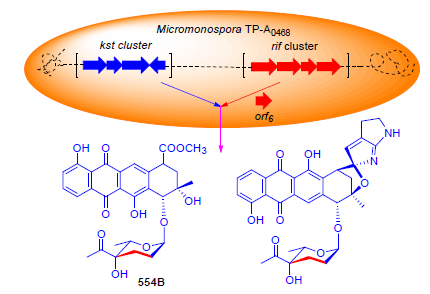
Micromonospora sp. TP-A0468 harbors multiple biosynthetic gene clusters encoding the biosynthesis of secondary metabolites, including kosinostatin (KST) and rifamycins. In our study on the biosynthesis of KST, a new anthracycline polyketide 554B was isolated from the kstB1 deletion mutant △kstB1 and identified as shunt product of KST pathway bearing 4-acetyl-2,3,6-deoxyhexosyl moiety. The unexpected elimination of C-3' hydroxyl suggests a 3,4-dehydratase involved in the biosynthesis of 554B, of which the encoding gene was proposed to located beyond the kst gene cluster. Bioinformatic analysis revealed orf6 of rifamycin biosynthetic gene cluster (rif) was the candidate of required 3,4-dehydratase gene. Deletion of orf6 abolished the production of 554B, confirming the involvement of orf6 in the biosynthesis of 554B. Our study attributed orf6 to the origin of 2,3,6-deoxyhexosyl and unveiled the cooperation between biosynthetic gene clusters in Micromonospora sp. TP-A0468.
Zhou Hongyang , Luo Guangcai , Zhang Zhuan , Zhou Qiang , Zhai Xin , Tang Gong-Li . Cooperation of Two Biosynthetic Gene Clusters in the Biosynthesis of New Anthracycline Polyketide[J]. Chinese Journal of Organic Chemistry, 2017 , 37(12) : 3262 -3266 . DOI: 10.6023/cjoc201708007
[1] Weiss, R. B. Semin Oncol. 1992, 19, 670.
[2] Batist, G. Cancer Chemother. Biol. Response Modif. 2001, 19, 47.
[3] Metsä-Ketelä, M.; Niemi, J.; Mäntsälä, P.; Schneider, G. Anthracycline Chemistry and Biology I, Springer Berlin Heidelberg, 2007, 101.
[4] Salas, J. A.; Méndez, C. Trends Microbiol. 2007, 15, 219.
[5] Minotti, G.; Menna, P.; Salvatorelli, E.; Cairo, G.; Gianni, L. Pharmacol. Rev. 2004, 56, 185.
[6] Madduri, K.; Kennedy, J.; Rivola, G.; Inventi-Solari, A.; Filippini, S.; Zanuso, G.; Colombo, A. L.; Gewain, K. M.; Occi, J. L.; MacNeil, D. J.; Hutchinson, C. R. Nat. Biotechnol. 1998, 16, 69.
[7] Zhang, Z.; Gong, Y. K.; Zhou, Q.; Hu, Y.; Ma, H. M.; Chen, Y. S.; Igarashi, Y.; Pan, L. F.; Tang, G. L. Proc. Natl. Acad. Sci. U. S. A. 2017, 114, 1554.
[8] Hong, L.; Zhao, Z.; Liu, H. J. Am. Chem. Soc. 2006, 128, 14262.
[9] (Li, H.; Zhou, Q.; Tang, Y. M.; Zhao, S. Y.; Tang, G. L. Chin. J. Org. Chem. 2013, 33, 1326(in Chinese). (李慧, 周强, 唐玉敏, 赵圣印, 唐功利, 有机化学, 2013, 33, 1326.)
[10] Furumai, T.; Igarashi, Y.; Higuchi, H.; Saito, N.; Oki, T. J. Antibiot. (Tokyo) 2002, 55, 128.
[11] Ma, H. M.; Zhou, Q.; Tang, Y. M.; Zhang, Z.; Chen, Y. S.; He, H. Y.; Pan, H. X.; Tang, M. C.; Gao, J. F.; Zhao, S. Y.; Igarashi, Y.; Tang, G. L. Chem. Biol. 2013, 20, 796.
[12] Balado, M.; Souto, A.; Vences, A.; Careaga, V. P.; Valderrama, K.; Segade, Y.; Rodríguez, J.; Osorio, C. R.; Jime?nez, C.; Lemos, M. L. ACS Chem. Biol. 2015, 10, 2850.
[13] Bosello, M.; Robbel, L.; Linne, U.; Xie, X.; Marahiel, M. A. J. Am. Chem. Soc. 2011, 133, 4587.
[14] Lazos, O.; Tosin, Z.; Slusarczyk, A. L.; Boakes, S.; Cortés, J.; Sidebottom, P. J.; Leadlay, P. F. Chem. Biol. 2010, 17, 160.
/
| 〈 |
|
〉 |

