Chinese Journal of Organic Chemistry >
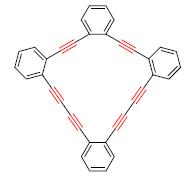
Synthesis of Cyclic Phenyl Polyynes: Ph2P-Deprotection/Intramolecular Eglington Coupling Cyclization
Received date: 2017-08-07
Revised date: 2017-09-28
Online published: 2017-10-20
Supported by
Project supported by the General Project of Hunan Education Department (No. 17C0629), the Doctoral Foundation of Hunan University of Science and Technology (No. E51693), the Open Foundation of Key Laboratory of Theoretical Organic Chemistry and Functional Molecule of Ministry of Education, Hunan University of Science and Technology (No. E21630) and the National Natural Science Foundation of China (No. 21402048).
Ph2P (O)-deprotection/intramolecular Eglington coupling cyclization, proceeding in one-pot manner, can be applied to synthesize cyclic phenyl polyynes. Compared to Micheal M. Haley's stepwise desilylation/Eglington coupling reaction, the polar Ph2P (O) protecting group enabled facile seperation of product from remaining starting compound for their different polarity, and it also led to easy separation of target compound because the amont of by-products which showed similar Rf to target compound decreased. Furthermore, our one-pot reaction, avoiding the workup after Ph2P (O)-deprotection and reducing losses of materials, increased the yield of cyclic aromatic polyynes. This method showed some other outstanding features including easy synthesis of intermediates and mild reaction conditions.
Peng Lifen , Zhang Siwei , Wang Binghao , Xun Mengshuo , Tang Zilong , Jiao Yinchun , Xu Xinhua . Synthesis of Cyclic Phenyl Polyynes: Ph2P-Deprotection/Intramolecular Eglington Coupling Cyclization[J]. Chinese Journal of Organic Chemistry, 2018 , 38(2) : 519 -525 . DOI: 10.6023/cjoc201708011
[1] Diederich, F.; Stang, P. J.; Tykwinski, R. R. Acetylene Chemistry, Willey-VCH Verlag GmbH & CO. KgaA, Weinheim, 2005.
[2] Fischer, M.; Lieser, G.; Rapp, A.; Schnell, I.; Mamdouh, W.; Feyter, S. D.; Schryver, F. C.; Höger, S. J. Am. Chem. Soc. 2004, 126, 214.
[3] Wan, W. B.; Brand, S. C.; Pak, J. J.; Haley, M. M. Chem. -Eur. J. 2005, 6, 2044.
[4] Zhou, Q.; Carroll, P. J.; Swager, T. M. J. Org. Chem. 1994, 59, 1294.
[5] (a) Glaser, C. Chem. Ber. 1869, 2, 422.
(b) Hay, A. S. J. Org. Chem. 1962, 27, 3320.
(c) Eglinton, G.; McRae, W. Adv. Org. Chem. 1963, 4, 225.
(d) Vögtle, F.; Berscheid, R. Synthesis 1992, 58.
[6] Haley, M. M.; Bell, M. L.; English, J. J.; Johnson, C. A.; Weakley, T. J. R. J. Am. Chem. Soc. 1997, 119, 2956.
[7] Orita, A.; Taniguchi, H.; Otera, J. Chem. -Asian J. 2006, 1, 430.
[8] Peng, L. -F.; Xu, F.; Suzuma, Y.; Orita, A.; Otera, J. J. Org. Chem. 2013, 78, 12802.
[9] (a) Eglinton, G.; Galbraith, A. R. Chem. Ind. 1956, 737.
(b) Behr, O. M.; Eglinton, G.; Galbraith, A. R.; Raphael. R. A. J. Chem. Soc. 1960, 3614.
(c) Altmann, M.; Friedrich, J.; Beer, F.; Reuter, R.; Enkelmann, V.; Bunz, U. H. F. J. Am. Chem. Soc. 1997, 119, 1472.
[10] Orita, A.; Miyamoto, K.; Nakashima, M.; Ye, F. -G.; Otera, J. Adv. Synth. Catal. 2004, 346, 767.
[11] Peng, L. -F.; Xu, F.; Shinohara, K.; Orita, A.; Otera, J. Chem. Lett. 2014, 43, 1610.
/
| 〈 |
|
〉 |