
Chinese Journal of Organic Chemistry >
Synthesis and Polymerization of Optically Active Epoxides with Diazafluorenyl Substituent
Received date: 2017-08-24
Revised date: 2017-09-17
Online published: 2017-10-20
Supported by
Project supported by the National Science Foundation of China (Nos. 11305086, 11375084) and the Science Foundation of Hunan Province (No. 14JJ6021).
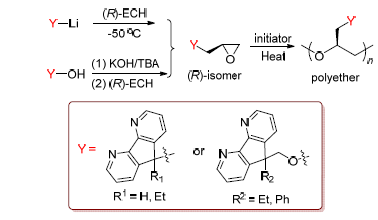
4,5-Diazafluoren-9-one (2), 4,5-diazafluorene (3) and 9-methylene-4,5-diazafluorene (5) were prepared by 1,10-Phenanthroline (1) as starting material. Using n-butyllithium to react with 3 (or using methyllithium to react with 5), the corresponding organic lithium salts could be given, and then, the optically active epichlorohydrin (ECH, ee>98%) was added dropwise at -50 ℃, according to regular treatment, the optically pure terminal epoxides (4 and 6) with diazafluorenyl substituent were obtained. The ee values of epoxides are larger than 98%. Using ethylmagnesium bromide (or phenylmagnesium bromide) to react with 2 in the presence of potassium hydroxide and tetrabutylammonium bromide, the corresponding substituted epoxy compounds (8a and 8b) were produced. The ee values of epoxides (8a and 8b) are larger than 97%. The epoxides (4, 6, 8a and 8b) were polymerized using KOH as an initiator and the polyethers with narrow molecular weight distributions (Mw/Mn=1.04 to 1.10) were obtained. The products were analyzed by NMR, elemental analysis and GPC.
Key words: epoxide; chirality; asymmetric synthesis; polymerization
Sun Yunkai , Zhang Jin , Liu Huijun , Wang Xiaofeng . Synthesis and Polymerization of Optically Active Epoxides with Diazafluorenyl Substituent[J]. Chinese Journal of Organic Chemistry, 2018 , 38(1) : 253 -258 . DOI: 10.6023/cjoc201708052
[1] Rao, A. S.; Paknikar, S. K.; Kirtane, J. G. Tetrahedron 1983, 39, 2323.
[2] Chai, F. L.; Wang, X. Y.; Tao, J. C. Prog. Chem. 2008, 20, 300(in Chinese). (柴凤兰, 王向宇, 陶京朝, 化学进展, 2008, 20, 300.)
[3] Wang, L. L.; Chen, Z.; Liu, W. E.; Ke, H.; Wang, S. H.; Jiang, W. J. Am. Chem. Soc. 2017, 139, 8436.
[4] Schrittwieser, J. H.; Lavandera, I.; Seisser, B.; Mautner, B.; Spelberg, J. H. L.; Kroutil, W. Tetrahedron:Asymmetry 2009, 20, 4833.
[5] Burke, C. P.; Shi, Y. A. J. Org. Chem. 2007, 72, 4093.
[6] Cao, J.; Yang, N. F.; Wang, P. D.; Yang, L. W. Polym. Int. 2008, 57, 530.
[7] Sun, Y. K.; Yang, N. F.; Liu, J.; Cao, J.; Gong, H. Polymer 2010, 51, 5712.
[8] Huang, C. W.; Yang, N. F.; Zhang, A. L.; Yang, L. W. Polymer 2012, 53, 3514.
[9] Xie, X. Q.; Garg, A.; Khosla, C.; Cane, D. E. J. Am. Chem. Soc. 2017, 139, 3283.
[10] Zhang, A. L.; Yu, Z. D.; Yang, L. W.; Yang, N. F.; Peng, D. J. Mol. Catal. A:Chem. 2015, 398, 407.
[11] Zhang, A. L.; Yu, Z. D.; Yang, L. W.; Yang, N. F. Tetrahedron:Asymmetry 2015, 26, 173.
[12] Sun, Y. K.; Zhang, J.; Cao, J.; Ouyang, K. B.; Yang, N. F. Acta Chim. Sinica 2010, 68, 2086(in Chinese). (孙允凯, 张劲, 曹靖, 欧阳昆冰, 阳年发, 化学学报, 2010, 68, 2086.)
[13] Plater, M. J.; Kemp, S.; Lattmann, E. J. Chem. Soc., Perkin Trans. 1 2000, 6, 971.
/
| 〈 |
|
〉 |

