
Chinese Journal of Organic Chemistry >
Lead Optimization and Antiproliferative Activity Using a New Dithiocarbamates Substructure
Received date: 2018-01-02
Revised date: 2018-03-15
Online published: 2018-04-13
Supported by
Project supported by the National Natural Science Foundation of China (No. 201502063) and the Natural Science Foundation of Hubei Province (No. 2016CFB562).
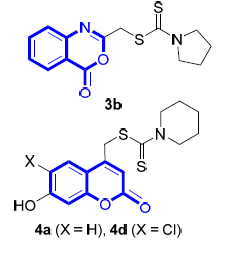
In this work, a series of dithiocarbamate derivatives bearing diverse quinazolinones, benzoxazinones, and coumarin moieties were designed and synthesized via a one-pot three-component reaction. These compounds produced good yields and functioned quickly under mild conditions, and the desired products were readily isolated. Their in vitro antitumor activities were evaluated by the methyl thiazolyl tetrazolium (MTT) method against hepatoma carcinoma cells HCCLM-7, cervical carcinoma cells Hela, mammary adenocarcinoma cells MDA-MB-435S, colon carcinoma cells SW-480, laryngocarcinoma cells Hep-2, and mammary adenocarcinoma cells MCF-7. 3 compounds were identified as the most promising candidates, due to their high potency and broad-spectrum antiproliferative activity (IC50:3.5~13.5 μmol·L-1). The activities of some lead compounds were more than 10-fold more potent than that of positive control 5-fluorouracil (5-FU) (IC50:8.1~128.7 μmol·L-1). These results indicated that the dithiocarbamate (DTC) derivatives bearing fused heterocyclic moieties could be used as lead for further developing new antitumor active compounds.
Key words: dithiocarbamate; quinazolinone; benzoxazinone; coumarin; antiproliferative activity
Sun Haiyan , Sun Hongshun , Liu Mingzhen , Huang Wei , Yang Guangfu . Lead Optimization and Antiproliferative Activity Using a New Dithiocarbamates Substructure[J]. Chinese Journal of Organic Chemistry, 2018 , 38(8) : 2067 -2075 . DOI: 10.6023/cjoc201801001
[1] Li, R.-D.; Wang, Y.-Q.; Ge, Z.-M.; Li, R.-T. Chin. J. Org. Chem. 2015, 35, 1805(in Chinese). (李日东, 王元强, 葛泽梅, 李润涛有机化学, 2015, 35, 1805.)
[2] Bala, V.; Gupta, G.; Sharma, V. L. Mini-Rev. Med. Chem. 2014, 14, 1021.
[3] Room, R.; Babor, T.; Rehm, J. Lancet 2005, 365, 519.
[4] Sauna, Z. E.; Shukla, S.; Ambudkar, S. V. Mol. Biosyst. 2005, 1, 127.
[5] Schenk, H.; Klein, M.; Erdbrügger, W.; Dröge, W.; Schul-ze-Osthoff, K. Proc. Natl. Acad. Sci. U. S. A. 1994, 91, 1672.
[6] Gaudernak, E.; Seipelt, J.; Triendl, A.; Grassauer, A.; Kuechler, E. J. Virol. 2002, 76, 6004.
[7] Kraljevic, T. G.; Harej, A.; Sedic, M.; Pavelic, S. K.; Stepanic, V.; Drenjancevic, D.; Talapko, J.; Raic-Malic, S. Eur. J. Med. Chem. 2016, 124, 794.
[8] Mo, S.; Ding, Y.; Zhang, G.; Zhang, Z.; Shao, X.-B.; Li, Q.-Y.; Yang, X.-J.; Chen, F. Chin. J. Org. Chem. 2017, 37, 1000(in Chinese). (莫松, 丁勇, 张刚, 张震, 杓学蓓, 李清寒, 杨学军, 陈峰, 有机化学, 2017, 37, 1000.)
[9] (a) Fu, D. J.; Zhang, S. Y.; Liu, Y. C.; Zhang, L.; Liu, J. J.; Song, J.; Zhao, R. H.; Li, F.; Sun H. H.; Liu, H. M.; Zhang, Y. B. Bioorg. Med. Chem. Lett. 2016, 26, 3918.
(b) Ding, P. P.; Gao, M.; Mao, B. B.; Cao, S. L.; Liu, C. H.; Yang, C. R.; Li, Z. F.; Liao, J.; Zhao, H. C.; Li, Z. Eur. J. Med. Chem. 2016, 108, 364.
(c) Fu, D. J.; Zhang, L.; Song, J.; Mao, R. W.; Zhao, R. H.; Liu, Y. C.; Hou, Y. H.; Li, J. H.; Yang J. J.; Jin, C. Y.; Li, P.; Zi, X. L.; Liu, H. M.; Zhang, S. Y.; Zhang, Y. B. Eur. J. Med. Chem. 2017, 127, 87.
(d) Jian, F.-F.; Xu, L.-Z.; Wen, L.-R.; Zhu, C.-Y. Chin. J. Org. Chem. 2005, 25, 423(in Chinese). (建方方, 许良忠, 文丽荣, 朱崇毅, 有机化学, 2005, 25, 423.)
[10] Carta, F.; Aggarwal, M.; Maresca, A.; Scozzafava, A.; McKenna, R.; Masini, E.; Supuran, C. T. J. Med. Chem. 2012, 55, 1721.
[11] Qian, Y.; Ma, G. Y.; Yang, Y.; Chen, K.; Zheng, Q. Z.; Mao, W. J.; Shi, L.; Zhao, J.; Zhu, H. L. Bioorg. Med. Chem. 2010, 18, 4310.
[12] Zheng, Y. C.; Duan, Y. C.; Ma, J. L.; Xu, R. M.; Zi, X.; Lv, W. L.; Wang, M. M.; Ye, X. W.; Zhu, S.; Mobley, D.; Zhu, Y. Y.; Wang, J. W.; Li, J. F.; Wang, Z. R.; Zhao, W.; Liu, H. M. J. Med. Chem. 2013, 56, 8543.
[13] Li, R. D.; Zhang, X.; Li, Q. Y.; Ge, Z. M.; Li, R. Bioorg. Med. Chem. Lett. 2011, 21, 3637.
[14] Zheng, Y. C.; Wang, L. Z.; Zhao, L. J.; Zhao, L. J.; Zhan, Q. N.; Ma, J. L.; Zhang, B.; Wang, M. M.; Wang, Z. R.; Li, J. F.; Liu, Y.; Chen, Z. S.; Shen, D. D.; Liu, X. Q.; Ren, M.; Lv, W. L.; Zhao, W.; Duan, Y. C.; Liu, H. M. Cell. Physiol. Biochem. 2016, 38, 185.
[15] Kamal, A.; Sathish. M., N ayak, V. L.; Srinivasulu, V.; Kavitha, B.; Tangella, Y.; Thummuri, D.; Bagul, C.; Shankaraiah, N., N agesh, N. Bioorg. Med. Chem. 2015, 23, 5511.
[16] Gaspari, P.; Banerjee, T.; Malachowski, W. P.; Muller, A. J.; Prendergast, G. C.; DuHadaway, J.; Bennett, S.; Donovan, A. M. J. Med. Chem. 2006, 49, 684.
[17] Buac, D.; Schmitt, S.; Ventro, G.; Kona, F. R.; Dou, Q. P. Mini-Rev. in Med. Chem. 2012, 12, 1193.
[18] Khan, I.; Zaib, S.; Batool, S.; Abbas, N.; Ashraf Z.; Iqbal, J.; Saeed, A. Bioorg. Med. Chem. 2016, 24, 2361.
[19] Macías, F. A.; Marín, D.; Oliveros-Bastidas, A.; Molinillo, J. M. Nat. Prod. Rep. 2009, 26, 478.
[20] Medina, F. G.; Marrero, J. G.; Macías-Alonso, M.; González, M. C.; Córdova-Guerrero, I.; Teissier García, A. G.; Osegueda-Robles, S. Nat. Prod. Rep. 2015, 32, 1472.
[21] Sandhu, S.; Bansal, Y.; Silakari, O.; Bansal, G. Bioorg. Med. Chem. 2014, 22, 3806.
[22] Huang, W.; Ding, Y.; Miao, Y.; Yang, G. F. Eur. J. Med. Chem. 2009, 44, 3687.
[23] Huang, W.; Chen, Q.; Yang, W. C.; Yang, G. F. Eur. J. Med. Chem. 2013, 66, 161.
[24] Huang, W.; Liu, M. Z.; Li, Y.; Tan, Y.; Yang, G. F. Bioorg. Med. Chem. 2007, 15, 5191.
[25] Liu, G.; Song, B. A.; Sang, W. J.; Yang, S.; Jin, L. H.; Ding, X. Chin. J. Org. Chem. 2004, 24, 1296(in Chinese). (刘刚, 宋宝安, 桑维钧, 杨松, 金林红, 丁雄, 有机化学, 2004, 24, 1296.)
[26] Clemence, F.; Le Martret, O.; Collard, J. J. Heterocycl. Chem. 1984, 21, 1345.
[27] Leonetti, F.; Favia, A.; Rao, A.; Aliano, R.; Paluszcak, A.; Hartmann, R. W.; Carotti, A. J. Med. Chem. 2004, 27, 6792.
[28] Li, R. T.; Cai, M. S. Synth. Commun. 1998, 28, 295.
[29] (a) Full crystallographic details has been deposited at the Cambridge Crystallographic Data Center and allocated the deposition number CCDC 715987(2h).
(b) Sheldrick, G. M. SHELXTL (Version 5. 0), University of Gottingen, Germany, 2001.
(c) Bruker SMART V5.628, SAINT V6.45. & SADABS Bruker AXS Inc., Madison, Wisconsin, USA, 2001.
[30] Mosmann, T. J. Immunol. Methods 1983, 65, 55.
/
| 〈 |
|
〉 |

