
Chinese Journal of Organic Chemistry >
Synthesis and Antitumor Evaluation of 2,4-Substituted Quinazoline Derivatives Containing Benzimidazole
Received date: 2018-04-10
Revised date: 2018-05-04
Online published: 2018-06-06
Supported by
Project supported by the National Natural Science Foundation of China (No. 81430085), the Natural Science Foundation of Henan Province (No. 182300410321) and the Technology Department Project of Henan Province (No. 182102310249).
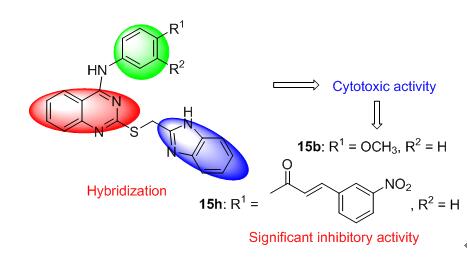
In order to find more efficient and economical antitumor drugs, a series of novel 2,4-substituted quinazoline derivatives containing benzimidazole were designed, synthesized and evaluated for their antitumor activities on two human tumor cell lines including human gastric cancer cells (MGC-803), human breast cancer cells (MCF-7) and the normal human gastric epithelial cell line (GES-1) by using thiazolyl blue tetrazolium bromide (MTT) assay in vitro. Among all the tested compounds, some compounds displayed moderate to potent antitumor activities against MGC-803 and MCF-7. When the 4-position of quinazoline was substituted by different aromatic amines, 2-(((1H-benzo[d]imidazol-2-yl)methyl)thio)-N-(4-methoxyphen-yl)quinazolin-4-amine (15e) had good anti-tumor activity against MGC-803 with IC50 value of 4.60 μmol·L-1. When the 4-position of quinazoline was replaced by different chalcone, (E)-1-(4-((2-(((1H-benzo[d]imidazol-2-yl)methyl)thio)quinazo-lin-4-yl)amino)phenyl)-3-(3-nitrophenyl)prop-2-en-1-one (15k) had a strong anti-tumor activity against MGC-803 with IC50 value of 0.97 μmol·L-1, which was significantly better than compound 15e. However, the toxicity of compound 15e was more serious than compound 15k whose toxicity was similar to that of the control drug 5-fluorouracil and gefitinib against GES-1. The result of docking with epidermal growth factor receptor (EGFR) suggested that the binding mode of 15k was better than that of 15e. It is believed that this work would be very useful for developing a new series of EGFR inhibitors.
Key words: quinazoline; benzimidazole; synthesis; antitumor activities
Li Na , Xin Jingchao , Meng Yaqi , Li Erdong , Ma Qisheng , Bao Chongnan , Yang Peng , Song Panpan , Cui Fei , Zhao Peirong , Li Wen , Ke Yu , Zhang Qiurong , Liu Hongmin . Synthesis and Antitumor Evaluation of 2,4-Substituted Quinazoline Derivatives Containing Benzimidazole[J]. Chinese Journal of Organic Chemistry, 2018 , 38(10) : 2673 -2679 . DOI: 10.6023/cjoc201804016
[1] Siegel, R. L.; Fedewa, S. A.; Miller, K. D.; Goding-Sauer, A.; Pinheiro, P. S.; Martinez-Tyson, D.; Jemal, A. Ca-Cancer J. Clin. 2015, 65, 457.
[2] Jemal, A.; Siegel, R.; Ward, E.; Murray, T.; Xu, J.; Thun, M. J. Ca-Cancer J. Clin. 2007, 57, 43.
[3] Creixell, M.; Peppas, N. A. Nano Today 2012, 7, 367.
[4] Loomis, D.; Huang, W.; Chen, G. Chin. J. Cancer 2014, 34, 189.
[5] Yang, S.; Li; Z.; Jin, L. H.; Song, B. A.; Liu, G.; Chen, J.; Chen, Z.; Hu, D. Y.; Xue, W.; Xu, R. Q. Bioorg. Med. Chem. Lett. 2007, 17, 2193.
[6] Zhang, H. Z.; Damu, Guri, L. V.; Cai, G. X.; Zhou, C. H. Eur. J. Med. Chem. 2013, 64, 329.
[7] Janmaat, N. L.; Giaccone, G. Oncologist 2003, 576.
[8] He, J. B.; Wang, X. G.; Zhao, X. Q; Liang, Y. J.; He, H. W.; Fu, L. W. Eur. J. Med. Chem. 2012, 54, 925.
[9] Chao, B.; Li, B. X.; Xiao, X. Bioorg. Med. Chem. Lett. 2017, 27, 3107.
[10] Khurana, L.; Ali, H. I.; Olszewska, T.; Ahn, K. H.; Damaraju, A.; Kendall, D. A.; Lu, D. J. Med. Chem. 2014, 57, 3070.
[11] Cui, M. T.; Jiang, L.; Goto, M.; Hsu, P. L.; Li, L. N.; Zhang, Q.; Wei, L.; Yuan, S. J.; Hamel, E.; Morris-Natschke, S. L. J.Med. Chem. 2017, 60, 5586.
[12] Wu, J. Z.; Li, J. L.; Cai, Y. P.; Pan, Y.; Ye, F. Q.; Zhang, Y. L.; Zhao, Y. J.; Yang, S. L.; Li, X. K.; Liang, G. . Med. Chem. 2011, 54, 8110.
[13] Wu, X. Q.; Li, M.; Tang, W. H.; Zheng, Y. G.; Lian, J. Q.; Xu, L.; Ji, M. Chem. Biol. Drug Design 2011, 78, 932.
[14] Refaat, H. M. Eur. J. Med. Chem. 2010, 45, 2949.
[15] Liu, F.; Huang, Y. Pestic. Biochem. Physiol. 2011, 101, 248.
[16] Raju, B.; Rao, R. N.; Suman, P.; Yogeeswari, P.; Sriram, D.; Shaik, T. B.; Kalivendi, S. V. Bioorg. Med. Chem. Lett. 2012, 22, 500.
[17] Pan, X. L.; Wang, L.; Dun, Y. Y..; Fang, H. Chin. J. Org. Chem. 2016, 36, 1044(in Chinese). (潘晓乐, 王磊, 顿艳艳, 方浩, 有机化学, 2016, 36, 1044.)
[18] Zhang, Y.; Lv, M. J..; Zhang, Y. L..; Chen, L.; Wang, W.; Li, B. L. Chin. J. Org. Chem. 2017, 37, 1787(in Chinese). (张颖, 吕梦娇, 张娅玲, 陈丽, 王伟, 李宝林, 有机化学, 2017, 37, 1787.)
[19] Yang, L. M.; Lin, S. J.; Hsu, F. L.; Yang, T. H. Bioorg. Med. Chem. 2002, 12, 1013.
[20] Sahay, I. I.; Ghalsasi, P. S. Synth. Commun. 2017, 47, 825.
[21] Chou, S.; Yin, W.; Chung, Y.; Chang, L.; Liu, C.; Chen, S.; Shih, K. Org. Process Res. Dev. 2002, 6, 273.
[22] Horowitz, D.; King, A. G. J. Immunol. Methods 2000, 244, 49.
[23] Putnam, K. P.; Bombick, D. W.; Doolittle, D. J. Toxicol. in Vitro 2002, 16, 599.
/
| 〈 |
|
〉 |

