Chinese Journal of Organic Chemistry >
Syntheses and Photovoltaic Performance of Nitrogen-Containing Rigid Heterocycle Substituted Coumarin Sensitizing Dyes
Received date: 2018-05-02
Revised date: 2018-07-20
Online published: 2018-08-23
Supported by
Project supported by the National Natural Science Foundation of China (No. 21406202).
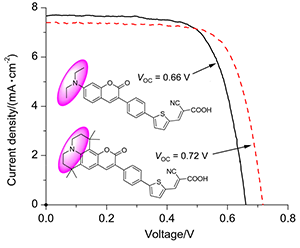
Two novel nitrogen-containing rigid heterocycle substituted coumarin sensitizing dyes were designed and synthesized with nitrogen-containing rigid heterocycle substituted coumarin as the electron donor, biphenyl or phenylthiophene as π bridge and cyanoacrylic acid as the electron acceptor. Their spectral properties, charge recombination rate and photovoltaic performance were compared with those of the corresponding diethylaminocoumarin sensitizing dyes. The results show that the incorporation of nitrogen-containing rigid heterocycle leads to the broadening of the absorption spectrum and the improvement of light-harvesting ability. In the dye with phenylthiophene as π bridge, the presence of nitrogen-containing rigid heterocycle distinctly weakens the molecular planarity, decreases the charge recombination rate and improves VOC. Therefore, among four coumarin sensitizing dyes, nitrogen-containing rigid heterocycle coumarin sensitizing dye with phenylthiophene π bridge exhibits the optimal photoelectric conversion efficiency 3.89% due to its better JSC, highest VOC and fill factor (ff).
Jiang Shaoliang , Liu Jie , Cui Yanhong , Wu Huabiao , Han Liang . Syntheses and Photovoltaic Performance of Nitrogen-Containing Rigid Heterocycle Substituted Coumarin Sensitizing Dyes[J]. Chinese Journal of Organic Chemistry, 2018 , 38(12) : 3219 -3226 . DOI: 10.6023/cjoc201805007
[1] Hussain, A.; Arif, S. M.; Aslam, M. Renewable Sustainable Energy Rev. 2017, 71, 12.
[2] Yamaguchi, M.; Yamada, H.; Katsumata, Y.; Lee, K. H.; Araki, K.; Kojima, N. J. Mater. Res. 2017, 32, 3445.
[3] Sugathan, V.; John, E.; Sudhakar, K. Renewable Sustainable Energy Rev. 2015, 52, 54.
[4] Kumavat, P. P.; Sonar, P.; Dalal, D. S. Renewable Sustainable Energy Rev. 2017, 78, 1262.
[5] Sharifi, N.; Tajabadi, F.; Taghavinia, N. ChemPhysChem 2014, 15, 3902.
[6] Gong, J. W.; Sumathy, K.; Qiao, Q. Q.; Zhou, Z. P. Renewable Sustainable Energy Rev. 2017, 68, 234.
[7] Al-Alwani, M. A. M.; Mohamad, A.; Ludin, N. A.; Kadhum, A. A. H.; Sopian, K. Renewable Sustainable Energy Rev. 2016, 65, 183.
[8] Sharma, S.; Siwach, B.; Ghoshal, S. K.; Mohan, D. Renewable Sustainable Energy Rev. 2017, 70, 529.
[9] Chawla P.; Tripathi, M. Int. J. Energy Res. 2015, 39, 1579.
[10] He, J. J.; Chen, S. X.; Wang, T. T.; Zeng, H. P. Chin. J. Org. Chem. 2012, 32, 472(in Chinese). (何俊杰, 陈舒欣, 王婷婷, 曾和平, 有机化学, 2012, 32, 472.)
[11] Housecroft, C. E.; Constable, E. C. Chem. Soc. Rev. 2015, 44, 8386.
[12] Jakubikova, E.; Bowman, D. N. Acc. Chem. Res. 2015, 48, 1441.
[13] Omae, I. Curr. Org. Chem. 2016, 20, 2848.
[14] Mahmood, A. Sol. Energy 2016, 123, 127.
[15] Wang, J. Y.; Liu, K.; Ma, L. C.; Zhan, X. W. Chem. Rev. 2016, 116, 14675.
[16] Zhong, C. J.; Gao, J. R.; Cui, Y. H.; Li, T.; Han, L. J. Power Sources 2015, 273, 831.
[17] Liu, Y.; He, J.; Han, L.; Gao, J. R. J. Photochem. Photobio., A 2017, 332, 283.
[18] Qian, X.; Yan R.; Xu, C.; Shao, L.; Li, H.; Hou, L. J. Power Sources 2016, 332, 103.
[19] Kim, S. H.; Sakong, C.; Chang, J. B.; Kim, B.; Ko, M. J.; Kim, D. H.; Hong, K. S.; Kim, J. P. Dyes Pigm. 2013, 97, 262.
[20] Huang, Z. S.; Meier, H.; Cao, D. R. J. Mater. Chem. C 2016, 4, 2404.
[21] Han, L.; Zhou, X.; Ye, Q.; Li, Y. J.; Gao, J. R. Chin. J. Org. Chem. 2013, 33, 1000(in Chinese). (韩亮, 周雪, 叶青, 李郁锦, 高建荣, 有机化学, 2013, 33, 1000.)
[22] Han, L.; Wu, H. B.; Cui, Y. H.; Zu, X. Y.; Ye, Q.; Gao, J. R. J. Photochem. Photobiol., A 2014, 290, 54.
[23] Han, L.; Kang, R.; Zu, X. Y.; Cui, X. H.; Gao, J. R. Photochem. Photobiol. Sci. 2015, 14, 2046.
[24] Liu, B.; Wang, R.; Mi, W. J.; Li, X. Y.; Yu, H. T. J. Mater. Chem. 2012, 22, 15379.
/
| 〈 |
|
〉 |