
Chinese Journal of Organic Chemistry >
Synthesis of Vicinal Trifluoromethanesulfonate Substituted Diaryliodonium Salts and Their Anti-bacterial Properties
Received date: 2018-08-31
Revised date: 2018-11-20
Online published: 2018-12-17
Supported by
Project supported by the National Natural Science Foundation of China (Nos. 21472213, 21772039), the National Key Research and Development Program (No. 2016YFA0200302), and by the Croucher Foundation (Hong Kong) in the Form of CAS-Croucher Foundation Joint Laboratory Grant.
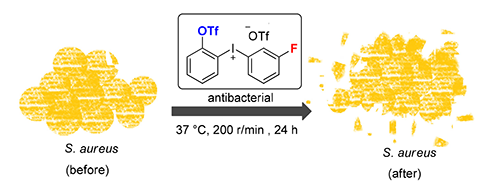
Diaryliodonium salts with fluorines have potential bioactivity. Vicinal trifluoromethanesulfonate substituted diaryliodonium salts were synthesized for the purpose of studying their anti-bacterial properties aganist Escherichia coli (E. coli), Staphylococcus aureus (S. aureus) and Bacillus subtilis (B. subtilis). Firstly, their chemical structures were characterized by 1H NMR, 13C NMR, 19F NMR and mass spectra. The minimum inhibitory concentration (MIC) of these compounds was tested by the micro-broth dilution method. The most active 2-((3-fluorophenyl)(((trifluoromethyl)sulfonyl)oxy)-l3-iodanyl)- phenyl trifluoromethanesulfonate (1) containing fluorine group gave the promising results for Escherichia coli (E. coli), Staphylococcus aureus (S. aureus) and Bacillus subtilis (B. subtilis) (MIC values of 16, 4 and 4 μg·mL-1), which is significantly lower than the commercial antibacterial agent of isothiazolinones. Scanning electron microscope (SEM) analysis sugggested that the compound led to the death of bacteria. Cytotoxicity tests showed that the compound 1 as well as isothiazolinones had a slight effect on the growth of Hela cells in vitro conditions.
Key words: diaryliodonium salts; anti-bacterial; Kathon; fluorine; trifluoromethanesulfonate
Cui Liyuan , Chen Huangguan , Ma Jingyi , Han Jianwei , Wang Limin . Synthesis of Vicinal Trifluoromethanesulfonate Substituted Diaryliodonium Salts and Their Anti-bacterial Properties[J]. Chinese Journal of Organic Chemistry, 2019 , 39(1) : 270 -276 . DOI: 10.6023/cjoc201808043
[1] Zhdankin, V. V.; Stang, P. J. Chem. Rev. 2008, 108, 5299.
[2] Chen, H.; Han, J.; Wang L. Angew. Chem., Int. Ed. 2018, 57, 12313.
[3] Zhang, Y.; Han, J.; Liu, Z.-J. RSC Adv. 2015, 5, 25485.
[4] Kuik, W.-J.; Kema, I. P.; Brouwers, A. H.; Zijlma, R.; Neumann, K. D.; Dierckx, R. A. J. O.; DiMagno, S. G.; Elsinga, P. H. J. Nucl. Med. 2015, 56, 106.
[5] DeSolms, S. J.; Woltersdorf, O. W., Jr.; Cragoe, E. J., Jr.; Watson, L. S.; Fanelli, G. M., Jr. J. Med. Chem. 1978, 215, 437.
[6] Das, P.; Etsuko T.; Tokunaga, H.; Akiyama, H.; Doi, H.; Saito, N.; Shibata, N. Beilstein J. Org. Chem. 2018, 14, 364.
[7] Goldstein, E. J. C.; Citron, D. M.; Warren, Y.; Merriam, C. V.; Tyrrell, K.; Fernandez, H.; Radhakrishnan, U.; Stang, P. J.; Conrads, G. Antimicrob. Agents Chemother. 2004, 48, 2766.
[8] Lu, J.; Risbood, P.; Kane, C. T., Jr.; Hossain, M. T.; Anderson, L.; Hill, K.; Monks, A.; Wu, Y.; Antony, S.; Juhasz, A.; Liu, H.; Jiang, G.; Harris, E.; Roy, K.; Meitzler, J. L.; Konaté, M.; Doroshow, J. H. Biochem. Pharmacol. 2017, 143, 25.
[9] Hui, F.; Debiemme-Chouvy, C. Biomacromolecules 2013, 14, 585.
[10] Dong, A.; Wang, Y.-J.; Gao, Y.; Gao, T.; Gao G. Chem. Rev. 2017, 117, 4806.
[11] Gottardi, W.; Debabov, D.; Nagl, M. Antimicrob. Agents Chemother. 2013, 57, 1107.
[12] Fang, G.; Li, W.; Shen, X.; Perez-Aguilar, J. M.; Chong, Y.; Gao, X..; Chai, Z.; Chen, C.; Ge, C.; Zhou, R. Nat. Commun. 2018, 9, 129.
[13] Hoque, J.; Akkapeddi, P.; Yarlagadda, V.; Uppu. D. S. S. M.; Kumar, P.; Haldar, J. Langmuir 2012, 28, 12225.
[14] Li, Y.-K.; Liu, B.; Zhang, L.-J.; Zhu, J.-H.; Wan, C.-P.; Mao, Z.-W. Chin. J. Org. Chem. 2018, 38, 949(in Chinese). (黎勇坤, 刘蓓, 张丽君, 朱加洪, 万春平, 毛泽伟, 有机化学, 2018, 38, 949.)
/
| 〈 |
|
〉 |

