
Chinese Journal of Organic Chemistry >
34a-Hydroxylation in Rifamycin Biosynthesis Catalyzed by Cytochrome P450 Encoded by rif-orf13
Received date: 2018-11-12
Revised date: 2018-12-06
Online published: 2018-12-17
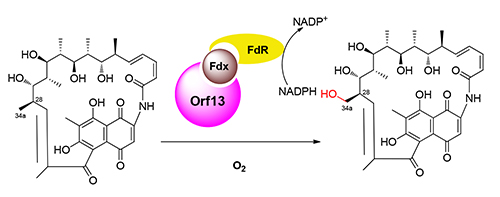
The biosynthetic pathway of rifamycins is still not completely deciphered after decades of study. For example, the gene responsible for the oxidative elimination of C34a is not identified. It was proposed that some cytochrome P450 is related to this essential biosynthetic step in the modification of rifamycin. Here, cytochrome P450 encoding genes rif-orf0, 4 and 13 from rifamycin biosynthetic gene cluster were heterologously expressed in Streptomyces lividans and fed with 16-demethyl-34a-deoxyrifamycin W (1). Compound 1 was completely converted into 16-demethylrifamycin W (2) in the strain harboring rif-orf13. His6-tagged Orf13 was prepared from E. coli BL21 (DE3) and characterized to be active cytochrome P450. Enzymatic assays demonstrated that compound 1 could be converted into 2 by Orf13 as in vivo. Therefore, we concluded that rif-orf13 is responsible for the hydroxylation on C34a in the biosynthesis of rifamycins. In addition, it's role in vivo could be functionally complemented by rif-orf5, which encoding another cytochrome P450 enzyme.
Key words: cytochrome P450; hydroxylation; rifamycin; rif-orf13
Zhou Qiangm , Luo Guang-Cai , Zhang Huizhan , Tang Gong-Li . 34a-Hydroxylation in Rifamycin Biosynthesis Catalyzed by Cytochrome P450 Encoded by rif-orf13[J]. Chinese Journal of Organic Chemistry, 2019 , 39(4) : 1169 -1174 . DOI: 10.6023/cjoc201811018
[1] Schupp, T.; Toupet, C.; Engel, N.; Goff, S. FEMS Microbiol. Lett. 1998, 159, 201.
[2] August, P. R.; Tang, L.; Yoon, Y. J.; Ning, S.; Muller, R.; Yu, T. W.; Taylor, M.; Hoffmann, D.; Kim, C. G.; Zhang, X.; Hutchinson, C. R.; Floss, H. G. Chem. Biol. 1998, 5, 69.
[3] Yu, T. W.; Shen, Y.; Doi-Katayama, Y.; Tang, L.; Park, C.; Moore, B. S.; Hutchinson, C. R.; Floss, H. G. Proc. Natl. Acad Sci. U. S. A. 1999, 96, 9051.
[4] Wilson, M. C.; Gulder, T. A.; Mahmud, T.; Moore, B. S. J. Am. Chem. Soc. 2010, 132, 12757.
[5] Xu, J.; Wan, E.; Kim, C. J.; Floss, H. G.; Mahmud, T. Microbiology 2005, 151, 2515.
[6] Xu, J.; Mahmud, T.; Floss, H. G. Arch. Biochem. Biophys. 2003, 411, 277.
[7] Yuan, H.; Zhao, W.; Zhong, Y.; Wang, J.; Qin, Z.; Ding, X.; Zhao, G. P. Acta Biochim. Biophys. Sin. (Shanghai) 2011, 43, 948.
[8] Qi, F.; Lei, C.; Li, F.; Zhang, X.; Wang, J.; Zhang, W.; Fan, Z.; Li, W.; Tang, G. L.; Xiao, Y.; Zhao, G.; Li, S. Nat. Commun. 2018, 9, 2342.
[9] Campbell, E. A.; Korzheva, N.; Mustaev, A.; Murakami, K.; Nair, S.; Goldfarb, A.; Darst, S. A. Cell 2001, 104, 901.
[10] Floss, H. G.; Yu, T. W. Chem. Rev. 2005, 105, 621.
[11] Lee, S. K.; Choi, C. Y.; Ahn, J. S.; Cho, J. Y.; Park, C. S.; Yoon, Y. J. J. Microbiol. Biotechnol. 2004, 14, 356.
[12] Zhou, Q.; Luo, G.-C.; Zhang, H.; Tang, G.-L. Appl. Environ. Microbiol. 2018, DOI:10.1128/AEM.02597-18.
[13] Omura, T.; Sato, R. J. Biol. Chem. 1964, 239, 2370.
[14] Cook, D. J.; Finnigan, J. D.; Cook, K.; Black, G. W.; Charnock, S. J. Adv. Protein Chem. Struct. Biol. 2016, 105, 105.
[15] Li, S.; Podust, L. M.; Sherman, D. H. J. Am. Chem. Soc. 2007, 129, 12940.
[16] Zhang, W.; Liu, Y.; Yan, J.; Cao, S.; Bai, F.; Yang, Y.; Huang, S.; Yao, L.; Anzai, Y.; Kato, F.; Podust, L. M.; Sherman, D. H.; Li, S. J. Am. Chem. Soc. 2014, 136, 3640.
[17] Kishi, T.; Yamana, H.; Muroi, M.; Harada, S.; Asai, M. J. Antibiot. (Tokyo) 1972, 25, 11.
/
| 〈 |
|
〉 |

