Chinese Journal of Organic Chemistry >
Recent Progress on Endoplasmic Reticulum-Targetable Small Organic Fluorescent Probes
Received date: 2018-10-18
Revised date: 2018-12-12
Online published: 2018-12-28
Supported by
Project supported by the National Natural Science Foundation of China (No.21272027).
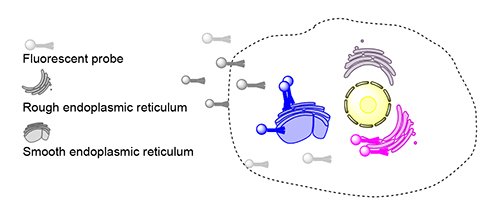
Endoplasmic reticulum (ER) is an important organelle in eukaryotic cells and participates in the synthesis and secretion of various proteins, glycogen, lipids, and cholesterol substances. It is surrounded by a single membrane in the cytoplasm, which is a three-dimensional mesh structure formed by flat cysts, membrane tubes, and bubbles. Research on the physiological morphology of ER can facilitate the resolution of certain metabolic diseases. Due to the good optical properties and outstanding specific localization, fluorescent probe technology has been widely used in structural investigation and activity tracking of organelles. The ER fluorescent probes can be divided into two types, one is a single functional ER localization probe, the other is a multi-functional ER probe, which has multiple functions of locating and detecting active species in ER, the morphology and environment of ER. In this article, the structure, function and biological application of ER fluorescent probes in recent years are summarized and reviewed. Various localization mechanisms of ER fluorescent probes are described. The development trend of ER fluorescent probes in life science research is prospected.
Zhang Shengxia, Niu Qingmina, Wu Songzeb, Lü Haijuana, Xing Guowen . Recent Progress on Endoplasmic Reticulum-Targetable Small Organic Fluorescent Probes[J]. Chinese Journal of Organic Chemistry, 2019 , 39(4) : 940 -951 . DOI: 10.6023/cjoc201810021
[1] Ling, Y.-P.; Yu, Z. Cellular Ultrastructure and Electron Microscope Technology-Fundamentals of Molecular Cell Biology, Fudan University Press, Shanghai, 2000, pp. 29~33(in Chinese). (凌诒萍, 俞彰主编, 细胞超微结构与电镜技术, 分子细胞生物学基础, 复旦大学出版社, 上海, 2000, pp. 29~33.)
[2] Liu, L.-Y. Cell Biology, Higher Education Press, Beijing, 2002, pp. 79~84(in Chinese). (刘凌云主编, 细胞生物学, 高等教育出版社, 北京, 2002, pp. 79~84.)
[3] Fang, H.; Shen, Z.-H. J. Med. Mol. Biol. 2004, 1, 36(in Chinese). (方欢, 申宗侯, 医学分子生物学杂志, 2004, 1, 36).
[4] Samali, A.; Fitzgerald, U.; Deegan, S.; Gupta, S. Int. J. Cell Biol. 2010, 830307.
[5] Chen, N.-Z.; Jiang, C.; Li, X.-K. Chin. Biotechnol. 2016, 36, 76(in Chinese). (陈娜子, 姜潮, 李校堃, 中国生物工程杂志, 2016, 36, 76.)
[6] (a) Li, N. Fluorescent Probe Application Technology, Military Medical Science Press, Beijing, 1998, pp. 11~13(in Chinese). (李楠, 荧光探针应用技术, 军事医学科学出版社, 北京, 1998, pp. 11~13.)
(b) Xie, Z.; Fu, M.; Yin, B.; Zhu, Q. Chin. J. Org. Chem. 2018, 38, 1364(in Chinese). (谢振达, 付曼琳, 尹彪, 朱勍, 有机化学, 2018, 38, 1364.)
[7] Terasaki, M.; Song, J.-D.; Wong, R. James.; Chen, L,-B. Cell 1984, 38, 101.
[8] Villa, A.; Caporizzo, E.; Papagni, A.; Miozzo, L.; Buttero, P.; Grilli, M.; Amboldi, N.; Fazio, F.; Doglia, S.; Giglioni, B. Eur. J. Cancer 2005, 41, 1453.
[9] Imai, T.; Hosokawa, M. J. Pestic. Sci. 2010, 35, 229.
[10] Hakamata, W.; Machida, A.; Oku, T.; Nishio, T. Bioorg. Med. Chem. Lett. 2011, 21, 3206.
[11] Zhang, H.; Fan, J.-L.; Dong, H.-J.; Zhang, S.-Z.; Xu, W.-Y.; Wang, J.-Y.; Gao, P.; Peng, X.-J. J. Mater. Chem. B 2013, 1, 5450.
[12] McDonald, L.; Liu, B.; Taraboletti, A.; Whiddon, K.; Shriver, L.; Konopka, M.; Liu, Q.; Pang, Y. J. Mater. Chem. B 2016, 4, 7902.
[13] Zhang, C.-J.; Cai, X.-L.; Xu, S.-D.; Zhan, R.-Y.;Wu J.-E.; Liu, B. Chem. Commun. 2017, 53, 10792.
[14] Phaniraj, S.; Gao, Z.; Rane, D.; Peterson, B. Dyes Pigm. 2016, 135, 127.
[15] Meinig, M.; Fu, L.-Q.; Peterson, B. Angew. Chem., Int. Ed. 2015, 54, 9696.
[16] Collot, M.; Kreder, R.; Tatarets, A.; Patsenker, L.; Melya, Y.; Klymchenko, A. Chem. Commun. 2015, 51, 17136.
[17] Kamkaew, A.; Thavornpradit, S.; Puangsamlee, T.; Xin, D.-Y.; Wanichachevab, N.; Burgess, K. Org. Biomol. Chem. 2015, 13, 8271.
[18] Anjog, T.; Kim, G.; Jang, H.-Y.; Yoon, J.; Kim, J. New J. Chem. 2017, 41, 377.
[19] Lee, H.-W.; Cho, M.-K.; Kim, H.-R.; Lim, C.-S.; Kang, C.; Kim, H.-M. Chem. Commun. 2017, 53, 6097.
[20] Chatterjee, A.; Guo, J.; Lee, H.; Schultz, P. J. Am. Chem. Soc. 2013, 135, 12540.
[21] Takeda, A. Brain Res. Rev. 2000, 34, 137.
[22] Gan, X.-P.; Sun, P.; Li, H.; Tian, X.-H.; Zhang, B.-W.; Wu, J.-Y.; Tian, Y.-P.; Zhou, H.-P. Biosens. Bioelectron. 2016, 86, 393.
[23] Loas, A.; Radford, J. R.; Lippard, J. S. Inorg. Chem. 2014, 53, 6491.
[24] Lin, W.; Buccella, D.; Lippard, J. S. J. Am. Chem. Soc. 2013, 135, 13512.
[25] Ganz T. J. Am. Soc. Nephrol. 2007, 18, 394.
[26] Lee, M. H.; Lee, H.; Chang, M. J.; Kim, H. S.; Kang, C.; Kim, J. S. Dyes Pigm. 2016, 130, 245.
[27] Park, S. Y.; Kim, W.; Park, S.-H.; Han, J.; Lee, J.; Kang, C.; Lee, M. H. Chem. Commun. 2017, 53, 4457.
[28] Dimenico, L.; Franco, C. Gen. Pharmacol. 1996, 27, 1145.
[29] Li, J.-P.; Xia, S.; Zhang, H.; Qu, G.-R.; Guo, H.-M. Sens. Actuators B 2018, 255, 622.
[30] Kong, M.; Chen, J.; Zhou, J.; Zhu, W.-D.; Wan, L.-M.; Xiong, Y.-F.; Li, Z.-X. Acta Med. Univ. Sci. Technol. Huazhong 2012, 41, 253(in Chinese). (孔曼, 陈娟, 周洁, 朱文德, 万丽敏, 熊宇芳, 李子希, 华中科技大学学报医学版, 2012, 41, 253.)
[31] Gao, C.-C.; Tian, Y.; Zhang, R.-B.; Jing, J.; Zhang X.-L. Anal. Chem. 2017, 89, 12945.
[32] Xiao, H.-B.; Liu, X.; Wu, C.-C.; Wu, Y.-H.; Li, P.; Guo, X.-M.; Tang, B. Biosens. Bioelectron. 2017, 91, 449.
[33] Xiao, H.-B.; Li, P.; Hu, X.-F.; Shi, X.-H.; Zhang, W.; Tang, B. Chem. Sci. 2016, 7, 6153.
[34] Irvine, J. C.; Ritchie, R. H.; Favaloro, J. L.; Andrews, K. L.; Widdop, R. E.; Kemp-Harper, B. K. Trends Pharmacol. Sci. 2008, 29, 601.
[35] Liu, P.; Han, X.-Y.; Yu, F.-B.; Chen, L.-X. Chin. J. Anal. Chem. 2015, 43, 1829(in Chinese). (刘萍, 韩潇玥, 于法标, 陈令新, 分析化学, 2015, 43, 1829.)
[36] Fruci, D.; Ferracuti, S.; Limongi, M. Z.; Cunsolo, V.; Giorda, E.; Fraioli, R.; Sibilio, L.; Carroll, O.; Hattori, A.; van Endert, P. M.; Giacomini, P. J. Immunol. 2006, 176, 4869.
[37] Hisatsune, C.; Ebisui, E.; Usui, M.; Ogawa, N.; Suzuki, A.; Mataga, N.; Takahashi-Iwanaga, H.; Mikoshiba, K. Mol. Cell 2015, 58, 1015.
[38] Xu, S.; Liu, H.-W.; Hu, X.-X.; Huan, S.-Y.; Zhang, J.; Liu, Y.-C.; Yuan, L.; Qu, F.-L.; Zhang, X.-B.; Tan, W.-H. Anal. Chem. 2017, 89, 7641.
[39] Olas, B. Clin. Chim. Acta 2015, 439, 212.
[40] Tang, Y.-H.; Xu, A.; Ma, Y.-Y.; Xu, G.-P.; Gao, S.-Y.; Lin, W.-Y. Sci. Rep. 2017, 7, 12944.
[41] Shaulov-Rotem, Y.; Merquiol, E.; Weiss-Sadan, T.; Moshel, O.; Salpeter, S.; Shabat, D.; Kaschani, F.; Kaiser, M.; Blum, G. Chem. Sci. 2016, 7, 1322.
[42] Kim, H.-R.; Kumar, R.; Kim, W.; Lee, J. H.; Suh, M.; Sharma, A.; Kim, C. H.; Kang, C.; Kim J. S. Chem. Commun. 2016, 52, 7134.
[43] Yang, Z.-G.; He, Y.-X.; Lee, J. H.; Chae, W.-S.; Ren, W. X.; Lee, J. H.; Kang, C.; Kim, J. S. Chem. Commun. 2014, 50, 11672.
[44] Yang, Z.-G.; Wi, Y.; Yoon, Y.-M.; Verwilst, P.; Jang, J. H.; Kim, T. W.; Kang, C.; Kim, J. S. Chem.-Asian J. 2016, 11, 527.
[45] Arai1, S.; Lee, S.-C.; Zhai, D.-T.; Suzuki, M.; Chang, Y. T. Sci. Rep. 2014, 4, 6701.
[46] McMahon, B. K.; Pal, R.; Parker, D. Chem. Commun. 2013, 49, 5363.
[47] Li, Y; Lv, Z.; Liu, M.; Xing, G. Chin. J. Org. Chem. 2016, 36, 962(in Chinese). (李杨洁, 吕子奇, 刘敏, 邢国文, 有机化学, 2016, 36, 962.)
[48] Li, M.; Wang, Y.; Liu, G.; Lv, H.; Xing, G. Chin. J. Org. Chem. 2017, 37, 356(in Chinese). (李美含, 王宇童, 刘广建, 吕海娟, 邢国文, 有机化学, 2017, 37, 356.)
/
| 〈 |
|
〉 |