
Chinese Journal of Organic Chemistry >
Synthesis and α-Amylase Inhibitory Potential and Molecular Docking Study of Nopinone-Based Thiazolylhydrazone Derivatives
Received date: 2018-12-19
Revised date: 2019-01-14
Online published: 2019-02-19
Supported by
Project supported by the National Natural Science Foundation of China (No. 31470592).
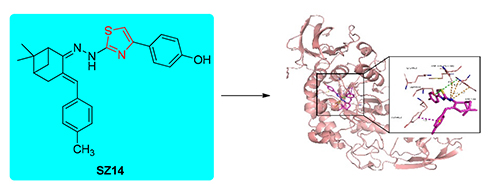
A series of nopinone-based thiazolyhydrazone derivatives were synthesized by using nopinone derivated from natural β-pinene as the starting material in three steps, including aldol reaction with aromatic aldehydes, condensation with aminothiourea, and cyclization with bromoacetophenone. The structures of synthesized compounds were characterized by 1H NMR, 13C NMR and HRMS. α-Amylase inhibitory activities of these compounds were also investigated. The results showed that 6 compounds among them had good inhibitory activities compared with the positive control acarbose. Especially, 4-(2-(2-(6,6-dimethyl-3-(4-methylbenzylidene))bicyclo[3.1.1]heptane-2-ylidene)indolyl-4-thiazol-4-yl)phenol (SZ14) exhibited remarkable α-amylase inhibitory activity with IC50 value of 4.11 μmol/L. From the structure-activity relationship, the structure of R2 gave great influence on the activities of thiazolyhydrazone derivatives. The kinetic inhibition study revealed that those 6 compounds were the noncompetitive inhibitor against α-amylase. It was used for molecular docking study to find out binding affinities for thiazolylhydrazone derivatives, and the binding mode of compound SZ14 with α-amylase was primarily investigated with molecular docking method.
Key words: nopinone; thiazolylhydrazone; α-amylase inhibitor; molecular docking
Zhang Qiangjian , Wang Yunyun , Zhao Yuxun , Ma Chonghui , Yang Yiqing , Xu Xu , Gu Wen , Wang Shifa . Synthesis and α-Amylase Inhibitory Potential and Molecular Docking Study of Nopinone-Based Thiazolylhydrazone Derivatives[J]. Chinese Journal of Organic Chemistry, 2019 , 39(5) : 1372 -1382 . DOI: 10.6023/cjoc201812032
[1] Rathmann, W; Giani, G. Diabetes Care 2004, 27, 1047.
[2] Gupta, Y.; Tandon, N. Nat. Med. J. India 2016, 29, 189.
[3] Liu, T.; Song, L.; Wang, H. J. Agric. Food Chem. 2011, 59, 9756.
[4] Mellor, D. D.; Sathyapalan, T.; Kilpatrick, E. S. J. Agric. Food Chem. 2015, 63, 9910.
[5] Murotomi, K.; Umeno, A.; Yasunaga, M. J. Agric. Food Chem. 2015, 63, 6715.
[6] Alberti, G.; Zimmet, P.; Shaw, J. Diabetes Care 2004, 27, 1798.
[7] Fowler, M. J. Clin. Diabetes 2008, 26, 77.
[8] Jarald, E.; Joshi, S. B.; Jain, D. C. Iran. J. Pharmacol. Ther. 2008, 7, 97.
[9] Bhandari, M. R.; Jong-Anurakkun, N.; Hong, G. Food Chem. 2008, 106, 247.
[10] Camargo, A. C.; Regitano-d'Arce, M. A. B.; Biasoto, A. C. T. Food Chem. 2016, 212, 395.
[11] Zhang, Y.; Wong, A. I. C.; Wu, J. J. Funct. Foods 2016, 25, 568.
[12] Ma, Y. Y.; Zhao, D. G.; Zhou, A. Y. J. Agric. Food Chem. 2015, 63, 8162.
[13] Martinez-Gonzalez, A. I.; Díaz-Sánchez, Á. G. Spectrochim. Acta, Part A 2019, 206, 437.
[14] Taha, M.; Syukri, B. M.; Hadiani, I, N. Bioorg. Chem. 2018, 80, 36.
[15] Yousuf, S.; Khan, K. M.; Salar, U. Eur. J. Med. Chem. 2018, 159, 47.
[16] Figueiredo-González, M.; Reboredo-Rodríguez, P.; González-Bar- reiro, C. Food Res. Int. 2019, 116, 447.
[17] Sun, L.; Chen, W.; Meng, Y. Food Chem. 2016, 208, 51.
[18] Hargrave, K. D.; Hess, F. K.; Oliver, J. T. J. Med. Chem. 1983, 26, 1158.
[19] Patt, W. C.; Hamilton, H. W.; Taylor, M. D. J. Med. Chem. 1992, 35, 2562.
[20] Kamble, R. D.; Meshram, R. J.; Hese, S. V. Comput. Biol. Chem. 2016, 61, 86.
[21] Jaen, J. C.; Wise, L. D.; Caprathe, B. W. J. Med. Chem. 1990, 33, 311.
[22] Mohammad, H.; Reddy, P. V. N.; Monteleone, D. Eur. J. Med. Chem. 2015, 94, 306.
[23] Ergenç, N.; Çapan, G.; Günay, N. S. Arch. Pharm. 1999, 332, 343.
[24] Bell, F. W.; Cantrell, A. S.; Hoegberg, M. J. Med. Chem. 1995, 38, 4929.
[25] Badorc, A.; Bordes, M. F.; Cointet, P. J. Med. Chem. 1997, 40, 3393.
[26] Khan, K. M.; Qurban, S.; Salar, U. Bioorg. Chem. 2016, 68, 245.
[27] Wang, G.; Peng, Z.; Gong, Z. Bioorg. Chem. 2018, 78, 195.
[28] Paudel, Y. N.; Ali, M. R.; Shah, S. Biomed. Pharmacother. 2017, 89, 651.
[29] Rui, J.; Zhang, Q.; Wang, X. Chin. J. Org. Chem. 2017, 37, 218(in Chinese). (芮坚, 张齐, 王欣, 有机化学, 2017, 37, 218.)
[30] Sun, N.; Wang, X.; Ding, Z. Chin. J. Org. Chem. 2016, 36, 2489(in Chinese). (孙楠, 王欣, 丁志彬, 有机化学, 2016, 36, 2489.)
[31] Wang, Y.; Gu, W.; Shan, Y. Bioorg. Med. Chem. Lett. 2017, 27, 2360.
[32] Yang, J.; Xu, X.; Rui, J. Spectrochim. Acta, Part A 2017, 183, 60.
[33] Yang, J.; Xu, H.; Xu, X. Dyes Pigm. 2016, 128, 75.
[34] Wang, Y.; Wu, C.; Zhang, Q. Bioorg. Chem. 2019, 84, 468.
[35] Williams, L. K.; Zhang, X.; Caner, S. Nat. Chem. Biol. 2015, 92, 387.
[36] Akkarachiyasit, S.; Yibchokanun, S.; Wacharasindhu, S. Molecules 2011, 16, 2075.
[37] Liu B, Ao W W, Yang Y. J. Nanjing For. Univ., Nat. Sci. Ed. 2010, 34, 89(in Chinese). (刘兵, 敖汪伟, 杨杨, 南京林业大学学报(自然科学版), 2010, 34, 89.)
[38] Bashary, R.; Khatik, G. L. Bioorg. Chem. 2018, 82, 156.
[39] O. Trott, A. J. Olson. J. Comput. Chem. 2010, 31, 455.
/
| 〈 |
|
〉 |

