
Chinese Journal of Organic Chemistry >
A High-Spin Iron(II) Complex Supported by a Tridentate Diamido-stibine Ligand: Synthesis, Structure and Its Reactions with Organic Azides and Diazo Compounds
Received date: 2019-04-16
Revised date: 2019-05-13
Online published: 2019-05-15
Supported by
Project supported by the National Key Research and Development Program of the Ministry of Science and Technology (No. 2016YFA0202900), the National Natural Science Foundation of China (Nos. 21725104, 21690062, 21432001, 21821002), the Strategic Priority Research Program of Chinese Academy of Sciences (No. XDB20000000), and the Program of Shanghai Academic Research Leader (No. 19XD1424800).
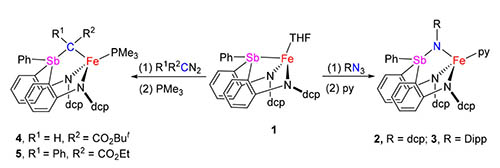
Treatment of PhSbCl2 with 2 equiv. of (2,6-Cl2C6H3)(2-LiC6H4)NLi, which was generated in situ by the interaction of (2,6-Cl2C6H3)(2-BrC6H4)NH with 2 equiv. of BunLi, followed by quenching with water, afforded the diamine-stibine compound ((o-(N-(2,6-Cl2C6H3)NH)C6H4)2SbPh (denoted as H2(dcpN2Sb)). H2(dcpN2Sb) undergoes amine-elimination reaction with[Fe(N(SiMe3)2)2]2 (0.5 euiqv.) to afford an iron(Ⅱ) complex[(κ3-N,N,Sb-dcpN2Sb)Fe(THF)] (1) bearing an unique tridentate bisamido-stibine ligand. Solution magnetic susceptibility measurements (μeff=4.7(2) μB in C6D6) reveal a high spin (S=2) electronic structure for 1. Complex 1 represents the first high-spin iron(Ⅱ) complex with organic stibine ligation, and features a long Fe-Sb bond distance of 0.2792(1) nm. Density functional theory (DFT) calculations indicate weak σ interaction betwen the high-spin iron(Ⅱ) center and the antimony atom due to ineffective orbital overlap. Complex 1 can react with organic azides RN3 to furnish the high-spin (S=2) iron(Ⅱ) complexes that bear tridentate bisamido-stibonium imine ligands[(κ3-N,N,N-dcpN2SbNR)Fe(py)] (R=dcp (2,6-Cl2C6H3), 2; R=Dipp (2,6-iPr2C6H3), 3). These compexes are among the rare metal complexes with stibonium imine ligation. The average Sb-N distance of 0.194 nm in the imine moieties is found comparable to those of the Sb-N bonds in the reported stibonium imine compounds Mes3SbNCOCl3 (0.199 nm) and 2-MeC6H4)3SbNSO2CF3 (0.196 nm). The reactions of 1 with diazo compounds (R1R2)CN2 afford the high-spin iron(Ⅱ) complexes featuring tridentate bisamido-stibonium ylide ligands[(κ3-N,N,C-dcpN2SbCR1,R2)Fe(PMe3)] (R1=H, R2=CO2But, 4; R1=Ph, R2=CO2Et, 5). The average Sb-C distance of 0.206 nm in the ylide moieties is found comparable to those of the Sb-C bonds in the reported stibonium ylide compounds (around 0.20 nm). H2(dcpN2Sb) and 1~5 have been characterized by elemental analysis, 1H NMR, solution magnetic susceptibility measurements and single-crystal X-ray diffraction studies.
Wang Peng , Xiao Jie , Leng Xuebing , Deng Liang . A High-Spin Iron(II) Complex Supported by a Tridentate Diamido-stibine Ligand: Synthesis, Structure and Its Reactions with Organic Azides and Diazo Compounds[J]. Chinese Journal of Organic Chemistry, 2019 , 39(8) : 2243 -2250 . DOI: 10.6023/cjoc201904040
[1] Levason, W.; Mcauliffe, C. A. Acc. Chem. Res. 1978, 11, 363.
[2] Champness, N. R.; Levason, W. Coord. Chem. Rev. 1994, 133, 115.
[3] Levason, W.; Reid, G. Coord. Chem. Rev. 2006, 250, 2565.
[4] Jones, J. S.; Gabbai, F. P. Acc. Chem. Res. 2016, 49, 857.
[5] Breunig, H. J.; Borrmann, T.; Lork, E.; Moldovan, O.; Rat, C. I.; Wagner, R. P. J. Organomet. Chem. 2009, 694, 427.
[6] Genge, A. R. J.; Holmes, N. J.; Levason, W.; Webster, M. Polyhedron 1999, 18, 2673.
[7] Bryan, R. F.; Schmidt, W. C. J. Chem. Soc., Dalton Trans. 1974, 2337.
[8] Benjamin, S. L.; Karagiannidis, L.; Levason, W.; Reid, G.; Rogers, M. C. Organometallics 2011, 30, 895.
[9] Godfrey, S. M.; McAuliffe, C. A.; Pritchard, R. G. J. Chem. Soc., Chem. Commun. 1994, 45.
[10] Jones, J. S.; Wade, C. R.; Gabbai, F. P. Angew. Chem., Int. Ed. 2014, 53, 8876.
[11] Mo, Z.; Deng, L. Coord. Chem. Rev. 2017, 350, 285.
[12] Poli, R. Chem. Rev. 1996, 96, 2135.
[13] Power, P. P. Chem. Rev. 2012, 112, 3482.
[14] Xiao, J.; Deng, L. Dalton Trans. 2013, 42, 5607.
[15] Zhao, M.; Mao, G.; Liu, Y.; Xiao, J.; Deng, L. Chin. J. Org. Chem. 2018, 38, 1656.
[16] Bojan, V. R.; Fernandez, E. J.; Laguna, A.; Lopez-de-Luzuriaga, J. M.; Monge, M.; Olmos, M. E.; Puelles, R. C.; Silvestru, C. Inorg. Chem. 2010, 49, 5530.
[17] Slater, J. C. J. Chem. Phys. 1964, 41, 3199.
[18] Alvarez, S. Dalton Trans. 2013, 42, 8617.
[19] Liu, J.; Hu, L.; Wang, L.; Chen, H.; Deng, L. J. Am. Chem. Soc. 2017, 139, 3876.
[20] You, D.; Yang, H. F.; Sen, S.; Gabbaï, F. P. J. Am. Chem. Soc. 2018, 140, 9644.
[21] Wade, C. R.; Gabbai, F. P. Angew. Chem., Int. Ed. 2011, 50, 7369.
[22] Matano, Y.; Nomura, H.; Suzuki, H.; Shiro, M.; Nakano, H. J. Am. Chem. Soc. 2001, 123, 10954.
[23] Matano, Y.; Nomura, H.; Suzuki, H. Inorg. Chem. 2000, 39, 1340.
[24] Edwards, A. J.; Paver, M. A.; Raithby, P. R.; Russell, C. A.; Wright, D. S. J. Chem. Soc., Dalton Trans. 1993, 2257.
[25] Edwards, A. J.; Paver, M. A.; Rennie, M.-A.; Raithby, P. R.; Russell, C. A.; Wright, D. S. J. Chem. Soc., Dalton Trans. 1994, 2963.
[26] Burford, N.; Macdonald, C. L. B.; Robertson, K. N.; Cameron, T. S. Inorg. Chem. 1996, 35, 4013.
[27] Burford, N.; Cameron, T. S.; Lam, K. C.; LeBlanc, D. J.; Macdonald, C. L. B.; Phillips, A. D.; Rheingold, A. L.; Stark, L.; Walsh, D. Can. J. Chem. 2001, 79, 342.
[28] Glidewell, C.; Lloyd, D.; Metcalfe, S. Tetrahedron 1986, 42, 3887.
[29] Ferguson, G.; Glidewell, C.; Gosney, I.; Lloyd, D.; Metcalfe, S.; Lumbroso, H. J. Chem. Soc., Perkin Trans. 2 1988, 1829.
[30] Koketsu, J.; Ninomiya, Y.; Suzuki, Y.; Koga, N. Inorg. Chem. 1997, 36, 694.
[31] Sudhakar, P. V.; Lammertsma, K. J. Am. Chem. Soc. 1991, 113, 1899.
[32] Evans, D. F. J. Chem. Soc. 1959, 2003.
[33] Sur, S. K. J. Magn. Reson. 1989, 82, 169.
[34] Chalmers, B. A.; Buhl, M.; Arachchige, K. S. A.; Slawin, A. M. Z.; Kilian, P. Chem. Eur. J. 2015, 21, 7520.
[35] Olmstead, M. M.; Power, P. P.; Shoner, S. C. Inorg. Chem. 1991, 30, 2547.
[36] Neese, F. ORCA-an ab initio, Density Functional and Semi-empirical Program Package (v.3.0.3), Max-Planck Institute for Bioinorganic Chemistry, Mülheim an der Ruhr, Germany, 2015.
[37] Becke, A. D. J. Chem. Phys. 1993, 98, 5648.
[38] Lee, C.; Yang, W.; Parr, R. G. Phys. Rev. B:Condens. Matter Mater. Phys. 1988, 37, 785.
[39] Schafer, A.; Huber, C.; Ahlrichs, R. J. Chem. Phys. 1994, 100, 5829.
[40] Schafer, A.; Horn, H.; Ahlrichs, R. J. Chem. Phys. 1992, 97, 2571.
/
| 〈 |
|
〉 |

