Chinese Journal of Organic Chemistry >
Iron-Catalyzed Selective Hydrogenation of Stearic Acid to Stearyl Alcohol
Received date: 2019-02-26
Online published: 2019-07-03
Supported by
the National Natural Science Foundation of China(21702227);the Science Foundation of China University of Petroleum (Beijing)(2462014YJRC037)
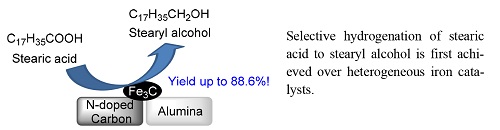
The utilization of sustainable resources such as biomass to produce fuels and chemicals has recently attracted significant attention due to the depletion of fossil reserves, increasing energy demand, and growing environmental concerns. Long-chain fatty acids, which are major constituents of plant oil, are important feedstock for biorefinery. Besides producing well-known biodiesels, the hydrogenation of fatty acids to fatty alcohols has recently drawn significant attention due to the versatility and growing market value of fatty alcohols. An example of heterogenous iron-catalyzed selective hydrogenation of stearic acid to stearyl alcohol is reported. Comparing with other reported non-noble metal centers, such as Co and Ni, Fe is 3000~30000 times more abundant and 20~150 times cheaper, thus making our method more economic and attractive. The iron catalyst was prepared by simultaneous pyrolysis of iron precursor[Fe(acac)3] and nitrogen-doped carbon precursor (melamine) onto alumina, bearing Fe3C active phase and nitrogen-doped carbon-alumina hybrid support. The optimization of preparation parameter showed that the optimal pyrolysis temperature is 900℃, while the best mass fraction of iron is 20%. The replacement of Fe(acac)3 with Fe(NO3)3 led to inferior catalytic performance, which was due to undesired redox reaction between NO3- and melamine during pyrolysis that hampered the reaction between Fe and melamine to form Fe3C active phase. Instead, hercynite phase became the predominant phase. The exploration of reaction parameter showed that the optimal reaction temperature is 320℃, and the best H2 pressure is 4 MPa. The time course for stearic acid conversion shows that stearic acid was rapidly converted into stearyl alcohol with yield of 88.6% within 0.5 h, and then gradually converted into octadecane with yield of 90% at 4 h. The unsatisfactory stability of the iron catalyst is probably due to the decomposition of Fe3C active phase to metallic Fe phase during recycling tests.
Key words: biomass conversion; hydrogenation; iron; fatty acid; fatty alcohol
Jiang Li , Tong Wan , Junjie Zhang , Yao Fu . Iron-Catalyzed Selective Hydrogenation of Stearic Acid to Stearyl Alcohol[J]. Chinese Journal of Organic Chemistry, 2019 , 39(11) : 3258 -3263 . DOI: 10.6023/cjoc201902031
| [1] | Huber G. W. Iborra S. Corma A. Chem. Rev. 2006 106 4044. |
| [2] | Corma A. Iborra S. Velty A. Chem. Rev. 2007 107 2411. |
| [3] | Yang Z. Fu Y. Guo Q. Chin. J. Org. Chem. 2015 35 273. |
| [3] | 杨 珍 傅 尧 郭 庆祥 有机化学 2015 35 273. |
| [4] | Jamil F. Al-Haj L. Al-Muhtaseb A. H. Al-Hinai M. A. Baawain M. Rashid U. Ahmad M. N. M. Rev. Chem. Eng. 2018 34 267. |
| [5] | Besson, M.; Gallezot, P.; Pinel, C. Chem. Rev. 2014, 114, 1827. |
| [6] | Gupta S. Frost and Sullivan Market Insight 2004 11075449. |
| [7] | Adkins H. Folkers K. J. Am. Chem. Soc. 1931 53 1095. |
| [8] | Toba M. Tanaka S.-I. Niwa S.-I. Mizukami F. Koppa?ny Z. Guczi L. Cheah K.-Y. Tang T.-S. Appl. Catal., A 1999 189 243. |
| [9] | Mendes M. Santos O. Jordao E. Silva A. Appl. Catal., A 2001 217 253. |
| [10] | Takeda Y. Nakagawa Y. Tomishige K. Catal. Sci. Technol. 2012 2 2221. |
| [11] | Takeda Y. Tamura M. Nakagawa Y. Okumura K. Tomishige K. ACS Catal. 2015 5 7034. |
| [12] | Ullrich J. Breit B. ACS Catal. 2018 8 785. |
| [13] | Manyar H. G. Paun C. Pilus R. Rooney D. W. Thompson J. M. Hardacre C. Chem. Commun. 2010 46 6279. |
| [14] | Rozmys?owicz B. Kirilin A. Aho A. Manyar H. Hardacre C. Wa?rn J. Salmi T. Murzin D. Y. J. Catalysis 2015 328 197. |
| [15] | Toyao T. Siddiki S. M. Touchy A. S. Onodera W. Kon K. Morita Y. Kamachi T. Yoshizawa K. Shimizu K. I. Chem.-Eur. J. 2017 23 1001. |
| [16] | Kandel K. Chaudhary U. Nelson N. C. Slowing I. I. ACS Catal. 2015 5 6719. |
| [17] | Wu L. Li L. Li B. Zhao C. Chem. Commun. 2017 53 6152. |
| [18] | Onyestya?k G. Harnos S. Kallo? D. Catal. Commun. 2011 16 184. |
| [19] | Gao X. Tong D. Zhong H. Jin B. Jin F. Zhang H. RSC Adv. 2016 6 27623. |
| [20] | Kong X. Fang Z. Bao X. Wang Z. Mao S. Wang Y. J. Catalysis 2018 367 139. |
| [21] | Jia W. Xu G. Liu X. Zhou F. Ma H. Zhang Y. Fu Y. Energy Fuels 2018 32 8438. |
| [22] | Song S. Wang D. Di L. Wang C. Dai W. Wu G. Guan N. Li L. Chin. J. Catal. 2018 39 250. |
| [23] | Li J. Zhang J. Wang S. Xu G. Wang H. Vlachos D. G. ACS Catal. 2019 9 1564. |
| [24] | Jagadeesh R. V. Surkus A. Junge H. Pohl M. Radnik J. Rabeah J. Huan H. Schunemann V. Bruckner A. Beller M. Science 2013 342 1073. |
| [25] | Cui X. Li Y. Bachmann S. Scalone M. Surkus A. Junge K. Topf C. Beller M. J. Am. Chem. Soc. 2015 137 10652. |
| [26] | Natte K. Neumann H. Jagadeesh R. V. Beller M. Nat. Commun. 2017 8 1344. |
| [27] | Li J. Liu J. Zhou H. Fu Y. ChemSusChem 2016 9 1339. |
| [28] | Li J. Liu J. Liu H. Xu G. Zhang J. Liu J. Zhou G. Li Q. Xu Z. Fu Y. ChemSusChem 2017 10 1436. |
| [29] | Li J. Zhang J. Liu H. Liu J. Xu G. Liu J. Sun H. Fu Y. ChemistrySelect 2017 2 11062. |
| [30] | Li J. Sun H. Liu J. X. Zhang J. J. Li Z. X. Fu Y. Mol. Catal. 2018 452 36. |
| [31] | Leveneur J. Waterhouse G. I. N. Kennedy J. Metson J. B. Mitchell D. R. G. J. Phys. Chem. C 2011 115 20978. |
/
| 〈 |
|
〉 |