
Chinese Journal of Organic Chemistry >
Synthesis and Reactivity of Group 10 Transition Metal Complexes with Alkenylphosphoryl Compounds
Received date: 2019-05-01
Revised date: 2019-06-19
Online published: 2019-07-09
Supported by
Project supported by the National Natural Science Foundation of China (No. 21871070), and the Natural Science Foundation of Hainan Province (No. 219MS005).
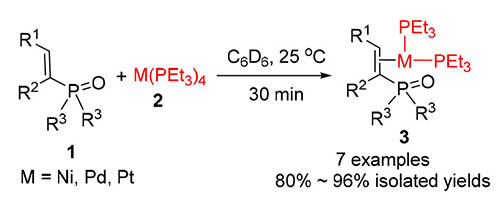
Alkenylphosphoryl compounds could quickly replace two phosphine ligands in Pd(PEt3)4 at room temperature to produce the corresponding palladium complexes 3a~3e in high yields. Similar nickel and platinium complexes 3f and 3g were also synthesized by the reaction. Complex 3e could react with HOAc to release alkenylphosphoryl compounds gradually. By further addition of 2 equiv. of PEt3, the reaction could take place completely, generating a phosphoniun 4 as a precipitation. Being similar to Pd(PEt3)4, 3d could also undergo hydropalladation with the combination of phenylacetylene and (EtO)2P(O)H, forming the expected vinyl-Pd-phosphoryl complex, but with a slower reaction rate. The result indicated that alkenylphosphoryl compounds generated from the palladium-catalyzed hydrophosphorylation of alkynes with H-phosphonates might play a negative role in the hydropalladation step of the catalytic cycle. Complexes 3a~3g and phosphonium 4 were charaterized by NMR analysis. The structures of 3a and 4 were also confirmed by X-ray technology.
Chen Tieqiao , Liu Long , Huang Tianzeng , Han Li-Biao . Synthesis and Reactivity of Group 10 Transition Metal Complexes with Alkenylphosphoryl Compounds[J]. Chinese Journal of Organic Chemistry, 2019 , 39(8) : 2183 -2187 . DOI: 10.6023/cjoc201905001
[1] For selected book and reviews, see:(a) Lawrance, G. A. Introduction to Coordination Chemistry, Wiley, Chichester, UK, 2010.
(b) Burgess, J.; Steel, P. J. Coord. Chem. Rev. 2011, 255, 2094.
(c) Steobenau, E. J.; Jordan, R. F. J. Am. Chem. Soc. 2006, 128, 8162.
(d) Harvey, B. G.; Ernst, R. D. Eur. J. Inorg. Chem. 2017, 2017, 1205.
(e) Defieber, C.; Grutzmacher, H.; Carreira, E. M. Angew. Chem., Int. Ed. 2008, 47, 4482.
(f) Johnson, J. B.; Rovis, T. Angew. Chem., Int. Ed. 2008, 47, 840.
(g) Feng, X.; Du, H. Chin. J. Org. Chem. 2015, 35, 259(in Chinese). (冯向青,杜海峰,有机化学, 2015, 35, 259.)
[2] For selected reviews, see:(a) Dembitsky, V. M.; Quntar, A. A. A. A.; Haj-Yehia, A.; Srebnik, M. Mini-Rev. Org. Chem. 2005, 2, 91.
(b) Minami, T.; Motoyoshiya, J. Synthesis 1992, 333.
(c) Wang, H.-Q.; Liu, Z.-J. Chin. J. Org. Chem. 2003, 23, 321(in Chinese). (王宏青,刘钊杰,有机化学, 2003, 23, 321.)
[3] (a) Al-Quntar, A. A.-A.; Baum, O.; Reich, R.; Srebnik, M. Arch. Pharm. 2004, 337, 76.
(b) Liu, Z.; MacRitchie, N.; Pyne, S.; Pyne, N. J.; Bittman, R. Bioorg. Med. Chem. 2013, 21, 2503.
(c) Harnden, M. R.; Parkin, A.; Parratt, M. J.; Perkins, R. M. J. Med. Chem. 1993, 36, 1343.
(d) Tonelli, F.; Lim, K. G.; Loveridge, C.; Long, J.; Pitson, S. M.; Tigyi, G.; Bittman, R.; Pyne, S.; Pyne, N. J. Cell. Signalling 2010, 22, 1536.
[4] (a) Kosolapoff, G. M. J. Am. Chem. Soc. 1948, 70, 1971.
(b) Mulla, K.; Aleshire, K. L.; Forster, P. M.; Kang, J. Y. J. Org. Chem. 2016, 81, 77 and references cited therein.
[5] Han, L.-B.; Tanaka, M. J. Am. Chem. Soc. 1996, 118, 1571.
[6] (a) Coudray, L.; Montchamp, J.-L. Eur. J. Org. Chem. 2008, 3601.
(b) Delacroix, O.; Gaumont, A. C. Curr. Org. Chem. 2005, 9, 1851.
(c) Xu, Q.; Han, L.-B. J. Organomet. Chem. 2011, 696, 130.
[7] http://www.katayamakagaku.co.jp/products/chemicalproducts/flameretardant/index.html
[8] Chen, T.; Zhao, C.-Q.; Han, L.-B. J. Am. Chem. Soc. 2018, 140, 3139.
[9] (a) Stewart, I. C.; Bergman, R. G.; Toste, F. D. J. Am. Chem. Soc. 2003, 125, 8696.
(b) Okuma, K.; Izaki, T. Bull. Chem. Soc. Jpn. 2005, 78, 1831.
(c) Kentaro, O., Koichiro, Y.; Toshiharu, I.; Keiko, Y.; Kosei, S. Bull. Chem. Soc. Jpn. 2007, 80, 1785.
(d) Arisawa, M.; Yamaguchi, M. J. Am. Chem. Soc. 2006, 128, 50.
(e) Arisawa, M.; Yamaguchi, M. In ACS Symposium Series, Ed.:Laali, K. K., American Chemical Society, Washington, DC, 2007, Vol. 965, Chapter 22, pp. 477~492.
[10] For a review, see:Guo, H.; Fan, Y. C.; Sun, Z.; Wu, Y.; Kwon, O. Chem. Rev. 2018, 118, 10049.
[11] Both electronic and steric factors affect the regioselectivity of hydropalladation, for details, please see Ref.
[8] . A related work on the basis of DFT calculation was also reported, see:Zhang, H.; Bao, X. RSC Adv. 2015, 5, 84636.
/
| 〈 |
|
〉 |

