[1] Newman, D. J.; Cragg, G. M.; Snader, K. M. J. Nat. Prod. 2003, 66, 1022.
[2] Aggarwal, B. B.; Kunnumakkara, A. B. Molecular Targets and Therapeutic Use of Spices, World Scientific Publishing Co. Pte. Ltd., 2009, pp. 281~309.
[3] Schobert, R.; Biersack, B. Chem. Biodiversity. 2019, 16, e1900366.
[4] Aggarwal, S.; Das, S. N. Tumor. Biol. 2016, 37, 7175.
[5] Ranjbarnejad, T.; Saidijam, M.; Tafakh, M. S.; Pourjafar, M.; Talebzadeh, F.; Najafi, R. Hum. Exp. Toxicol. 2017, 36, 692.
[6] Li, F.; Shanmugam, M. K.; Chen, L. X.; Chatterjee, S.; Basha, J.; Kumar, A. P.; Kundu, T. K.; Sethi, G. Cancer Prev. Res. (Phila) 2013, 6, 843.
[7] Wang, J. H.; Wang, L. W..; Ho, C. T.; Zhang, K. S.; Liu, Q.; Zhao, H. J Agric. Food Chem. 2017, 65, 3675.
[8] Ahmad, A.; Wang, Z. W.; Wojewoda, C.; Ali, R.; Kong, D.; Maitah, M. Y.; Banerjee, S.; Bao, B.; Padhye, S.; Sarkar, F. H. Front. Biosci. 1492, 3, 1483.
[9] Liu, C.; Ho, P. C.; Wong, F. C.; Sethi, G.; Wang, L. Z.; Goh, C. Cancer Lett. 2015, 362, 8.
[10] Liao, C. H.; Ho, C. T.; Lin, J. K. Biochem. Biophys. Res. Commun. 2005, 329, 1306.
[11] Liao, C. H.; Sang, S. M.; Liang, Y. C.; Ho, C. T.; Lin, J. K. Mol. Carcinog. 2004, 41, 140.
[12] Zhou, X. Y.; Cao, J.; Han, C. M.; Li, S. W.; Zhang, C.; Du, Y, D.; Zhou, Q. Q.; Zhang, X. Y.; Chen, X. Bioorg. Chem. 2017, 71, 74.
[13] Cao, J.; Han, C. M.; Zhang, G. L.; Zhou, X. Y.; Li, S. W.; Du, Y. D.; Zhao, S.; Zhang, X. Y.; Chen, X. Chin. J. Org. Chem. 2017, 37, 8(in Chinese). (曹菁, 韩超明, 张桂莲, 周新莹, 李舒雯, 杜银端, 赵帅, 张辛燕, 陈新, 有机化学, 2017, 37, 8.)
[14] Han, C. M.; Zhou, X. Y.; Cao, J.; Zhang, X. Y.; Chen, X. Bioorg. Chem. 2015, 60, 123.
[15] Chen, X.; Zhang, X. Y.; Lu, Y.; Shim, J. Y.; Sang, S. M.; Sun, Z.; Chen, X. X. Nutr. Cancer. 2012, 64, 1211.
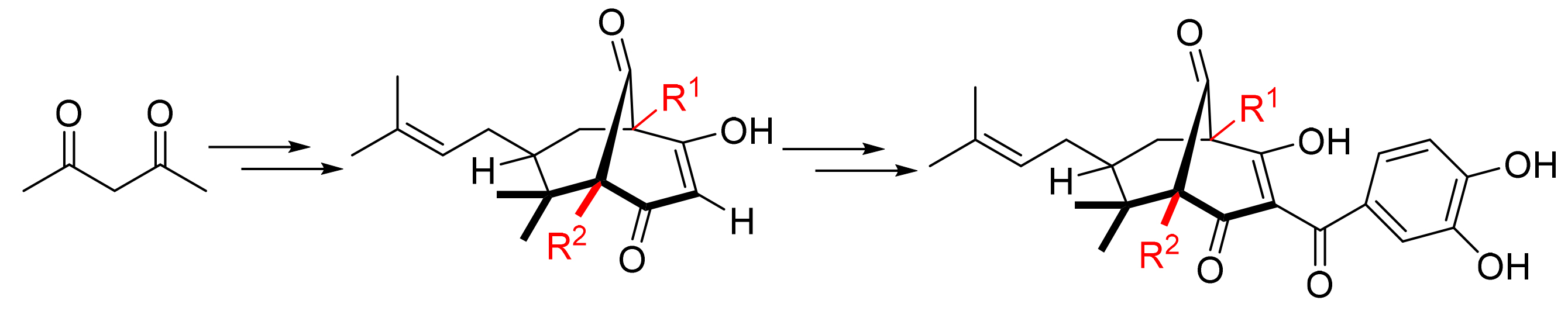
[16] Socolsky, C.; Plietker, B. Chem.-Eur. J. 2015, 21, 3053.
[17] Guttroff, C.; Baykal, A.; Wang, H. H.; Popella, P.; Kraus, F.; Biber, N.; Krauss, S.; Gotz, F.; Plietker, B. Angew. Chem., Int. Ed. 2017, 56, 15852.
[18] Biber, N.; Mows, K.; Plietker, B. Nat. Chem. 2011, 3, 938.
[19] Holzwarth, M.; Dieskau, A.; Tabassam, M.; Plietker, B. Angew. Chem. Int. Ed. 2009, 48, 7251.
[20] Saba, S.; Brescia, A.; Kaloustian, M. Tetrahedron Lett. 1991, 32, 5031.