
Chinese Journal of Organic Chemistry >
Synthesis and Antibacterial Activity Evaluation of Guanidine Hydrazone Derivatives Containing Linear Alkanes
Received date: 2022-10-24
Revised date: 2022-12-05
Online published: 2023-01-05
Supported by
National Natural Science Foundation of China(81560561); Natural Science Foundation of Jiangxi Province(20224ACB206044)
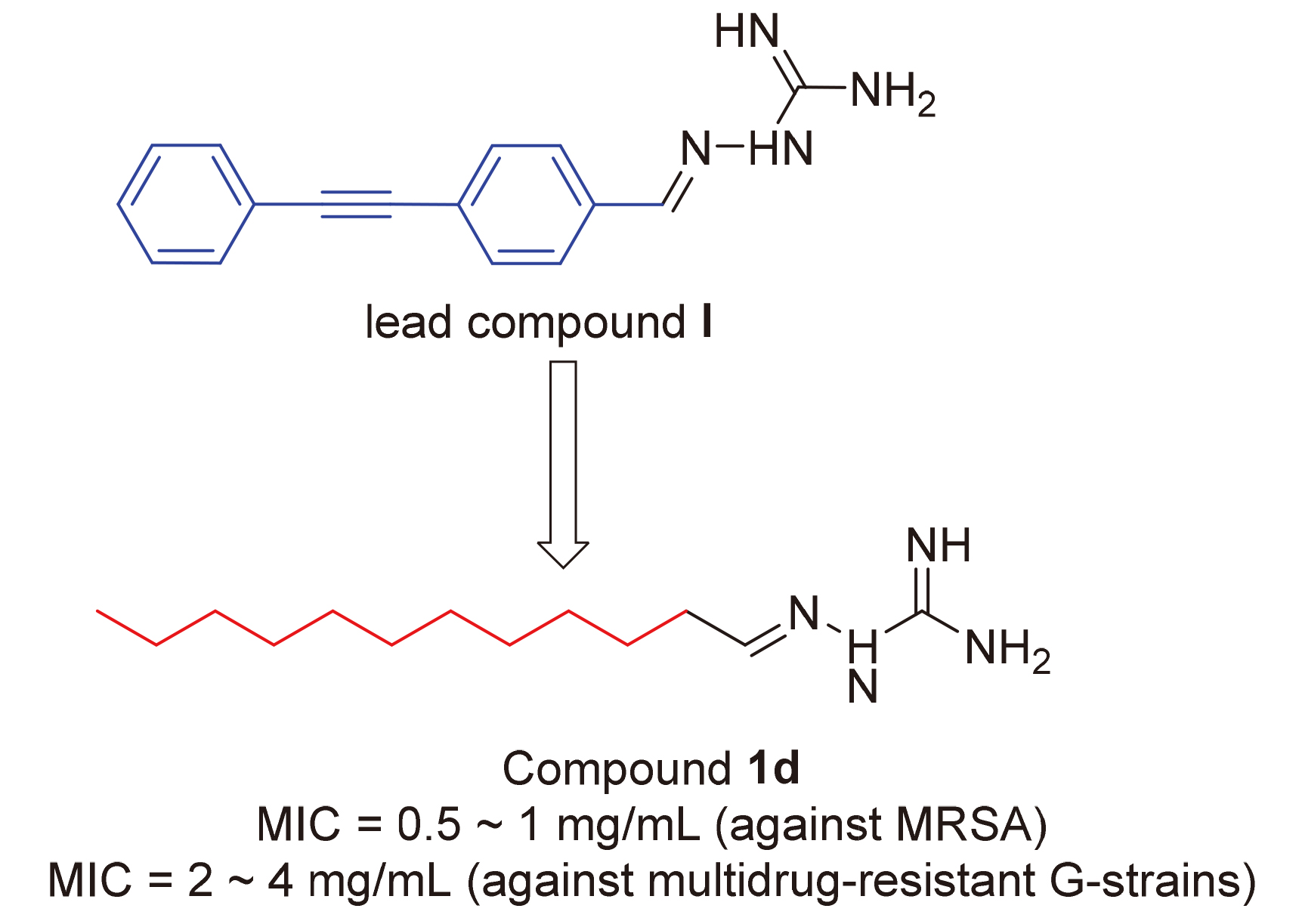
The rise of antibiotic resistance and the declining discovery of new antibiotics have created a global health crisis. To obtain effective antibacterial agents and relieve bacterial resistance, a series of novel guanidine hydrazones containing linear alkanes were designed and synthesized. The antimicrobial activities of these compounds were evaluated against five gram-positive strains, four gram-negative strains and four multidrug-resistant strains. All of the targets except (E)-2-hexyli- denehydrazine-1-carboximidamide (1a) exhibited a different degree of antibacterial properties with minimum inhibitory concentration (MIC) in 0.5~64 μg/mL. Among them, (E)-2-dodecylidenehydrazine-1-carboximidamide (1d), (E)-2-tetradecyli- denehydrazine-1-carbox-imidamide (1e), (E)-2-(4-(heptyloxy)benzylidene)hydrazine-1-carboximidamide (2d) and (E)-2-(4- (octyloxy)benzylidene)hydrazine-1-carbox-imidamide (2e) showed equivalent or better antibacterial activity than penicillin and norfloxacin against strains 33693, 29212, 63501, 10104 and 43300. Excellent bactericidal properties of 2d and low frequency of bacteria developing resistance toward 2d were established. The cytotoxicity evaluation showed that the target compounds had certain cytotoxicity, but no cytotoxicity was found under the concentration of antibacterial activity. Molecular docking of 2d with LpxC was performed, which demonstrated that 2d has a forceful binding with LpxC. These findings strongly support the assumption that guanidine hydrazone coupled with linear alkane is a potential skeleton to develop new antimicrobial agents.
Key words: guanidine hydrazone; antimicrobial; linear alkane; resistance
Mingxia Song , Yangnv Zhu , Shishuai Wang , Yuping Huang , Xianqing Deng , Yushan Huang . Synthesis and Antibacterial Activity Evaluation of Guanidine Hydrazone Derivatives Containing Linear Alkanes[J]. Chinese Journal of Organic Chemistry, 2023 , 43(6) : 2163 -2170 . DOI: 10.6023/cjoc202210029
| [1] | Hughes, D.; Andersson, D. I. Annu. Rev. Microbiol. 2017, 8, 579. |
| [2] | Mühlberg, E.; Umst?tter, F.; Kleist, C.; Domhan, C.; Mier, W.; Uhl, P. Can. J. Microbiol. 2020, 66, 11. |
| [3] | Chellat, M. F.; Raguz?, L.; Riedl, R. Angew. Chem., nt. Ed. 2016, 55, 6600. |
| [4] | Yang, T.; Wang, J. Y.; Cao, J. Y.; Zhang, X. Y.; Lai, Y.; Li, L. N.; Ye, X. Y.; You, C. Ital. J. Pediatr. 2021, 47, 169. |
| [5] | So, M.; Walti, L. Curr. Infect. Dis. Rep. 2022, 24, 63. |
| [6] | Rai, M.; Zimowska, B.; Gade, A.; Ingle, P. AMB Express 2022, 12, 60. |
| [7] | Prasad, N. K.; Seiple, I. B.; Cirz, R. T.; Rosenberg, O. S. Antimicrob. Agents Chemother. 2022, 66, e0005422. |
| [8] | Alfei, S.; Schito, A. M. Pharmaceuticals (Basel) 2022, 15, 476. |
| [9] | Whittington, D. A.; Rusche, K. M.; Shin, H.; Fierke, C. A.; Christianson, D. W. Proc. Natl. Acad. Sci. U. S. A. 2003, 100, 8146. |
| [10] | Kalinin, D. V.; Holl, R. Curr. Top Med. Chem. 2016, 16, 2379. |
| [11] | Erwin, A. L. Cold Spring Harbor Perspect. Med. 2016, 6, a025304. |
| [12] | Zhou, P.; Hong, J. Acc. Chem. Res. 2021, 54, 1623. |
| [13] | Kang, Y.; Zhao, M.; Zhang, J. Chin. J. Antibiot. 2017, 42, 169. (in Chinese) |
| [13] | (康悦, 赵明, 张菁, 中国抗生素杂志, 2017, 42, 169.) |
| [14] | Sidoryk, K.; ?witalska, M.; Rózga, P.; Wietrzyk, J.; Bujak, I.; ?erek, B.; Kaczmarek, ?.; Cybulski, M. Med. Chem. Res. 2017, 26, 3354. |
| [15] | D?m?t?r, O.; May, N. V.; Gál, G. T.; Spengler, G.; Dobrova, A.; Arion, V. B.; Enyedy, é. A. Molecules 2022, 27, 2044. |
| [16] | Deng, X. Q.; Song, M. X. J. Enzyme Inhib. Med. Chem. 2020, 35, 354. |
| [17] | Yu, H.-H.; Zhou, S.-C.; Guo, T.-T.; Liang, Z.; Chen, H.-B.; Dai, W.-K.; Song, M.-X. Chin. J. Org. Chem. 2019, 39, 1497. (in Chinese) |
| [17] | (余海红, 周胜超, 郭婷婷, 梁焯, 陈华斌, 代卫凯, 宋明霞, 有机化学, 2019, 39, 1497.) |
| [18] | Song, M. X.; Wang, S. B.; Wang, Z. T.; Fu, Z. Y.; Zhou, S. C.; Cheng, H. B.; Liang, Z.; Deng, X. Q. Eur. J. Med. Chem. 2019, 166, 108. |
| [19] | Brown, E. D.; Wright, G. D. Nature 2016, 529, 336. |
| [20] | Dubey, K. K.; Sharma, I. M. Arch. Pharm. (Weinheim, Ger.) 2020, 353, e2000168. |
| [21] | Makovitzki, A.; Avrahami, D.; Shai, Y. Proc. Natl. Acad. Sci. U. S. A. 2006, 103, 15997. |
| [22] | Hoque, J.; Akkapeddi, P.; Yadav, V.; Manjunath, G. B.; Uppu, D. S.; Konai, M. M.; Yarlagadda, V.; Sanyal, K.; Haldar, J. ACS Appl. Mater. Interfaces 2015, 7, 1804. |
| [23] | Kosowska-Shick, K.; Clark, C.; Pankuch, G. A.; McGhee, P.; Dewasse, B.; Beachel, L.; Appelbaum, P. C. Antimicrob. Agents Chemother. 2009, 53, 4217. |
| [24] | Qiu, X.; Janson, C. A.; Smith, W. W.; Head, M.; Lonsdale, J.; Konstantinidis, A. K. J. Mol. Biol. 2001, 307, 341. |
/
| 〈 |
|
〉 |

