
Chinese Journal of Organic Chemistry >
Research Progress of Polychloroalkylation Based on C—H Bond Cleavage
Received date: 2022-11-16
Revised date: 2023-02-09
Online published: 2023-03-07
Supported by
National Natural Science Foundation of China(21801023); Changsha Municipal Science and Technology Project(kq2004070); Hunan Provincial Key Laboratory of Materials Protection for Electric Power and Transportation(2020CL03)
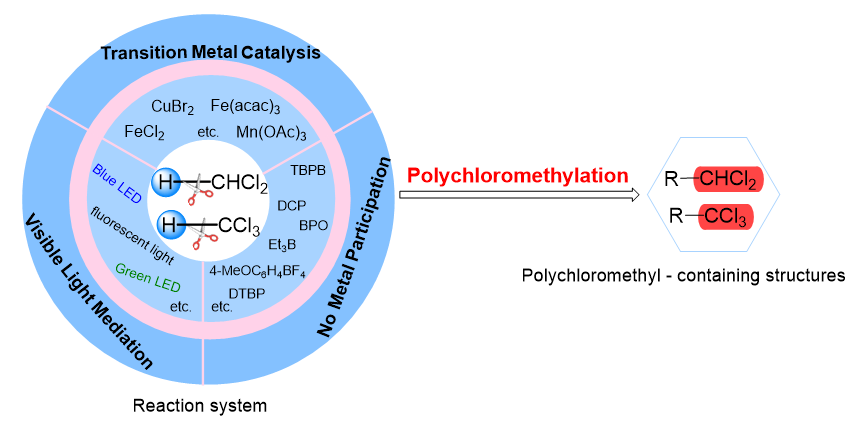
Polychlorinated hydrocarbons are particularly important in organic synthesis and chemical industries, especially in the fields of pharmaceuticals and materials, which have attracted wide attention of chemists and given birth to various methods for the synthesis of chlorinated organic compounds. The introduction of polychloroalkyl can be used as key component to change the drug activity of the compound. At the same time, polychloroalkyl can be used as precursors to transform into aldehydes, ketones, carboxylic acids and other functional groups with different functions, providing strong support for the realization of late synthesis and modification of natural products. The strategy of constructing polychlorinated compounds by breaking C—H bonds in polychloroalkanes has become a hot research topic among chemists due to its high step economy and has made significant progress in research. In this paper, the use of dichloromethane and trichloromethane as precursors of polychloroalkyl is summarized, starting from different reaction systems (transition metal catalyzed, visible light mediated, metal-free involved), the relevant work of polychloroalkylation reactions based on C—H bond breaking strategy in the last decade is reviewed, and the reaction design, mechanism research, and research prospects are reviewed.
Fen Huang , Weiwei Luo , Jun Zhou . Research Progress of Polychloroalkylation Based on C—H Bond Cleavage[J]. Chinese Journal of Organic Chemistry, 2023 , 43(7) : 2368 -2390 . DOI: 10.6023/cjoc202211018
| [1] | Jeschke, P. Pest Manage. Sci. 2010, 66, 10. |
| [2] | Vaillancourt, F. H.; Yeh, E.; Vosburg, D. A.; Garneau-Tsodikova, S.; Walsh, C. T. Chem. Rev. 2006, 106, 3364. |
| [3] | Unson, M. D.; Rose, C. B.; Faulkner, D. J.; Brinen, L. S.; Steiner, J. R.; Clardy, J. J. Org. Chem. 1993, 58, 6336. |
| [4] | Hughes, G.; Lewis, J. C. Chem. Rev. 2018, 118, 1. |
| [5] | Sadar, M. D. Cancer Res. 2011, 71, 1208. |
| [6] | Gribble, G. W. Heterocycles 2012, 84, 157. |
| [7] | Owusu-Ansah, E.; Durow, A. C.; Harding, J. R.; Jordan, A. C.; O’Connell, S. J.; Willis, C. L. Org. Biomol. Chem. 2011, 9, 265. |
| [8] | Gribble, G. W. J. Chem. Educ. 2004, 81, 1441. |
| [9] | Gu, Z.; Zakarian, A. Angew. Chem., Int. Ed. 2010, 49, 9702. |
| [10] | Nguyen, V.-A.; Willis, C. L.; Gerwick, W. H. Chem. Commun. 2001, 19, 1934. |
| [11] | Flores, B.; Molinski, T. F. Org. Lett. 2011, 13, 3932. |
| [12] | Paul, C.; Pohnert, G. Nat. Prod. Rep. 2011, 28, 186. |
| [13] | Sadar, M. D.; Williams, D. E.; Mawji, N. R.; Patrick, B. O.; Wikanta, T.; Chasanah, E.; Irianto, H. E.; Soest, R. V.; Andersen, R. J. Org. Lett. 2008, 10, 4947. |
| [14] | Orjala, J.; Gerwick, W. H. J. Nat. Prod. 1996, 59, 427. |
| [15] | Xiao, Q.; Young, K.; Zakarian, A. Org. Lett. 2013, 15, 3314. |
| [16] | Ardá, A.; Soengas, R. G.; Nieto, M. I.; Jiménez, C.; Rodríguez, J. Org. Lett. 2008, 10, 2175. |
| [17] | Durow, A. C.; Long, G. C.; O'Connel, S. J.; Willis, C. L. Org. Lett. 2006, 8, 5401. |
| [18] | Fu, X.; Su, J.-Y.; Zeng, L.-M. Chin. J. Chem. 2000, 18, 882. |
| [19] | Kapojos, M. M.; Abdjul, D. B.; Yamazaki, H.; Ohshiro, T.; Rotinsulu, H.; Wewengkang, D. S.; Sumilat, D. A.; Tomoda, H.; Namikoshi, M.; Uchida, R. Bioorg. Med. Chem. Lett. 2018, 28, 1911. |
| [20] | Zada, S. L.; Green, K. D.; Shrestha, S. K.; Herzog, I. M.; Garneau- Tsodikova, S.; Fridman, M. ACS Infect. Dis. 2018, 4, 1121. |
| [21] | Bao, Y.; Wang, G.-Y.; Zhang, Y.-X.; Bian, K.-J.; Wang, X.-S. Chem. Sci. 2018, 9, 2986. |
| [22] | Shimakoshi, H.; Luo, Z.; Inaba, T.; Hisaeda, Y. Dalton Trans. 2016, 45, 10173. |
| [23] | Sharma, P.; Rohilla, S.; Jain, N. J. Org. Chem. 2017, 82, 1105. |
| [24] | Liu, X.; Li, B.; Gu, Z. J. Org. Chem. 2015, 80, 7547. |
| [25] | Brennführer, A.; Neumann, H.; Beller, M. Angew. Chem., Int. Ed. 2009, 48, 4114. |
| [26] | Luo, W.; Jiang, K.; Li, Y.; Jiang, H.; Yin, B. Org. Lett. 2020, 22, 2093. |
| [27] | Kharasch, M. S.; Jensen, E. V.; Urry, W. H. Science 1945, 102, 128. |
| [28] | Vaillancourt, F. H.; Yeh, E.; Vosburg, D. A.; O’Connor, S. E.; Walsh, C. T. Nature 2005, 436, 1191. |
| [29] | Liang, Y.-Y.; Lv, G.-F.; Ouyang, X.-H.; Song, R.-J.; Li, J.-H. Adv. Synth. Catal. 2021, 363, 290. |
| [30] | Huang, G.; Yu, J.-T.; Pan, C.-D. Adv. Synth. Catal. 2021, 363, 305. |
| [31] | Liu, S.; Su, Y.-L.; Sun, T.-Y.; Doyle, M.P.; Wu, Y.-D.; Zhang, X. J. Am. Chem. Soc. 2021, 143, 13195. |
| [32] | Lu, M.-Z.; Loh, T.-P. Org. Lett. 2014, 16, 4698. |
| [33] | Chan, C.-W.; Lee, P.-Y.; Yu, W.-Y. Terahedron Lett. 2015, 56, 2559. |
| [34] | Li, X.; Xu, J.; Gao, Y.; Fang, H.; Tang, G.; Zhao, Y. J. Org. Chem. 2015, 80, 2621. |
| [35] | Li, W.-Y.; Wu, C.-S.; Wang, Z.; Yang, L. Chem. Commun. 2018, 54, 11013. |
| [36] | Xu, L.; Chen, J.; Chu, L. Org. Chem. Front. 2019, 6, 512. |
| [37] | Liang, Y.-Y.; Huang, J.; Ouyang, X.-H.; Qin, J.-H.; Song, R.-J.; Li, J.-H. Chem. Commun. 2021, 57, 3684. |
| [38] | Zhao, Z.-W.; Ran, Y.-S.; Hou, Y.-J.; Chen, X.; Ding, X.-L.; Zhang, C.; Li, Y.-M. J. Org. Chem. 2022, 87, 4183. |
| [39] | Zhang, J.-H.; Jiang, L.-L.; Hu, S.-J.; Li, J.-Z.; Yu, X.-C.; Liu, F.-L.; Guan, Y.-T.; Lei, K.-W.; Wei, W.-T. Org. Biomol. Chem. 2022, 20, 7067. |
| [40] | Luo, W.; Jiang, K.; Yin, B. Chin. J. Chem. 2022, 40, 2893. |
| [41] | Liu, Y.; Zhang, J.-L.; Song, R.-J.; Li, J.-H. Eur. J. Org. Chem. 2014, 2014, 1177. |
| [42] | Liu, Y.; Zhang, J.-L.; Song, R.-J.; Li, J.-H. Org. Chem. Front. 2014, 1, 1289. |
| [43] | Liu, Y.; Song, R.-J.; Luo, S.; Li, J.-H. Org. Lett. 2018, 20, 212. |
| [44] | Huang, J.; Liang, Y.-Y.; Ouyang, X.-H.; Xiao, Y.-T.; Qin, J.-H.; Song, R.-J.; Li, J.-H. Org. Chem. Front. 2021, 8, 7009. |
| [45] | Wang, T.-L.; Zhang, B.-S.; Liu, J.-J.; Liu, X.-J.; Wang, X.-C.; Quan, Z.-J. Org. Chem. Front. 2022, 9, 1004. |
| [46] | Ma, N.; Guo, L.; Shen, Z.-J.; Qi, D.; Yang, C.; Xia, W. Org. Biomol. Chem. 2022, 20, 1731. |
| [47] | Behr, J.-B.; Chavaria, D.; Plantier-Royon, R. J. Org. Chem. 2013, 78, 11477. |
| [48] | Tian, Y.; Liu, Z.-Q. RSC Adv. 2014, 4, 64855. |
| [49] | Ueda, M.; Doi, N.; Miyagawa, H.; Sugita, S.; Takeda, N.; Shinada, T.; Miyata, O. Chem. Commun. 2015, 51, 4204. |
| [50] | Sheng, W.-J.; Jin, C.-A.; Shan, S.; Jia, Y.-X.; Gao, J.-R. Chin. J. Org. Chem. 2016, 36, 325 (in Chinese). |
| [50] | (盛卫坚, 金城安, 单尚, 贾义霞, 高建荣, 有机化学, 2016, 36, 325.) |
| [51] | Xu, J.-K.; Li, S.-J.; Wang, H.-Y.; Xu, W.-C.; Tian, S.-K. Chem. Commun. 2017, 53, 1708. |
| [52] | Pan, C.; Gao, D.; Yang, Z.; Wu, C.; Yu, J.-T. Org. Biomol. Chem. 2018, 16, 5752. |
| [53] | Li, W.-L.; Sun, Y.-T.; Yao, Y.-C.; Xu, Y.; Li, P.; Liu, Y.-J.; Liang, D.-Q. Chin. J. Org. Chem. 2019, 39, 1727 (in Chinese). |
| [53] | (李文兰, 孙一茼, 姚永超, 许颖, 李鹏, 刘颖杰, 梁德强, 有机化学, 2019, 39, 1727.) |
| [54] | Pan, C.; Wu, C.; Yuan, C.; Yu, J.-T. Tetrahedron Lett. 2020, 61, 151499. |
| [55] | Sun, M.; Xu, Z.; Li, W.; Yang, L.; You, H.; Yu, D.; Fang, F.; Wang, Y.; Liu, Z.-Q. Adv. Synth. Catal. 2020, 362, 2195. |
| [56] | Ge, Y.-X.; Yan, Q.-Q.; Tian, Y.-F.; Wang, H.-J.; Zhang, C.-F.; Li, Z.-J. Chin. J. Org. Chem. 2021, 41, 3106 (in Chinese). |
| [56] | (葛雅欣, 闫芹芹, 田云飞, 王海军, 张春芳, 李泽江, 有机化学, 2021, 41, 3106.) |
| [57] | Ren, Y.; Ge, Y.; Yan, Q.; Chen, S.; Li, Y.; Li, L.; Liu, Z.-Q.; Li, Z.-J. J. Org. Chem. 2021, 86, 12460. |
| [58] | Peng, C.-C.; Long, F.; Hu, Y.-C.; Zhou, Z.-R.; Zhang, K.-Y.; Wang, R.; Ye, M.-H.; Xiao, H.-B.; Wu, L.-J. J. Org. Chem. 2022, 87, 2740. |
| [59] | Liu, H.; Yang, Z.; Yu, J.-T.; Pan, C. Adv. Synth. Catal. 2022, 364, 1085. |
| [60] | Shan, Y.; Yang, Z.; Yu, J.-T.; Pan, C. Org. Biomol. Chem. 2022, 20, 5259. |
| [61] | Li, J.-N.; Li, Z.-J.; Shen, L.-Y.; Li, P.; Zhang, Y.; Yang, W.-C. Org. Biomol. Chem. 2022, 20, 6659. |
/
| 〈 |
|
〉 |

