
Chinese Journal of Organic Chemistry >
Selective Mono- and Di-deuterodefluorination of Trifluoroacetamides Promoted by Boryl Radicals
Received date: 2022-12-23
Revised date: 2023-02-10
Online published: 2023-03-07
Supported by
National Natural Science Foundation of China(21971226); Fundamental Research Funds for the Central Universities(WK2060000017)
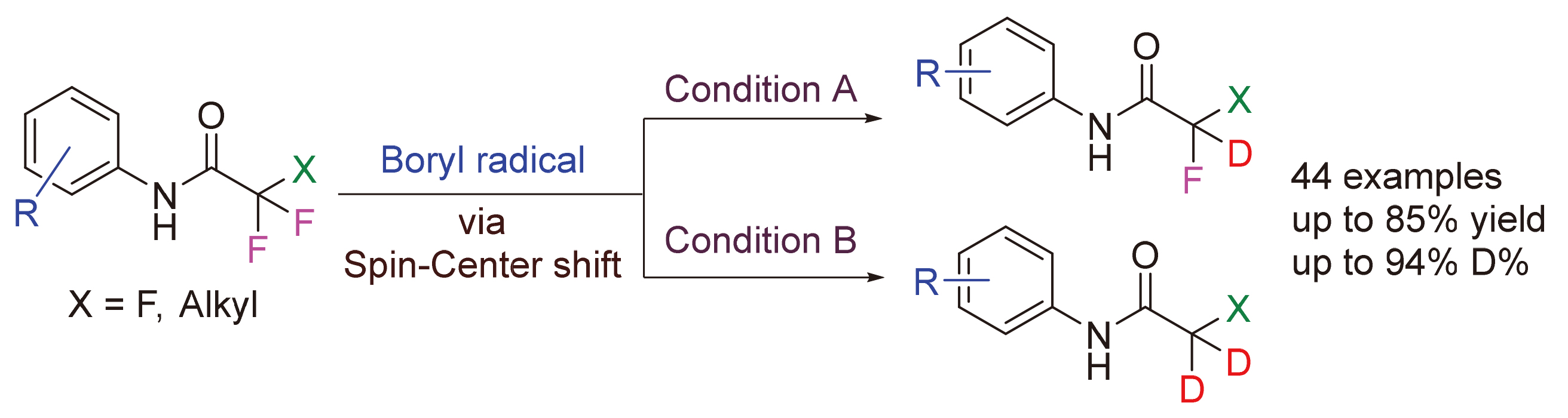
Deuterated mono- and difluoroalkyl groups have attracted increasing attention in medicinal and biological studies. Controllable snipping one or two fluorine atoms from widely accessible trifluoromethyl groups followed by deuteration is an attractive method to access these molecules, whereas this has been hindered by the challenges associated with the chemoselectivity control during the defluoriantion process. Herein, a strategy for chemoselective deuterodefluorination reaction of trifluoro- and difluoroalkylacetamides via spin-center shifts is reported. The reaction starts with the attack of a deuterated 4-dimethylaminopyridine-boryl radical (DMAP-BD2) to the amide oxygen atom, followed by a spin-center shift process to trigger the C—F bond scission. The resulting α,α-difluorocarbonyl radicals undergo deuterium atom transfer to afford the CF2D-products in high yields and high levels of D-incorporation. Notably, increasing the amount of DMAP-BD3 enables the selective cleavage of the two C—F bonds, leading to CFD2-products in good yields meanwhile maintaining good levels of D-incorporation.
Qiuyu Gu , Tianyu Peng , Mingcheng Bo , Yifeng Wang . Selective Mono- and Di-deuterodefluorination of Trifluoroacetamides Promoted by Boryl Radicals[J]. Chinese Journal of Organic Chemistry, 2023 , 43(5) : 1832 -1842 . DOI: 10.6023/cjoc202212030
| [1] | (a) Gillis, E. P.; Eastman, K. J.; Hill, M. D.; Donnelly, D. J.; Meanwell, N. A. J. Med. Chem. 2015, 58, 8315. |
| [1] | (b) Zhou, Y.; Wang, J.; Gu, Z.; Wang, S.; Zhu, W.; Ace?a, J. L.; Soloshonok, V. A.; Izawa, K.; Liu, H. Chem. Rev. 2016, 116, 422. |
| [1] | (c) Meanwell, N. A. J. Med. Chem. 2018, 61, 5822. |
| [2] | Fujiwara, T.; O’Hagan, D. J. Fluorine Chem. 2014, 167, 16. |
| [3] | Berger, R.; Resnati, G.; Metrangolo, P.; Weber, E.; Hulliger, J. Chem. Soc. Rev. 2011, 40, 3496. |
| [4] | Wallin, R. F.; Regan, B. M.; Napoli, M. D.; Stern, I. J. Anesth. Analg. 1975, 54, 758. |
| [5] | (a) Camerino, E.; Wong, D. M.; Tong, F.; K?rber, F.; Gross, A. D.; Islam, R.; Viayna, E.; Mutunga, J. M.; Li, J.; Totrov, M. M.; Bloomquist, J. R.; Carlier, P. R. Bioorg. Med. Chem. Lett. 2015, 25, 4405. |
| [5] | (b) Hartz, R. A.; Ahuja, V. T.; Rafalski, M.; Schmitz, W. D.; Brenner, A. B.; Denhart, D. J.; Ditta, J. L.; Deskus, J. A.; Yue, E. W.; Arvanitis, A. G.; Lelas, S.; Li, Y.-W.; Molski, T. F.; Wong, H.; Grace, J. E.; Lentz, K. A.; Li, J.; Lodge, N. J.; Zaczek, R.; Combs, A. P.; Olson, R. E.; Mattson, R. J.; Bronson, J. J.; Macor, J. E. J. Med. Chem. 2009, 52, 4161. |
| [6] | Meanwell, N. A. J. Med. Chem. 2011, 54, 2529. |
| [7] | Elmore, C. S.; Bragg, R. A. Bioorg. Med. Chem. Lett. 2015, 25, 167. |
| [8] | Shao, M.; Keum, J.; Chen, J.; He, Y.; Chen, W.; Browning, J. F.; Jakowski, J.; Sumpter, B. G.; Ivanov, I. N.; Ma, Y. Z.; Rouleau, C. M.; Smith, S. C.; Geohegan, D. B.; Hong, K.; Xiao, K. Nat. Commun. 2014, 5, 3180. |
| [9] | (a) Zhu, Y.; Zhou, J.; Jiao, B. ACS Med. Chem. Lett. 2013, 4, 349. |
| [9] | (b) Pirali, T.; Serafini, M.; Cargnin, S.; Genazzani, A. A. J. Med. Chem. 2019, 62, 5276. |
| [10] | (a) Ahrens, T.; Kohlmann, J.; Ahrens, M.; Braun, T. Chem. Rev. 2015, 115, 931. |
| [10] | (b) Shen, Q.; Huang, Y.-G.; Liu, C.; Xiao, J.-C.; Chen, Q.-Y.; Guo, Y. J. Fluorine Chem. 2015, 179, 14. |
| [10] | (c) Jaroschik, F. Chem.-Eur. J. 2018, 24, 14572. |
| [11] | Simur, T. T.; Ye, T.; Yu, Y.-J.; Zhang, F.-L.; Wang, Y.-F. Chin. Chem. Lett. 2022, 33, 1193. |
| [12] | Dang, H.; Whittaker, A. M.; Lalic, G. Chem. Sci. 2016, 7, 505. |
| [13] | Munoz, S. B.; Ni, C.; Zhang, Z.; Wang, F.; Shao, N.; Mathew, T.; Olah, G. A.; Prakash, G. K. S. Eur. J. Org. Chem. 2017, 2017, 2322. |
| [14] | Zhang, X.; Zhang, X.; Song, Q.; Sivaguru, P.; Wang, Z.; Zanoni, G.; Bi, X. Angew. Chem., Int. Ed. 2022, 61, e202116190. |
| [15] | (a) Yu, Y.-J.; Zhang, F.-L.; Peng, T.-Y.; Wang, C.-L.; Cheng, J.; Chen, C.; Houk, K. N.; Wang, Y.-F. Science 2021, 371, 1232. |
| [15] | (b) Simur, T. T.; Dagnaw, F. W.; Yu, Y.-J.; Zhang, F.-L.; Wang, Y.-F. Chin. J. Chem. 2022, 40, 577. |
| [15] | (c) Peng, T.-Y.; Zhang, F.-L.; Wang, Y.-F. Acc. Chem. Res. 2023, 56, 169. |
| [16] | Loh, Y. Y.; Nagao, K.; Hoover, A. J.; Hesk, D.; Rivera, N. R.; Colletti, S. L.; Davies, I. W.; MacMillan, D. W. C. Science 2017, 358, 1182. |
| [17] | Roberts, B. P. Chem. Soc. Rev. 1999, 28, 25. |
| [18] | (a) Zhang, F.-L.; Li, B.; Houk, K. N.; Wang, Y.-F. JACS Au 2022, 2, 1032. |
| [18] | (b) Wessig, P.; Muehling, O. Eur. J. Org. Chem. 2007, 2007, 2219. |
/
| 〈 |
|
〉 |

