
Chinese Journal of Organic Chemistry >
Research Progress of Electron Transport Properties in Ferrocene- Containing Single-Molecule Junctions
Received date: 2023-01-03
Revised date: 2023-02-21
Online published: 2023-03-24
Supported by
National Natural Science Foundation of China(22071025)
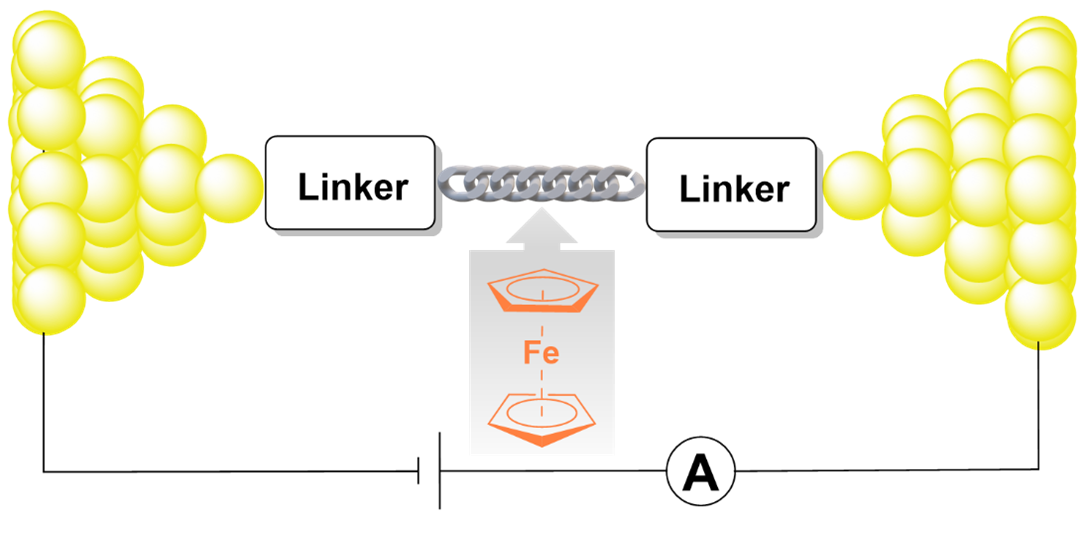
The development of molecular wires, the key component of molecular devices and the bridge and link between electrodes, is expected to solve the problem of future electronic devices that are reaching their theoretical size limit and cannot meet the higher demands of the population. After a long period of development, molecular wires are no longer limited to the basic stages of synthesis and modification. In recent years, the exploration of the practical functions of molecular wires has been a major focus of research in molecular electronics. Ferrocene has been widely used in the fields of nonlinear optics and molecular electronics due to its excellent physical and chemical properties. In the past decade or so, the introduction of ferrocene groups has led to the construction of a variety of novel molecular wires, which have significantly contributed to the basic research of single-molecule devices. The molecular wires based on ferrocene groups have several advantages over conventional pure organic molecular wires, including (1) reduced π-π stacking between molecules, (2) adjustable molecular lengths and flexibility, (3) reduced front-line molecular orbital energy differences, which improves the electron transfer capability of molecular wires, and (4) inherently good conductive properties, which allow direct interaction with gold electrodes to form single- molecule junction. However, most of the research on ferrocene-based molecular wires has focused on their 1,1'-substituted derivatives, while their 1,3-substituted derivatives have not received much attention due to the difficulty of their synthesis. Based on the structural properties of the molecules, metallocene molecular wires are classified into two types: π-conjugated and non π-conjugated. The work on the electron transport properties of ferrocene-containing single-molecule junctions in the last decade is summarized in terms of the conformational relationships of the molecules, in the hope of providing a reference for future research on ferrocene molecular wires.
Xin Zuo , Shinuo Xu , Zhongyang Chen , Jianfeng Yan , Yaofeng Yuan . Research Progress of Electron Transport Properties in Ferrocene- Containing Single-Molecule Junctions[J]. Chinese Journal of Organic Chemistry, 2023 , 43(7) : 2313 -2322 . DOI: 10.6023/cjoc202301002
| [1] | Jeschke, G.; Sajid, M.; Schulte, M.; Ramezanian, N.; Volkov, A.; Zimmermann, H.; Godt, A. J. Am. Chem. Soc. 2010, 132, 10107. |
| [2] | Xu, X. N.; Han, B.; Yu, X.; Zhu, Y. Y. Acta Chim. Sinica 2019, 77, 485 (in Chinese). |
| [2] | (许晓娜, 韩宾, 于曦, 朱艳英, 化学学报, 2019, 77, 485.) |
| [3] | Cui, X. D.; Primak, A.; Zarate, X.; Tomfohr, J.; Sankey, O. F.; Moore, A. L.; Moore, T. A.; Gust, D.; Harris, G.; Lindsay, S. M. Science 2001, 294, 571. |
| [4] | Venkataraman, L.; Klare, J. E.; Tam, I. W.; Nuckolls, C.; Hybertsen, M. S.; Steigerwald, M. L. Nano Lett. 2006, 6, 458. |
| [5] | Kubatkin, S.; Danilov, A.; Hjort, M.; Cornil, J.; Brédas, J.-L.; Stuhr-Hansen, N.; Hedeg?rd, P.; Bj?rnholm, T. Nature 2003, 425, 698. |
| [6] | Venkataraman, L.; Klare, J. E.; Nuckolls, C.; Hybertsen, M. S.; Steigerwald, M. L. Nature 2006, 442, 904. |
| [7] | Bigelow, W. C.; Pickett, D. L.; Zisman, W. A. J. Colloid. Sci. 1946, 1, 513. |
| [8] | Liu, J.; Zhao, X.; Al-Galiby, Q.; Huang, X.; Zheng, J.; Li, R.; Huang, C.; Yang, Y.; Shi, J.; Manrique, D. Z.; Lambert, C. J.; Bryce, M. R.; Hong, W. Angew. Chem., Int. Ed. 2017, 56, 13061. |
| [9] | Yang, G. G.; Sangtarash, S.; Liu, Z. T.; Li, X. H.; Sadeghi, H.; Tan, Z. B.; Li, R. H.; Zheng, J. T.; Dong, X. B.; Liu, J. Y.; Yang, Y.; Shi, J.; Xiao, Z. Y.; Zhang, G. X.; Lambert, C.; Hong, W. J.; Zhang, D. Q. Chem. Sci. 2017, 8, 7505. |
| [10] | Al, Y.; Zhang, H. L. Acta Phys.-Chim. Sin. 2012, 28, 2237 (in Chinese). |
| [10] | (艾勇, 张浩力, 物理化学学报, 2012, 28, 2237.) |
| [11] | Frei, M.; Aradhya, S. V.; Koentopp, M.; Hybertsen, M. S.; Venkataraman, L. Nano Lett. 2011, 11, 1518. |
| [12] | Getty, S. A.; Engtrakul, C.; Wang, L.; Liu, R.; Ke, S. H.; Baranger, H. U.; Yang, W.; Fuhrer, M. S.; Sita, L. R. Phys. Rev. B 2005, 71, 4. |
| [13] | Astruc, D. Eur. J. Inorg. Chem. 2017, 2017, 6. |
| [14] | Sun, Y.-Y.; Peng, Z.-L.; Hou, R.; Liang, J.-H.; Zheng, J.-F.; Zhou, X.-Y.; Zhou, X.-S.; Jin, S.; Niu, Z.-J.; Mao, B.-W. Phys. Chem. Chem. Phys. 2014, 16, 2260. |
| [15] | Kuznetsov, A. M.; Ulstrup, J. J. Phys. Chem. A 2000, 104, 11531. |
| [16] | Kuznetsov, A. N.; Schmickler, W. Chem. Phys. 2002, 282, 371. |
| [17] | Schmickler, W.; Henderson, D. J. Electroanal. Chem. 1990, 290, 283. |
| [18] | Xiao, X. Y.; Brune, D.; He, J.; Lindsay, S.; Gorman, C. B.; Tao, N. J. Chem. Phys. 2006, 326, 138. |
| [19] | Zhou, X.-S.; Liu, L.; Fortgang, P.; Lefevre, A.-S.; Serra-Muns, A.; Raouafi, N.; Amatore, C.; Mao, B.-W.; Maisonhaute, E.; Sch?ll- horn, B. J. Am. Chem. Soc. 2011, 133, 7509. |
| [20] | Li, Y.; Haworth, N. L.; Xiang, L.; Ciampi, S.; Coote, M. L.; Tao, N. J. J. Am. Chem. Soc. 2017, 139, 14699. |
| [21] | Dief, E. M.; Darwish, N. ACS Sens. 2021, 6, 573. |
| [22] | Li, Y. Q.; Wang, H.; Wang, Z. X.; Qiao, Y. J.; Ulstrup, J.; Chen, H. Y.; Zhou, G.; Tao, N. J. Proc. Natl. Acad. Sci. U. S. A. 2019, 116, 3407. |
| [23] | Chen, C.-P.; Luo, W.-R.; Chen, C.-N.; Wu, S.-M.; Hsieh, S.; Chiang, C.-M.; Dong, T.-Y. Langmuir 2013, 29, 3106. |
| [24] | Zhang, F.; Wu, X.-H.; Zhou, Y.-F.; Wang, Y.-H.; Zhou, X.-S.; Shao, Y.; Li, J.-F.; Jin, S.; Zheng, J.-F. ChemElectroChem 2020, 7, 1337. |
| [25] | Bredow, T.; Tegenkamp, C.; Pfnur, H.; Meyer, J.; Maslyuk, V. V.; Mertig, I. J. Chem. Phys. 2008, 128, 7. |
| [26] | Farzadi, R.; Moghaddam, H. M.; Farmanzadeh, D. Chem. Phys. Lett. 2018, 704, 37. |
| [27] | Lu, Q.; Yao, C.; Wang, X. H.; Wang, F. S. J. Phys. Chem. C 2012, 116, 17853. |
| [28] | Hsung, R. P.; Chidsey, C. E. D.; Sita, L. R. Organometallics 1995, 14, 4808. |
| [29] | Engtrakul, C.; Sita, L. R. Nano Lett. 2001, 1, 541. |
| [30] | Vollmann, M.; Butenschon, H. C. R. Chim. 2005, 8, 1282. |
| [31] | Engtrakul, C.; Sita, L. R. Organometallics 2008, 27, 927. |
| [32] | Ma, J. X.; Vollmann, M.; Menzel, H.; Pohle, S.; Butensch?n, H. J. Inorg. Organomet. Polym. Mater. 2008, 18, 41. |
| [33] | Baumgardt, I.; Butensch?n, H. Eur. J. Org. Chem. 2010, 2010, 1076. |
| [34] | Ma, J. X.; Krau?e, N.; Butensch?n, H. Eur. J. Org. Chem. 2015, 2015, 4510. |
| [35] | Lu, Q.; Wang, X. H.; Wang, F. S. Chin. J. Appl. Chem. 2011, 28, 136 (in Chinese). |
| [35] | (路崎, 王献红, 王佛松, 应用化学, 2011, 28, 136.) |
| [36] | Lambert, C. J. Chem. Soc. Rev. 2015, 44, 875. |
| [37] | Zhao, X.; Stadler, R. Phys. Rev. B 2019, 99, 10. |
| [38] | Camarasa-Gómez, M.; Hernangómez-Pérez, D.; Inkpen, M. S.; Lovat, G.; Fung, E. D.; Roy, X.; Venkataraman, L.; Evers, F. Nano Lett. 2020, 20, 6381. |
| [39] | Pei, L.-Q.; Horsley, J. R.; Seng, J.-W.; Liu, X.; Yeoh, Y. Q.; Yu, M.-X.; Wu, X.-H.; Abell, A. D.; Zheng, J.-F.; Zhou, X.-S.; Yu, J.; Jin, S. ACS Appl. Mater. Interfaces 2021, 13, 57646. |
| [40] | Wilkinson, L. A.; Bennett, T. L. R.; Grace, I. M.; Hamill, J.; Wang, X.; Au-Yong, S.; Ismael, A.; Jarvis, S. P.; Hou, S.; Albrecht, T.; Cohen, L. F.; Lambert, C.; Robinson, B. J.; Long, N. J. Chem. Sci. 2022, 13, 8380. |
| [41] | Yuan, Y.; Yan, J.-F.; Lin, D.-Q.; Mao, B.-W.; Yuan, Y.-F. Chem. - Eur. J. 2018, 24, 3545. |
| [42] | Vazquez, H.; Skouta, R.; Schneebeli, S.; Kamenetska, M.; Breslow, R.; Venkataraman, L.; Hybertsen, M. S. Nat. Nanotechnol. 2012, 7, 663. |
| [43] | Zhao, X.; Kastlunger, G.; Stadler, R. Phys. Rev. B 2017, 96, 085421. |
| [44] | Takaloo, A. V.; Sadeghi, H. J. Nanosci. Nanotechnol. 2019, 19, 7452. |
| [45] | Sato, M.; Fukui, K.; Sakamoto, M.; Kashiwagi, S.; Hiroi, M. Thin Solid Films. 2001, 393, 210. |
| [46] | Bildstein, B.; Loza, O.; Chizhov, Y. Organometallics 2004, 23, 1825. |
| [47] | Aragonès, A. C.; Darwish, N.; Ciampi, S.; Jiang, L.; Roesch, R.; Ruiz, E.; Nijhuis, C. A.; Díez-Pérez, I. J. Am. Chem. Soc. 2019, 141, 240. |
| [48] | Lawson, B.; Zahl, P.; Hybertsen, M. S.; Kamenetska, M. J. Am. Chem. Soc. 2022, 144, 6504. |
/
| 〈 |
|
〉 |

