
Chinese Journal of Organic Chemistry >
Aggregation-Induced Emission and Cell Imaging of Triphenylimidazole Derivatives
Received date: 2022-12-05
Revised date: 2023-03-04
Online published: 2023-03-31
Supported by
Natural Science Foundation of Hainan Province(222MS059)
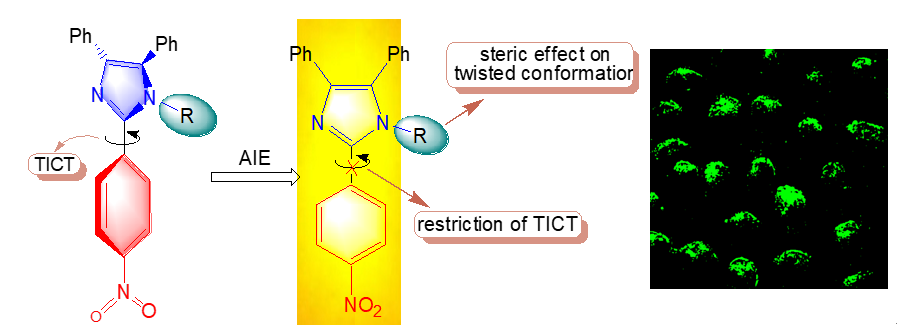
Aggregation-induced emission (AIE)-active materials have great advantages in the biomedical field and open up a whole new world of opportunity for bioimaging. Herein, two butylidene-bridged bisimidazole derivatives and two butyl-sub- stituted monoimidazole derivatives were easily synthesized from dibromobutane/bromobutane and 2,4,5-triphenyl-1H-imida- zole derivatives. All the obtained imidazole derivatives showed excellent AIE properties, and the derivatives containing methoxy groups exhibited red-shifted emission. The research on AIE mechanism indicated that the restriction of twisted intramolecular charge transfer (TICT) mechanism was responsible for the AIE behaviors of these imidazole derivatives. Therefore, the strong electron-withdrawing nitro group is crucial for their AIE property. In addition, the steric effect of the substituent group at 1-position of imidazole ring is also indispensable for AIE, because it results in the twisted conformation and thus hampers the intermolecular π-π stacking interactions. Ultimately, the cell staining and bioimaging behaviour of butyl-substituted monoimidazole derivatives were investigated. Both of them displayed an excellent bioimaging performance in blue, green and red channels, but the different staining regions in cells were observed in different channels.
Yang Zhao , Panpan Chen , Lizhi Han , Enju Wang . Aggregation-Induced Emission and Cell Imaging of Triphenylimidazole Derivatives[J]. Chinese Journal of Organic Chemistry, 2023 , 43(7) : 2454 -2461 . DOI: 10.6023/cjoc202212004
| [1] | Luo, J.; Xie, Z.; Lam, J. W. Y.; Cheng, L.; Tang, B. Z.; Chen, H.; Qiu, C.; Kwok, H. S.; Zhan, X.; Liu, Y.; Zhu, D. Chem. Commun. 2001, 1740. |
| [2] | Rizzo, F.; Cucinotta, F. Isr. J. Chem. 2018, 58, 1. |
| [3] | Qian, J.; Tang, B. Z. Chem 2020, 3, 56. |
| [4] | Gao, M.; Tang, B. Z. Coord. Chem. Rev. 2020, 402, 213076. |
| [5] | Parrott, E. P. J.; Tan, N. Y.; Hu, R.; Zeitler, J. A.; Tang, B. Z.; Pickwell-MacPherson, E. Mater. Horiz. 2014, 1, 251. |
| [6] | Leung, N. L. C.; Xie, N.; Yuan, W.; Liu, Y.; Wu, Q.; Peng, Q.; Miao, Q.; Lam, J. W. Y.; Tang, B. Z. Chem.-Eur. J. 2014, 20, 15349. |
| [7] | Xiong, J. B.; Yuan, Y. X.; Wang, L.; Sun, J. P.; Qiao, W. G.; Zhang, H. C.; Duan, M.; Han, H.; Zhang, S.; Zheng, Y. S. Org. Lett. 2018, 20, 373. |
| [8] | Kokado, K.; Machida, T.; Iwasa, T.; Taketsugu, T.; Sada, K. J. Phys. Chem. C 2018, 122, 245. |
| [9] | Gao, B. R.; Wang, H. Y.; Hao, Y. W.; Fu, L. M.; Fang, H. H.; Jiang, Y.; Wang, L.; Chen, Q. D.; Xia, H.; Pan, L. Y.; Ma, Y. G.; Sun, H. B. J. Phys. Chem. B 2010, 114, 128. |
| [10] | Abedi, S. A. A.; Chi, W.; Tan, D.; Shen, T.; Wang, C.; Ang, E. C. X.; Tan, C. H.; Anariba, F.; Liu, X. J. Phys. Chem. A 2021, 125, 8397. |
| [11] | Mei, J.; Leung, N. L. C.; Kwok, R. T. K.; Lam, J. W. Y.; Tang, B. Z. Chem. Rev. 2015, 115, 11718. |
| [12] | Zhang, Y.; Zhang, H.; Li, G.; Xu, X.; Kong, L.; Tao, X.; Tian, Y.; Yang, J. J. Mater. Chem. C 2016, 4, 2971. |
| [13] | Zhang, Y.; Huang, J.; Kong, L.; Tian, Y.; Yang, J. CrystEngComm 2018, 20, 1237. |
| [14] | Gao, T.; Cao, X.; Bi, A.; Dong, J.; Huang, S.; Huang, X.; Wen, S.; Zeng, W. Sens. Actuators, B 2018, 273, 1139. |
| [15] | Dwivedi, B. K.; Singh, V. D.; Kumar, Y.; Pandey, D. S. Dalton Trans. 2020, 49, 438. |
| [16] | Aradhyula, B. P. R.; Chinta, R. V. R. N.; Dhanunjayarao, K.; Venkatasubbaiah, K. RSC Adv. 2020, 10, 13149. |
| [17] | Kwon, J. E.; Park, S.; Park, S. Y. J. Am. Chem. Soc. 2013, 135, 11239. |
| [18] | Park, S.; Seo, J.; Kim, S. H.; Park, S. Y. Adv. Funct. Mater. 2008, 18, 726. |
| [19] | Li, Q.; Zhao, Y.; Niu, Z.; Wang, E. J. Fluoresc. 2022, 32, 443. |
| [20] | Li, Q.; Niu, Z.; Nan, X.; Wang, E. J. Fluoresc. 2022, 32, 1611. |
| [21] | Zhao, Y.; Li, Q.; Wang, E.; Niu, Z. Spectrochim. Acta A 2022, 7, 121621. |
| [22] | Li, Q.; Zhao, Y.; Wang, E. Chem. J. Chin. Univ. 2022, 43, 20210690 (in Chinese). |
| [22] | (李巧, 赵洋, 王恩举, 高等学校化学学报, 2022, 43, 20210690.) |
| [23] | Kajjam, A. B.; Dubey, D. K.; Kumar Yadav, R. A.; Jou, J.-H.; Sivakumar, V. Mater. Today Chem. 2019, 14, 100201. |
| [24] | Zeng, Q.; Li, Z.; Dong, Y.; Di, C.; Qin, A.; Hong, Y.; Ji, L.; Zhu, Z.; Jim, C. K. W.; Yu, G.; Li, Q.; Li, Z.; Liu, Y.; Qin, J.; Tang, B. Z. Chem. Commun. 2007, 70. |
| [25] | Tong, H.; Hong, Y.; Dong, Y.; H?ussler, M.; Li, Z.; Lam, J. W. Y.; Dong, Y.; Sung, H. H. Y.; Williams, I. D.; Tang, B. Z. J. Phys. Chem. B 2007, 111, 11817. |
| [26] | Baumann, W.; Bischof, H.; Frohling, J. C.; Brittinger, C.; Tettig, W.; Rotkiewicz, K. J. Photochem. Photobiol. A.,Chem. 1992, 64, 49. |
| [27] | Hu, R.; Lager, E.; Aguilar-Aguilar, A.; Liu, J.; Lam, J. W. Y.; Sung, H. H. Y.; Williams, I. D.; Zhong, Y.; Wong, K. S.; Pena-Cabrera, E.; Tang, B. Z. J. Phys. Chem. C 2009, 113, 15845. |
| [28] | Gao, T.; Zeng, H. L.; Xu, H.; Gao, F.; Li, W.; Zhang, S.; Liu, Y.; Luo, G.; Li, M.; Jiang, D.; Chen, Z.; Wu, Y.; Wang, W.; Zeng, W. Theranostics 2018, 8,1911. |
| [29] | Gao, T.; Cao, X.; Bi, A.; Dong, J.; Huang, S.; Huang, X.; Wen, S.; Zeng, W. Sens. Actuators, B 2018, 273, 1139. |
| [30] | Cao, X.; Tang, G.; Jie, D.; Jiang, X.; Zou, H.; Liu, T.; Yu, K.; Zeng, W. New J. Chem. 2019, 43, 7874. |
| [31] | Huang, S.; Gao, T.; Bi, A.; Cao, X.; Feng, B.; Liu, M.; Du, T.; Feng, X.; Zeng, W. Dyes Pigm. 2020, 172, 107830. |
/
| 〈 |
|
〉 |

