
Chinese Journal of Organic Chemistry >
Visible Light-Induced Pd-Catalyzed Heck Reactions
Received date: 2023-03-10
Revised date: 2023-05-23
Online published: 2023-06-07
Supported by
Marine Medicine Innovation Platform for the Integration of Production and Education of Guangdong Provincial Education Department(6021210004P); Innovation Team of Guangdong Education Department(2021KCXTD069); Post-doctoral Foundation Project of Shenzhen Polytechnic(6021330005K); Shenzhen Science and Technology Innovation Committee(JSGG20201103153800002); Shenzhen Science and Technology Innovation Committee(GJHZ20200731095412037); Shenzhen Science and Technology Innovation Committee(JCYJ20200109141808025)
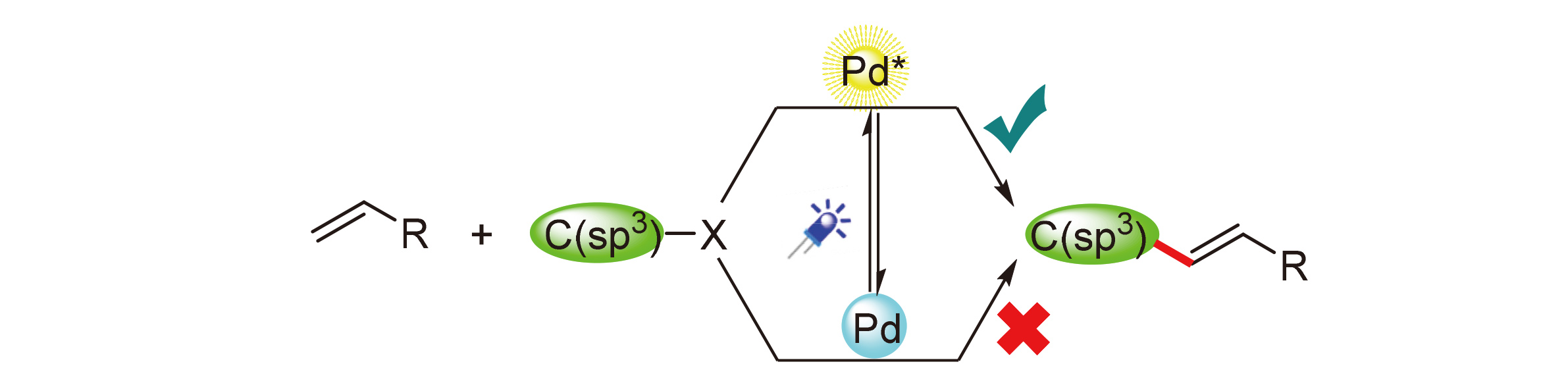
Heck reaction is regarded as one of the most powerful and practical synthetic tools to construct C—C bonds, and has gained increasingly widespread applications in the synthesis of various functional molecules over the past decades. As an emerging strategy for the formation of C—C bonds, visible light-induced Pd-catalyzed Heck reaction has tremendously extended the scope of substrates, in both aspects of nucleophiles and electrophiles. This unique transformation, triggered by photoexcited Pd0 and mechanistically involving hybrid radical-PdⅠ species, features mild conditions, excellent functional compatibility and transformational diversity, which greatly complements classical Heck reaction catalyzed by ground-state Pd complexes. These advantages will render visible light-induced Heck reaction widespread applications in the synthesis of functional molecules and late-stage modification of structurally complex compounds. According to the species of nucleophiles/ electrophiles and types of cascade reactions, visible light-induced Heck reactions are logically classified, and some of the elusive reaction mechanisms are also illustrated.
Key words: visible light; PdⅠ species; radical; single electron transfer; Heck reaction
Wei Xu , Hongbin Zhai , Bin Cheng , Taimin Wang . Visible Light-Induced Pd-Catalyzed Heck Reactions[J]. Chinese Journal of Organic Chemistry, 2023 , 43(9) : 3035 -3054 . DOI: 10.6023/cjoc202303013
| [1] | Beletskaya I. P.; Cheprakov A. V. Chem. Rev. 2000, 100, 3009. |
| [2] | (a) Heck R. F. J. Am. Chem. Soc. 1968, 90, 5518. |
| [2] | (b) Heck R. F. Acc. Chem. Res. 1979, 12, 146. |
| [2] | (c) Cabri W.; Candiani I. Acc. Chem. Res. 1995, 28, 2. |
| [2] | (d) Shibasaki M.; Boden C. D. J.; Kojima A. Tetrahedron 1997, 53, 7371. |
| [2] | (e) T. Crisp G. Chem. Soc. Rev. 1998, 27, 427. |
| [2] | (f) Dounay A. B.; Overman L. E. Chem. Rev. 2003, 103, 2945. |
| [2] | (g) Xie J. Q.; Liang R. X.; Jia Y. X. Chin. J. Chem. 2021, 39, 710. |
| [2] | (h) Jia Y.; Zhou P.; Cao Z.; Liang R.; Zhou B. Acta Chim. Sinica 2021, 79, 176. (in Chinese) |
| [2] | (周波, 梁仁校, 曹中艳, 周平海, 贾义霞, 化学学报, 2021, 79, 176.) |
| [2] | (i) Li Y.; Hao M.; Chang Y. C.; Liu Y.; Wang W. F.; Sun N.; Zhu W. Q.; Gao Z. Chin. J. Chem. 2021, 39, 2962. |
| [3] | Parasram M.; Chuentragool P.; Sarkar D.; Gevorgyan V. J. Am. Chem. Soc. 2016, 138, 6340. |
| [4] | (a) Chuentragool P.; Parasram M.; Shi Y.; Gevorgyan V. J. Am. Chem. Soc. 2018, 140, 2465. |
| [4] | (b) Ratushnyy M.; Parasram M.; Wang Y.; Gevorgyan V. Angew. Chem. Int. Ed. 2018, 57, 2712. |
| [4] | (c) Ratushnyy M.; Kvasovs N.; Sarkar S.; Gevorgyan V. Angew. Chem. Int. Ed. 2020, 59, 10316. |
| [5] | (a) Liu Q.; Dong X.; Li J.; Xiao J.; Dong Y. H.; Liu H. ACS Catal. 2015, 5, 6111. |
| [5] | (b) Zhou W. J.; Zhang Y. H.; Cao G. M.; Liu H. D.; Yu D. G. Chin. J. Org. Chem. 2017, 37, 1322. (in Chinese) |
| [5] | (周文俊, 张逸寒, 曹光梅, 刘惠东, 余达刚, 有机化学, 2017, 37, 1322.) |
| [5] | (c) Chuentragool P.; Kurandina D.; Gevorgyan V. Angew. Chem. Int. Ed. 2019, 58, 11586. |
| [5] | (d) Kancherla R.; Muralirajan K.; Sagadevan A.; Rueping M. Trends Chem. 2019, 1, 510. |
| [5] | (e) Kurandina D.; Chuentragool P.; Gevorgyan V. Synthesis 2019, 51, 985. |
| [5] | (f) Zhou W. J.; Cao G. M.; Zhang Z. P.; Yu D. G. Chem. Lett. 2019, 48, 181. |
| [5] | (g) Cheng W. M.; Shang R. ACS Catal. 2020, 10, 9170. |
| [5] | (h) Cheung K. P. S.; Sarkar S.; Gevorgyan V. Chem. Rev. 2022, 122, 1543. |
| [6] | Kurandina D.; Parasram M.; Gevorgyan V. Angew. Chem. Int. Ed. 2017, 56, 14212. |
| [7] | Wang G. Z.; Shang R.; Cheng W. M.; Fu Y. J. Am. Chem. Soc. 2017, 139, 18307. |
| [8] | Oku N.; Murakami M.; Miura T. Org. Lett. 2022, 24, 1616. |
| [9] | Kurandina D.; Rivas M.; Radzhabov M.; Gevorgyan V. Org. Lett. 2018, 20, 357. |
| [10] | Adamik R.; Foldesi T.; Novak Z. Org. Lett. 2020, 22, 8091. |
| [11] | Li M.; Qiu Y. F.; Wang C. T.; Li X. S.; Wei W. X.; Wang Y. Z.; Bao Q. F.; Ding Y. N.; Shi W. Y.; Liang Y. M. Org. Lett. 2020, 22, 6288. |
| [12] | Yao W.; Zhao G.; Wu Y.; Zhou L.; Mukherjee U.; Liu P.; Ngai M. Y. J. Am. Chem. Soc. 2022, 144, 3353. |
| [13] | Zhao G. Y.; Mukherjee U.; Zhou L.; Wu Y.; Yao W.; Mauro J. N.; Liu P.; Ngai M. Y. Chem. Sci. 2022, 13, 6276. |
| [14] | Lee G. S.; Kim D.; Hong S. H. Nat. Commun. 2021, 12, 991. |
| [15] | (a) Isse A. A.; Lin C. Y.; Coote M. L.; Gennaro A. J. Phys. Chem. B 2011, 115, 678. |
| [15] | (b) Pratsch G.; Lackner G. L.; Overman L. E. J. Org. Chem. 2015, 80, 6025. |
| [16] | Wang G. Z.; Shang R.; Fu Y. Org. Lett. 2018, 20, 888. |
| [17] | Koy M.; Sandfort F.; Tlahuext-Aca A.; Quach L.; Daniliuc C. G.; Glorius F. Chem. Eur. J. 2018, 24, 4552. |
| [18] | Xing W. L.; Shang R.; Wang G. Z.; Fu Y. Chem. Commun. 2019, 55, 14291. |
| [19] | Zhang Z.; Kvasovs N.; Dubrovina A.; Gevorgyan V. Angew. Chem. Int. Ed. 2022, 61, e202110924. |
| [20] | Zhang Z.; Gevorgyan V. J. Am. Chem. Soc. 2022, 144, 20875. |
| [21] | Zhao B.; Shang R.; Wang G.-Z.; Wang S.; Chen H.; Fu Y. ACS Catal. 2019, 10, 1334. |
| [22] | Kvasovs N.; Iziumchenko V.; Palchykov V.; Gevorgyan V. ACS Catal. 2021, 11, 3749. |
| [23] | Kvasovs N.; Gevorgyan V. Org. Lett. 2022, 24, 4176. |
| [24] | Chuentragool P.; Yadagiri D.; Morita T.; Sarkar S.; Parasram M.; Wang Y.; Gevorgyan V. Angew. Chem. Int. Ed. 2019, 58, 1794. |
| [25] | Du Y. J.; Sheng X. X.; Li J. H.; Chen J. M.; Yang S.; Chen M. Chem. Sci. 2023, 14, 3580. |
| [26] | Huang H.-M.; Koy M.; Serrano E.; Pflüger P. M.; Schwarz J. L.; Glorius F. Nat. Catal. 2020, 3, 393. |
| [27] | Huang H. M.; Bellotti P.; Pfluger P. M.; Schwarz J. L.; Heidrich B.; Glorius F. J. Am. Chem. Soc. 2020, 142, 10173. |
| [28] | Shing Cheung K. P.; Kurandina D.; Yata T.; Gevorgyan V. J. Am. Chem. Soc. 2020, 142, 9932. |
| [29] | Liu Z. L.; Ye Z. P.; Chen Y. X.; Zheng Y.; Xie Z. Z.; Guan J. P.; Xiao J. A.; Chen K.; Xiang H. Y.; Yang H. Org. Lett. 2022, 24, 924. |
| [30] | Huang H.-M.; Bellotti P.; Kim S.; Zhang X.; Glorius F. Nat. Synth. 2022, 1, 464. |
| [31] | Bellotti P.; Koy M.; Gutheil C.; Heuvel S.; Glorius F. Chem. Sci. 2020, 12, 1810. |
| [32] | Sun L.; Ye J. H.; Zhou W. J.; Zeng X.; Yu D. G. Org. Lett. 2018, 20, 3049. |
| [33] | Sun S.; Zhou C.; Yu J. T.; Cheng J. Org. Lett. 2019, 21, 6579. |
| [34] | Chen L.; Guo L. N.; Liu S.; Liu L.; Duan X. H. Chem. Sci. 2020, 12, 1791. |
| [35] | Koy M.; Bellotti P.; Katzenburg F.; Daniliuc C. G.; Glorius F. Angew. Chem. Int. Ed. 2020, 59, 2375. |
| [36] | Feng L.; Guo L.; Yang C.; Zhou J.; Xia W. Org. Lett. 2020, 22, 3964. |
| [37] | Du J.; Wang X.; Wang H.; Wei J.; Huang X.; Song J.; Zhang J. Org. Lett. 2021, 23, 5631. |
| [38] | Muralirajan K.; Kancherla R.; Gimnkhan A.; Rueping M. Org. Lett. 2021, 23, 6905. |
| [39] | Chen S.; Van Meervelt L.; Van der Eycken E. V.; Sharma U. K. Org. Lett. 2022, 24, 1213. |
| [40] | Renzi P.; Azzi E.; Bessone E.; Ghigo G.; Parisotto S.; Pellegrino F.; Deagostino A. Org. Chem. Front. 2022, 9, 906. |
/
| 〈 |
|
〉 |

