
Chinese Journal of Organic Chemistry >
Theoretical Study of How Electronic Effect of Substituent Affects Regioselectivity of C—Si Reductive Elimination
Received date: 2023-08-11
Revised date: 2023-08-29
Online published: 2023-08-31
Supported by
National Natural Science Foundation of China(22003006); National Natural Science Foundation of China(22201027); National Natural Science Foundation of China(22271034); China Postdoctoral Science Foundation(2021M700578)
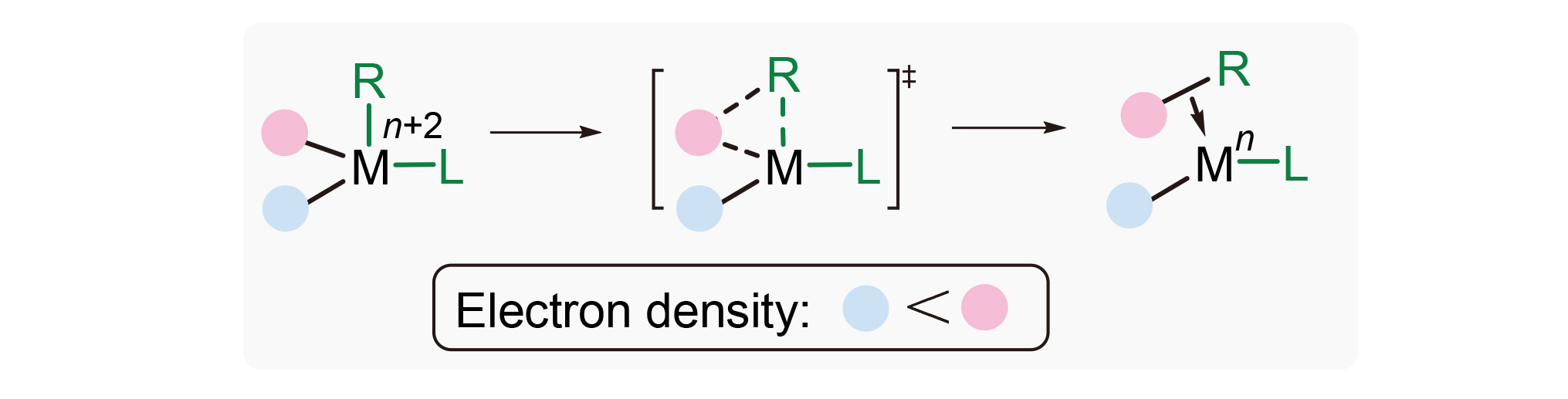
Regioselectivity adjustment is one of the key research fields in organic chemistry, and electronic effect is the key factor for adjustment. In this work, density functional theory (DFT) calculation was carried out to investigate how electronic effect of substituent affects regioselectivity in the reductive elimination step. Palladium-catalyzed annulation of silacyclo- butanes and 2-iodobiarenes was selected as model reaction, and detailed reaction mechanism is illustrated. The results shows that the reaction undergoes Pd—I bond oxidative addition, concerted metalation deprotonation (CMD), Pd—Si bond oxidative addition, and reductive elimination process to synthesize eight-membered silacycles, and C—Si bond reductive elimination is the rate determining step. Study of electronic effect in Pd(IV) reductive elimination transition state shows that when asymmetrically substituted 2-iodobyphenyl is used as substrate, electron density of aromatic ring is the main factor to control regioselectivity. Groups with higher electron density have higher priority for reductive elimination, and this is in accordance with electron flow in this elementary reaction.
Ju Peng , Xiaoqian He , Li-Li Liao , Ruopeng Bai , Yu Lan . Theoretical Study of How Electronic Effect of Substituent Affects Regioselectivity of C—Si Reductive Elimination[J]. Chinese Journal of Organic Chemistry, 2023 , 43(10) : 3608 -3613 . DOI: 10.6023/cjoc202308009
| [1] | (a) Liu P.; Montgomery J.; Houk K. N. J. Am. Chem. Soc. 2011, 133, 6956. |
| [1] | (b) Bronner S. M.; Mackey J. L.; Houk K. N.; Garg N. K. J. Am. Chem. Soc. 2012, 134, 13966. |
| [1] | (c) Wright J. S.; Scott P. J. H.; Steel P, G. Angew. Chem. Int. Ed. 2021, 60, 2796. |
| [2] | (a) Kakiuchi F.; Kochi T.; Mutsutani H.; Kobyashi N.; Urano S.; Sato M.; Nishiyama S.; Tanabe T. J. Am. Chem. Soc. 2009, 131, 11310. |
| [2] | (b) Liu P.; Sirois L. E.; Cheong P. H. Y.; Yu Z. X.; Hartung I. V.; Rieck H.; Wender P. A.; Houk K. N. J. Am. Chem. Soc. 2010, 132, 10127. |
| [2] | (c) Medina J. M.; Mackey J. L.; Garg N. K.; Houk K. N. J. Am. Chem. Soc. 2014, 136, 15798. |
| [2] | (d) Tomioka K.; Shioya Y.; Nagaoka Y.; Yamada K. J. Org. Chem. 2001, 66, 7051. |
| [2] | (e) Baral R. N.; Thomas S. W. J. Org. Chem. 2015, 80, 11086. |
| [2] | (f) Moore L. P.; Hagedorn Z. J.; Barnes M. E.; Dye M. L. N.; Whitt L. M.; Wilger D. J. Organometallics 2023, 42, 357. |
| [2] | (g) Karmakar R.; Yun S. Y.; Wang K. P.; Lee D. Org. Lett. 2014, 16, 6. |
| [3] | Liu S. H.; Zhang T.; Zhu L.; Liu F. R. Bai R. P.; Lan Y. Org. Lett. 2020, 22, 2124. |
| [4] | Huo J. F.; Zhong K. B.; Xue Y. Z.; Lyu M. M.; Ping Y. F.; Ouyang W. B.; Liu Z. X.; Lan Y.; Wang J. B. Chem.-Eur. J. 2022, 28, e202200191. |
| [5] | (a) Lai W.; Zhong K. B.; Liu S.; Liu S. H.; Chen H. H.; Ni H.; Zeng Z. Zhao Z.; Lan Y.; Bai R. P. J. Phys. Chem. Lett. 2022, 13, 7694. |
| [5] | (b) Chen S. W.; He X. Q.; Jin C. Y.; Zhang W. L.; Yang Y. X.; Liu S. S. Lan Y.; Houk K. N.; Shen X. Angew. Chem. Int. Ed. 2022, 61, e202213431. |
| [5] | (c) Hirano K. Yorimitsu H.; Oshima K. Org. Lett. 2006, 8, 483. |
| [6] | (a) Zhang Y.; Ma J. W.; Chen J.; Meng L. P. Liang Y.; Zhu S. L. Chem. 2021, 7, 3171. |
| [6] | (b) Zhang Y. L.; He J.; Song P. H. Wang Y.; Zhu S. L. CCS Chem. 2020, 2, 2259. |
| [6] | (c) He Y. L.; Han B.; Zhu S. L. Organometallics 2021, 40, 2253. |
| [7] | (a) Zhao W. T.; Gao F.; Zhao D. Angew. Chem., Int. Ed. 2018, 57, 6329. |
| [7] | (b) Ishida N.; Ikemoto W.; Murakami M. J. Am. Chem. Soc. 2014, 136, 5912. |
| [7] | (c) Okumura S.; Sun F.; Ishida N.; Murakami M. J. Am. Chem. Soc. 2017, 139, 12414. |
| [8] | Zhu M. H.; Zhang X. W.; Usman M.; Cong H. J.; Liu W. B. ACS Catal. 2021, 11, 5703. |
| [9] | Zhang J.; Zhang T.; Liu T.; Lan Y. Dalton Trans. 2021, 50, 7656. |
| [10] | (a) Chen H.; Peng J.; Pang Q. J.; Du H. M.; Huang L. Y.; Lu Gao Lan, Y.; Yang C.; Song Z. L. Angew. Chem. Int. Ed. 2022, e202212889. |
| [10] | (b) Li L. J.; Zhang Y. B.; Gao L.; Song Z. L. Tetrahedron Lett. 2015, 56, 1466. |
| [11] | Frisch M. J.; Trucks G. W.; Schlegel H. B.; Scuseria G. E.; Robb M. A.; Cheeseman J. R.; Scalmani G.; Barone V.; Petersson G. A.; Nakatsuji H.; Li X.; Caricato M.; Marenich A. V.; Bloino J.; Janesko B. G.; Gomperts R.; Mennucci B.; Hratchian H. P.; Ortiz J. V.; Izmaylov A. F.; Sonnenberg J. L.; Williams-Young D.; Ding F.; Lipparini F.; Egidi F.; Goings J.; Peng B.; Petrone A.; Henderson T.; Ranasinghe D.; Zakrzewski V. G.; Gao J.; Rega N.; Zheng G.; Liang W.; Hada M.; Ehara M.; Toyota K.; Fukuda R.; Hasegawa J.; Ishida M.; Nakajima T.; Honda Y.; Kitao O.; Nakai H.; Vreven T.; Throssell K.; Montgomery J. A., Jr.; Peralta J. E.; Ogliaro F.; Bearpark M. J.; Heyd J. J.; Brothers E. N.; Kudin K. N.; Staroverov V. N.; Keith T. A.; Kobayashi R.; Normand J.; Raghavachari K.; Rendell A. P.; Burant J. C.; Iyengar S. S.; Tomasi J.; Cossi M.; Millam J. M.; Klene M.; Adamo C.; Cammi R.; Ochterski J. W.; Martin R. L.; Morokuma K.; Farkas O.; Foresman J. B.; Fox D. J. Gaussian 16, Revision A.03, Gaussian, Inc., Wallingford CT, 2016. |
| [12] | (a) Becke A. D. J. Chem. Phys. 1993, 98, 5648. |
| [12] | (b) Stephens P. J.; Devlin F. J.; Chabalowski C. F.; Frisch M. J. J. Phys. Chem. 1994, 98, 11623. |
| [12] | (c) Lee C.; Yang W.; Parr R. G. Phys. Rev. B: Condens. Matter Mater. Phys. 1988, 37, 785. |
| [13] | Cancès E.; Mennucci B.; Tomasi J. J. Chem. Phys. 1997, 107, 3032. |
| [14] | (a) Zhao Y.; Truhlar D. Theor. Chem. Acc. 2008, 120, 215. |
| [14] | (b) Qi X.; Zhang H.; Shao A.; Zhu L.; Xu T.; Gao M.; Liu C.; Lan Y. ACS Catal. 2015, 5, 6640. |
| [14] | (c) Zhao Y.; Truhlar D. G. J. Chem. Phys. 2006, 125, 194101. |
| [15] | Weigend F.; Ahlrichs R. Phys. Chem. Chem. Phys. 2005, 7, 3297. |
| [16] | (a) Li Y.; Liu S.; Qi Z.; Qi X.; Li X.; Lan Y. Chem. Eur. J. 2015, 21, 10131. |
| [16] | (b) Qi X.; Li Y.; Zhang G.; Li Y.; Lei A.; Liu C.; Lan Y. Dalton Trans. 2015, 44, 11165. |
| [16] | (c) Marenich A. V.; Cramer C. J.; Truhlar D. G. J. Phys. Chem. B 2009, 113, 6378. |
| [16] | (d) Marenich A. V.; Cramer C. J.; Truhlar D. G. J. Phys. Chem. B 2009, 113, 4538. |
| [16] | (e) Yu Z.; Qi X.; Li Y.; Liu S.; Lan Y. Org. Chem. Front. 2016, 3, 209. |
| [17] | Legault C. Y. CYLview 1.0b, Université de Sherbrooke, Canada, 2009, http://www.cylview.org. |
/
| 〈 |
|
〉 |

