
Chinese Journal of Organic Chemistry >
Detection of Oxygen Based on Host-Guest Doped Room-Temperature Phosphorescence Material
Received date: 2024-04-01
Revised date: 2024-05-31
Online published: 2024-07-02
Supported by
National Natural Science Foundation of China(22222501); National Natural Science Foundation of China(22175023); Natural Science Foundation of Beijing(2232022); Natural Science Foundation of Beijing(2242060); Beijing Institute of Technology Research and Innovation Promoting Project(2023YCXZ016)
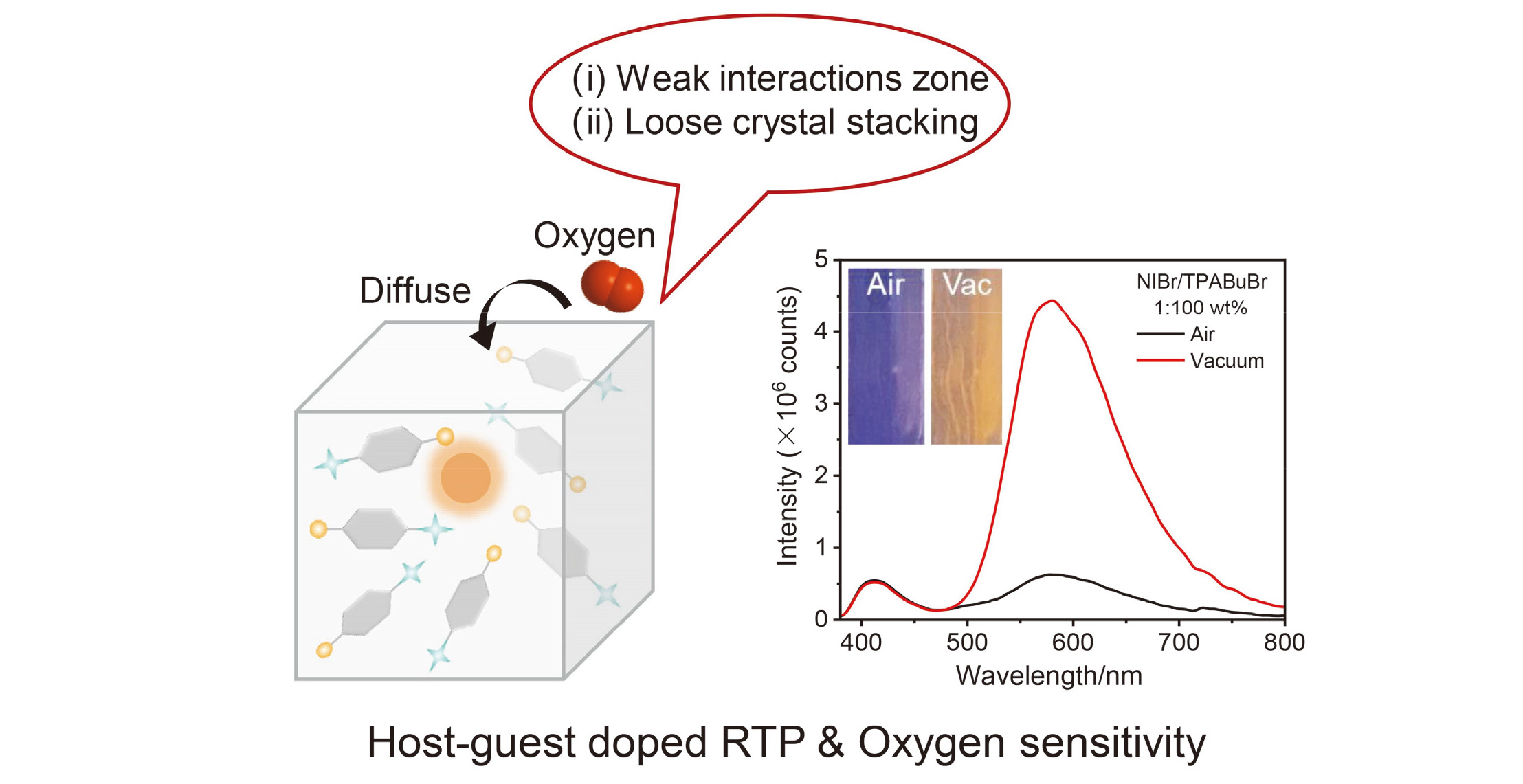
Quantitative oxygen detection, especially at low concentrations, holds significant importance in the realms of biology, complex environments, and chemical process engineering. Due to the high sensitivity and rapid response of the triplet excitons of phosphorescence to oxygen, pure organic room-temperature phosphorescence (RTP) materials have garnered widespread attention in recent years for oxygen detection. However, simultaneously achieving ultralong phosphorescence at room temperature and quantitative oxygen detection from pure organic host-guest doped materials poses challenges. The densely packed materials may decrease non-radiative decay to increase the phosphorescence, but are unsuitable for oxygen diffusion in oxygen detection. Herein, the oxygen sensitivity of host-guest doped RTP materials using 4-bromo-N,N-bis(4-(tert- butyl)phenyl)aniline (TPABuBr) as the host and 6-bromo-2-butyl-1H-benzo[de]isoquinoline-1,3(2H)-dione (NIBr) as the guest was developed. The doped material exhibits fluorescence-phosphorescence dual-emission behavior at room temperature. The tert-butyl groups in TPABuBr facilitate appropriate intermolecular spacing in the crystal state, enhancing oxygen permeability. Therefore, oxygen penetration can quench the phosphorescence emission. The observed linear relationship between the phosphorescence intensity of the doped material and the oxygen volume fraction conforms to the Stern-Volmer equation, suggesting its potential for quantitative analysis of oxygen concentration. The calculated limit of detection is 0.015% (φ), enabling the analysis of oxygen with a volume fraction of less than 2.5% (φ). Moreover, the doped materials demonstrate rapid response and excellent photostability, indicating their potential utility as oxygen sensors. This study elucidates the design and characteristics of NIBr/TPABuBr doped materials, highlighting their potential application in oxygen concentration detection and offering insights for the design of oxygen sensors.
Wei Zhang , Gengchen Li , Hao Su , Wenbo Dai , Peng Sun , Jianbing Shi , Bin Tong , Zhengxu Cai , Yuping Dong . Detection of Oxygen Based on Host-Guest Doped Room-Temperature Phosphorescence Material[J]. Chinese Journal of Organic Chemistry, 2024 , 44(8) : 2523 -2529 . DOI: 10.6023/cjoc202404003
| [1] | O’Riordan, T. C.; Voraberger, H.; Kerry, J. P.; Papkovsky, D. B. Anal. Chim. Act. 2005, 530, 135. |
| [2] | (a) Wu, C.; Bull, B.; Christensen, K.; McNeill, J. Angew. Chem., Int. Ed. 2009, 48, 2741. |
| [2] | (b) Wang, S.; Gu, K.; Guo, Z.; Yan, C.; Yang, T.; Chen, Z.; Tian, H.; Zhu, W.-H. Adv. Mater. 2019, 31, 1805735. |
| [2] | (c) Feng, G.; Zhang, G.-Q.; Ding, D. Chem. Soc. Rev. 2020, 49, 8179. |
| [2] | (d) Zhang, G.; Palmer, G. M.; Dewhirst, M. W.; Fraser, C. L. Nat. Mater. 2009, 8, 747. |
| [2] | (e) Godet, I.; Doctorman, S.; Wu, F.; Gilkes, D. M. Cell. 2022, 11, 686. |
| [3] | Seife, C. Scienc. 2003, 299, 1971. |
| [4] | (a) Jin, H.; Jiang, X.; Sun, Z.; Gui, R. Coord. Chem. Rev. 2021, 431, 213694. |
| [4] | (b) Ju, Y.; Wu, X. g.; Huang, S.; Dai, G.; Song, T.; Zhong, H. Adv. Funct. Mater. 2021, 32, 2108296. |
| [4] | (c) Liu, H.; Pan, G.; Yang, Z.; Wen, Y.; Zhang, X.; Zhang, S. T.; Li, W.; Yang, B. Adv. Opt. Mater. 2022, 10, 2102814. |
| [5] | (a) Liu, X. Q.; Zhang, K.; Gao, J. F.; Chen, Y. Z.; Tung, C. H.; Wu, L. Z. Angew. Chem., Int. Ed. 2020, 59, 23456. |
| [5] | (b) Zeng, Y.; Nguyen, V. P.; Li, Y.; Kang, D. H.; Paulus, Y. M.; Kim, J. ACS Appl. Mater. Interface. 2022, 14, 18182. |
| [5] | (c) Kou, M.; Qin, F.; Wang, Y.; Zhang, X.; Hu, Z.; Zhao, H.; Zhang, Z. J. Phys. Chem. Lett. 2023, 14, 7193. |
| [6] | (a) Dai, W.; Bianconi, T.; Ferraguzzi, E.; Wu, X.; Lei, Y.; Shi, J.; Tong, B.; Carlotti, B.; Cai, Z.; Dong, Y. ACS Mater. Lett. 2021, 3, 1767. |
| [6] | (b) Cao, Y.; Wang, D.; Zhang, Y.; Li, G.; Gao, C.; Li, W.; Chen, X.; Chen, X.; Sun, P.; Dong, Y.; Cai, Z.; He, Z. Angew. Chem., Int. Ed. 2024, e202401331. |
| [6] | (c) Zhang, Y.; Zhang, W.; Xia, J.; Xiong, C.; Li, G.; Li, X.; Sun, P.; Shi, J.; Tong, B.; Cai, Z.; Dong, Y. Angew. Chem., Int. Ed. 2023, 62, e202314273. |
| [6] | (d) Zhao, Y.; Yang, J.; Liang, C.; Wang, Z.; Zhang, Y.; Li, G.; Qu, J.; Wang, X.; Zhang, Y.; Sun, P.; Shi, J.; Tong, B.; Xie, H.-Y.; Cai, Z.; Dong, Y. Angew. Chem., Int. Ed. 2024, 63, e202317431. |
| [6] | (e) Dai, W.; Jiang, Y.; Lei, Y.; Huang, X.; Sun, P.; Shi, J.; Tong, B.; Yan, D.; Cai, Z.; Dong, Y. Chem. Sci. 2024, 15, 4222. |
| [7] | He, T.; Guo, W. J.; Chen, Y. Z.; Yang, X. F.; Tung, C. H.; Wu, L. Z. Aggregat. 2023, 4, e250. |
| [8] | (a) Han, X.; Chen, K.; Lei, Y.; Huang, J.; Wei, S.; Cai, Z.; Wu, H.-Y.; Liu, M.-C.; Huang, X.-B.; Dong, Y. ACS Mater. Lett. 2022, 4, 1764. |
| [8] | (b) Dai, W.; Li, G.; Zhang, Y.; Ren, Y.; Lei, Y.; Shi, J.; Tong, B.; Cai, Z.; Dong, Y. Adv. Funct. Mater. 2023, 33, 2210102. |
| [8] | (c) Dai, W.; Niu, X.; Wu, X.; Ren, Y.; Zhang, Y.; Li, G.; Su, H.; Lei, Y.; Xiao, J.; Shi, J.; Tong, B.; Cai, Z.; Dong, Y. Angew. Chem., Int. Ed. 2022, 61, e202200236. |
| [8] | (d) Lei, Y.; Dai, W.; Guan, J.; Guo, S.; Ren, F.; Zhou, Y.; Shi, J.; Tong, B.; Cai, Z.; Zheng, J.; Dong, Y. Angew. Chem., Int. Ed. 2020, 59, 16054. |
| [8] | (e) Dai, W.; Zhang, Y.; Wu, X.; Guo, S.; Ma, J.; Shi, J.; Tong, B.; Cai, Z.; Xie, H.; Dong, Y. CCS Chem. 2022, 4, 2550. |
| [8] | (f) Ding, B.; Ma, L.; Huang, Z.; Ma, X.; Tian, H. Sci. Adv. 2021, 7, eabf9668. |
| [8] | (g) Song, J.; Ma, X. Chin. J. Org. Chem. 2021, 41, 4519 (in Chinese). |
| [8] | (宋金明, 马骧, 有机化学, 2021, 41, 4519.) |
| [8] | (h) Han, P.; Qin, A. Chin. J. Org. Chem. 2023, 43, 2254 (in Chinese). |
| [8] | (韩鹏博, 秦安军, 有机化学, 2023, 43, 2254.) |
| [9] | (a) Lei, Y.; Yang, J.; Dai, W.; Lan, Y.; Yang, J.; Zheng, X.; Shi, J.; Tong, B.; Cai, Z.; Dong, Y. Chem. Sci. 2021, 12, 6518. |
| [9] | (b) Li, G.; Dai, W.; Lei, Y.; Shi, J.; Tong, B.; Cai, Z.; Dong, Y. ChemPhotoChe. 2022, 7, e202200198. |
| [9] | (c) Guo, Y.; Chen, K.; Hu, Z.; Lei, Y.; Liu, X.; Liu, M.; Cai, Z.; Xiao, J.; Wu, H.; Huang, X. J. Phys. Chem. Lett. 2022, 13, 7607. |
| [9] | (d) Lei, Y.; Dai, W.; Li, G.; Zhang, Y.; Huang, X.; Cai, Z.; Dong, Y. J. Phys. Chem. Lett. 2023, 14, 1794. |
| [9] | (e) Ren, Y.; Dai, W.; Guo, S.; Dong, L.; Huang, S.; Shi, J.; Tong, B.; Hao, N.; Li, L.; Cai, Z.; Dong, Y. J. Am. Chem. Soc. 2022, 144, 1361. |
| [9] | (f) Xiao, F.; Gao, H.; Lei, Y.; Dai, W.; Liu, M.; Zheng, X.; Cai, Z.; Huang, X.; Wu, H.; Ding, D. Nat. Commun. 2022, 13, 186. |
| [9] | (g) Zhang, Y.; Xiong, C.; Wang, W.; Dai, W.; Ren, Y.; Xia, J.; Li, G.; Shi, J.; Tong, B.; Zheng, X.; Shao, X.; Cai, Z.; Dong, Y. Aggregat. 2023, 4, e310. |
| [10] | Guo, S.; Dai, W.; Chen, X.; Lei, Y.; Shi, J.; Tong, B.; Cai, Z.; Dong, Y. ACS Mater. Lett. 2021, 3, 379. |
| [11] | Gu, F.; Jiang, T.; Ma, X. ACS Appl. Mater. Interface. 2021, 13, 43473. |
| [12] | Zhou, Y.; Qin, W.; Du, C.; Gao, H.; Zhu, F.; Liang, G. Angew. Chem., Int. Ed. 2019, 58, 12102. |
| [13] | Guo, W.-J.; Chen, Y.-Z.; Tung, C.-H.; Wu, L.-Z. CCS Chem. 2021, 3, 1384. |
| [14] | (a) Cai, Y.; Guo, Z.; Chen, J.; Li, W.; Zhong, L.; Gao, Y.; Jiang, L.; Chi, L.; Tian, H.; Zhu, W.-H. J. Am. Chem. Soc. 2016, 138, 2219. |
| [14] | (b) Lumpi, D.; Holzer, B.; Bintinger, J.; Horkel, E.; Waid, S.; Wanzenb?ck, H. D.; Marchetti-Deschmann, M.; Hametner, C.; Bertagnolli, E.; Kymissis, I.; Fr?hlich, J. New J. Chem. 2015, 39, 1840. |
| [15] | Chen, X.; Xu, C.; Wang, T.; Zhou, C.; Du, J.; Wang, Z.; Xu, H.; Xie, T.; Bi, G.; Jiang, J.; Zhang, X.; Demas, J. N.; Trindle, C. O.; Luo, Y.; Zhang, G. Angew. Chem., Int. Ed. 2016, 55, 9872. |
| [16] | (a) Wang, Y.; Yang, J.; Gong, Y.; Fang, M.; Li, Z.; Tang, B. Z. SmartMa. 2020, 1, 1006. |
| [16] | (b) Xu, Z.; He, Y.; Shi, H.; An, Z. SmartMa. 2023, 4, e1139. |
| [16] | (c) Cai, S.; Yao, X.; Ma, H.; Shi, H.; An, Z. Aggregat. 2023, 4, e320. |
| [16] | (d) Zhang, Y.; Li, J.; Zhao, J.; Li, X.; Wang, Z.; Huang, Y.; Zhang, H.; Liu, Q.; Lei, Y.; Ding, D. Angew. Chem., Int. Ed. 2024, 63, e202313890. |
| [17] | (a) Huang, R. W.; Wei, Y. S.; Dong, X. Y.; Wu, X. H.; Du, C. X.; Zang, S. Q.; Mak, T. C. W. Nat. Chem. 2017, 9, 689. |
| [17] | (b) Xie, Z.; Ma, L.; deKrafft, K. E.; Jin, A.; Lin, W. J. Am. Chem. Soc. 2010, 132, 922. |
| [17] | (c) Wang, X.-D.; Wolfbeis, O. S. Chem. Soc. Rev. 2014, 43, 3666. |
/
| 〈 |
|
〉 |

