


1 Introduction
Acylsilanes are readily available reagents with a silyl group connected to a carbonyl group, which have been used in a variety of reactions as a relative stable synthetic build-ing block.[1] For example, the electron-withdrawing ability of the carbonyl unit leads to the α-H acidic and enables the formation of an enol form intermediate.[2] On the other hand, under heating or irradiation with light, siloxy carbene can be generated smoothly through a 1,2-silyl transfer process. The pioneering work in this area can be traced back to 1967, when Brook and Duff[3] reported that 1,2-silyl transfer occurred under irradiation with UV-light, resulting the generation of α-siloxy carbenes, which underwent an O—H bond insertion reaction. With the development of visible light-induced reactions,[4] it has been found that acylsilanes can also form α-siloxy carbenes under the irradiation of visible light, which offers the opportunity to exploration of novel carbene chemistry under mild conditions.[5] The generally accepted mechanism for the generation of α-siloxy carbene is via the excited triplet state of acylsilane that derived from the excited singlet state through intersystem crossing (ISC) process, followed by a 1,2-Brook rearrangement, leading to the key triplet state α-siloxy carbene intermediate. Then, the triplet α-siloxy carbene led to the singlet state carbene via ISC.[6] Omitting the process of ISC can simplify the mechanism to the schematic diagram as shown in Scheme 1a. Like other carbene species, singlet α-siloxy carbene undergoes typical carbene transfer reactions under corresponding conditions, such as O—H bond insertion,[3,7] N—H bond insertion,[8] B—H bond insertion,[9] P—H bond insertion,[10] cyclization reaction,[11] and others,[12] which provides a practical and efficient method for the construction of silicon-containing molecules with structural diversity.
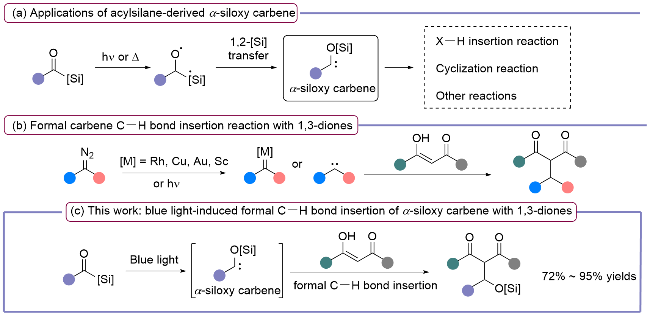
1,3-Diketones are one of the commonly used materials in synthetic chemistry.[13] In recent years, the reaction between 1,3-diketones and carbene intermediates has attracted in-creasing attention, which directly forms C—C bond via C—H bond insertion reactions (Scheme 1, b). Due to the electron-withdrawing property of the bicarbonyl group, the C—H bond of the enol formula of 1,3-diketones is prone to transition metal-catalyzed carbene insertion reactions, such as Rh,[14] Cu,[15] Au[16] or Sc[17] catalysis, resulting the C-alkylation products. On the other hand, free carbene intermediates generated from diazo compounds under visible light irradiation[18] can lead to various transformations, including the C—H bond insertion reaction with 1,3-dike-tones.[19] These methods provide alternative approaches for the construction of alkylated 1,3-diketones under mild con-ditions.
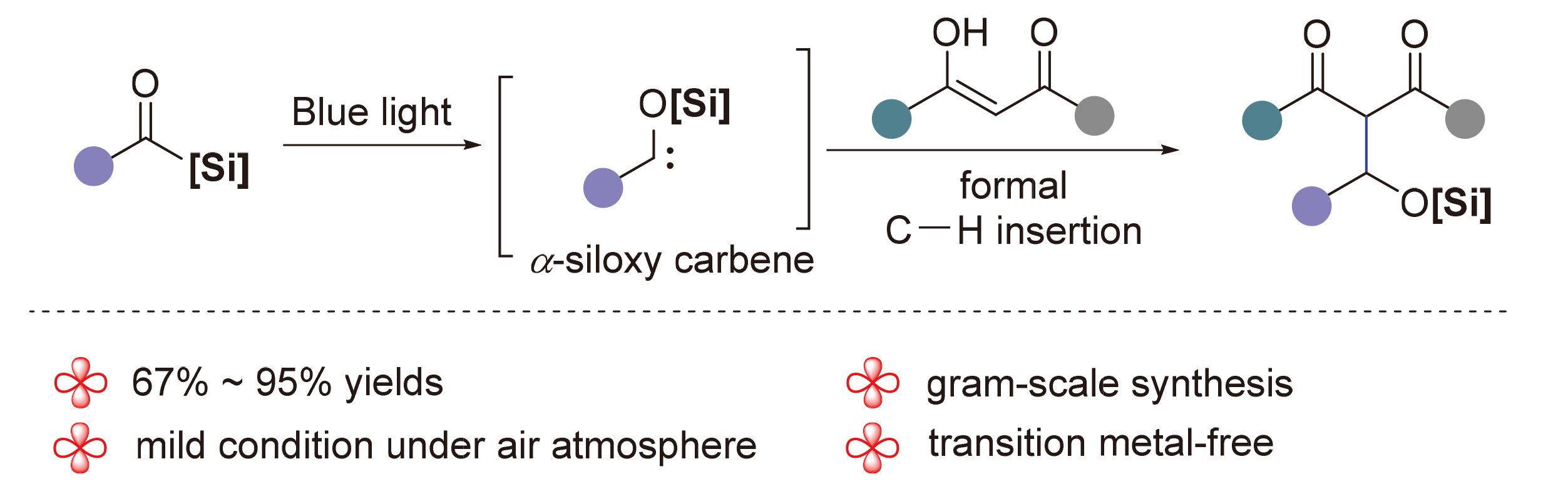
Inspired by above advances and as our ongoing interest in the catalytic carbene transformations with different precursors, we herein report a blue light-induced C—H bond insertion reaction of α-siloxy carbene that derived from acylsilane. To the best of our knowledge, this is the only example of C—H bond insertion reaction using acylsilane as the carbene precursor, which features a simple and metal-free approach for the direct access to the alkylated 1,3-diketones under mild conditions (Scheme 1, c). Moreover, the synthetic potential of this protocol has been demonstrated by performing the reaction on a gram scale with comparable high yield.
2 Results and discussion
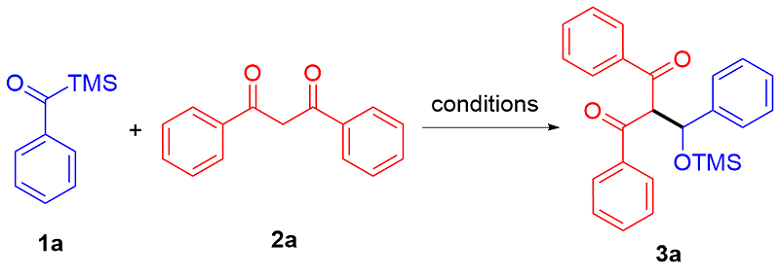
The initial investigation using phenyl(trimethylsilyl)-methanone (1a) and 1,3-diphenylpropane-1,3-dione (2a) as model substrates in 1,2-dichloroethane (DCE) under 427 nm blue LED at room temperature for 4 h afforded 76% yield of the expected product 3a (Table 1, Entry 1). Subsequently, the effect of the light source was investigated (Entries 2~5), however, no improved result has been obtained in term of yield. It's worth mentioning that the target product was not obtained when the reaction was conducted in the absence of light, implying that the reaction was driven by visible light. Next, varying the ratios of the two substrates was studied to determine the best ratio for this reaction, and higher yield was recorded with the ratio 1.5∶1 of 1a∶2a (Entries 6 and 7). An evaluation of different solvents, such as dichloromethane (DCM), CHCl3, hexane, xylene, toluene, PhCl, tetrahydrofuran (THF), and N,N-di-methyl formamide (DMF), revealed that the reaction could be carried out in most of these tested solvents (Entries 8~15), and PhCl proved to be the most efficient one, affording the product 3a in 94% yield (Entry 13). Additionally, the reaction was not affected at all without the protection of argon atmosphere, producing 3a in comparable high yield under the air atmosphere (Entry 16). Whiles, the yields dropped when the reaction time was shortened (Entries 17 and 18).
Table 1 Optimization of the reaction conditionsa
|
| Entry | Light source | 1a∶2a | Solvent | Yieldb/% |
|---|---|---|---|---|
| 1 | 10 W, 427 nm | 1∶1 | DCE | 76 |
| 2 | Dark | 1∶1 | DCE | 0 |
| 3 | 10 W, 390 nm | 1∶1 | DCE | 43 |
| 4 | 10 W, 450 nm | 1∶1 | DCE | 52 |
| 5 | 10 W, 470 nm | 1∶1 | DCE | 47 |
| 6 | 10 W, 427 nm | 1.5∶1 | DCE | 86 |
| 7 | 10 W, 427 nm | 2∶1 | DCE | 86 |
| 8 | 10 W, 427 nm | 1.5∶1 | DCM | 83 |
| 9 | 10 W, 427 nm | 1.5∶1 | CHCl3 | 78 |
| 10 | 10 W, 427 nm | 1.5∶1 | Hexane | 53 |
| 11 | 10 W, 427 nm | 1.5∶1 | Xylene | 61 |
| 12 | 10 W, 427 nm | 1.5∶1 | Toluene | 50 |
| 13 | 10 W, 427 nm | 1.5∶1 | PhCl | 94 |
| 14 | 10 W, 427 nm | 1.5∶1 | THF | 23 |
| 15 | 10 W, 427 nm | 1.5∶1 | DMF | 15 |
| 16c | 10 W, 427 nm | 1.5∶1 | PhCl | 93 |
| 17c,d | 10 W, 427 nm | 1.5∶1 | PhCl | 92 |
| 18c,e | 10 W, 427 nm | 1.5∶1 | PhCl | 81 |
a Unless otherwise noted, the reactions were carried out with acylsilane 1a (26.7 mg, 0.15 mmol), 1,3-diketone 2a (22.4 mg, 0.1 mmol) in indicated solvent (1.0 mL) under the light irradiation (1×10 W, 427 nm) and argon atmosphere at 25 ℃ for 4 h. b Isolated yields of 3a. c Under the air. d Running for 6 h. e Running for 3 h. |
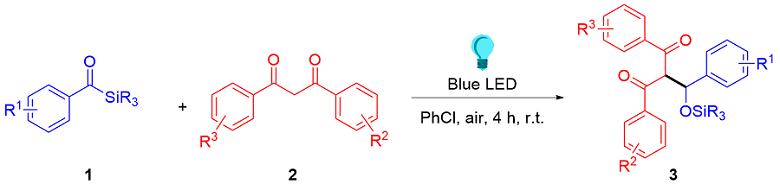
With the obtained optimal reaction conditions, the substrate generality of this transformation was investigated and the results are summarized in Table 2. The protocol showed good tolerance for substituted 1,3-diphenylpropane-1,3-diones 2 bearing electron-neutral (Me), electron-donating (OMe) and electron-withdrawing (F, Cl, Br and CF3) groups. All the reactions proceeded smoothly to afford the desired products in good yields (3b~3g, 78%~92% yields). The structure of 3b was determined by X-ray crystallography analysis. The reaction could be successfully applied to substrates bearing different substituents on the para position of phenyl(trimethylsilyl)methanone (1a). For example, derivatives containing electron-neutral (Me), electron-donating (OMe), electron-withdrawing (CF3) and halogen (F, Cl) groups, could effectively generate products 3h~3l in 76%~91% yields. For substrates 1 containing a steric bulky tertiary butyl, 3,5-dimethyl or additional phenyl substituent on the para-position of the benzene ring, the reaction all performed well with 2a, generating corresponding target products 3m~3o 77%~84% yield under current conditions. The tert-butyl silyl (TBS) and triiso-propylsilyl (TIPS) substituted analogues, (tert-butyl-dimethylsilyl)(phenyl)methanone (1p) and phenyl(triiso-propylsilyl)methanone (1q), also proved suitable for this reaction and afforded the desired products 3p and 3q in 87% and 90% yields, respectively. In addition, the target products 3s~3u derived from 2-naphthyl 1,3-diketone could be obtained in >80% yields. 1,3-Diketones with asymmetric structure were also suitable for this reaction, providing product 3v in 87% yield with1.2∶1 dr.
Table 2 Substrate scope for the formal C—H insertion
|
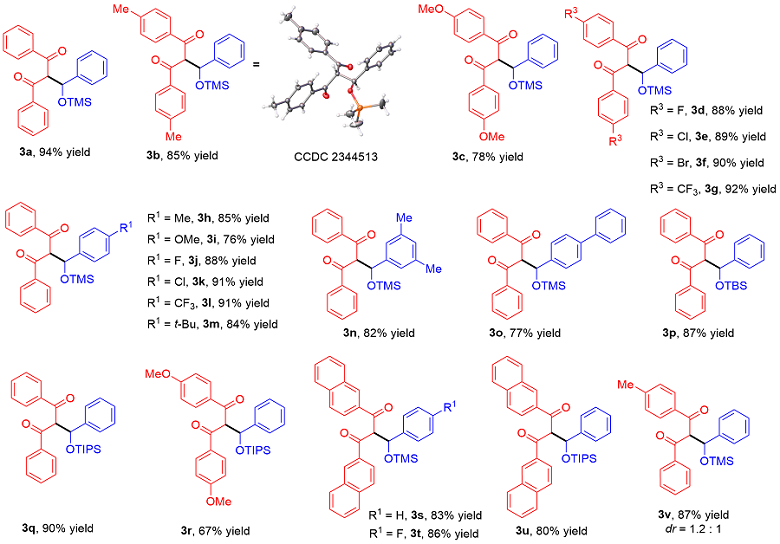 |
a Reaction conditions: acylsilanes 1 (0.15 mmol), 1,3-diketones 2 (0.1 mmol) in PhCl (1.0 mL) under the light irradiation (1×10 W, 427 nm) and air atmosphere at 25 ℃ for 4 h; The yields are given in isolated yields; TMS=trimethylsilyl. |
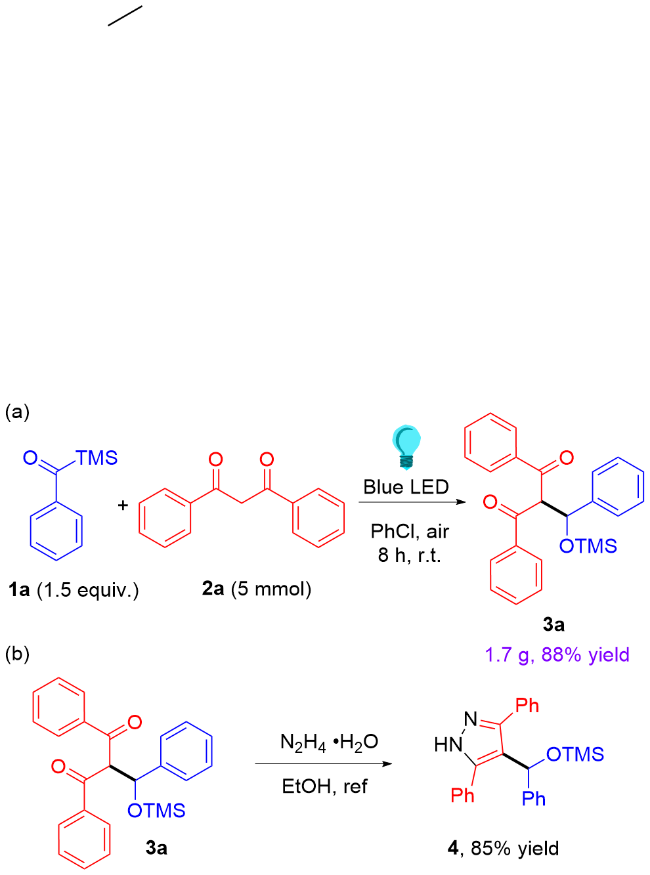
To show the synthetic potential of this method, gram-scale reaction was conducted with 1a and 2a under standard conditions. To our delight, the desired product 3a was isolated in 88% (1.57 g) yield (Scheme 2, a). Besides, we have successfully synthesized heterocyclic compound 4 containing siloxy fragment based on the condensation reaction of the 1,3-bicarbonyl unit of product 3a with hydrazine hydrate (Scheme 2, b). In addition, we also attempted asymmetric catalysis, but unfortunately, only moderate enantioselectivity was observed due to the strong background reaction (see Table S1 in Supporting Information for details).
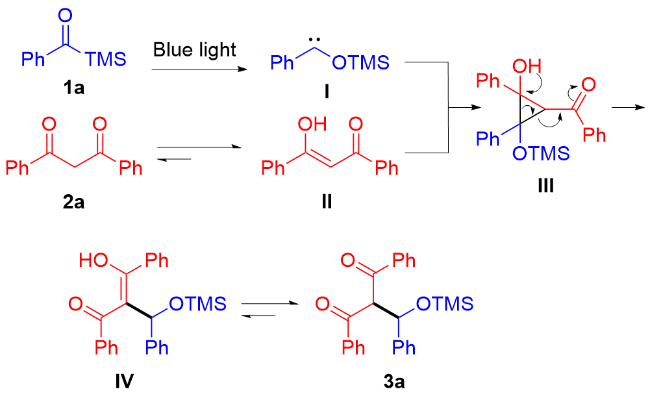
A plausible reaction mechanism for the C—H bond insertion reaction has been proposed in Scheme 3 according to the reported literature. Initially, direct excitation of acyl-silane 1a by visible light generates an excited state, which then produces siloxy carbene I through a 1,2-silyl transfer process.[6] Subsequently, cyclopropanation of I with enol form species II of 1,3-diketone leads to the intermediate III. Finally, ring opening of this cyclopropane structure forms intermediate IV,[19-20] followed by keto-enol tautomerization, giving the target product 3a.


3 Conclusions
In summary, a blue light-induced formal insertion reaction of in situ formed α-siloxy carbene into the C—H bond of the enol forms of 1,3-diketones has been developed. A variety of siloxy-substituted 1,3-diketones have been obtained in good to high yields under mild and metal-free conditions. Gram-scale synthesis and synthetic transformation demonstrated the potential practicality of this method.
4 Experimental section
4.1 Instruments and reagents
1H NMR, 13C NMR and 19F NMR were performed by Bruker 500 MHz/Avance III or Bruker 400 MHz/Avance III nuclear magnetic resonance spectrometer. The internal standard is tetramethylsilane (TMS), and the solvent is deuterated chloroform (CDCl3). ESI high-resolution mass spectrometry was determined by an Agilent ultra-high performance liquid chromatography. The melting point was determined by a microscope melting point analyzer (X4) from Beijing Optical Instrument Factory. Blue light source proposed by a Kessil lamp (10 W, 427 nm). The other instruments used are the German IKA C-MAG HS7 magnetic stirrer, German IKA RV 8 rotary evaporator, and 10 mL Synthware screw sample bottle (high type).
All reagents are commercially available analytical reagents (AR). The starting materials for the synthesis of various substrates 1 and 2 are all purchased from commercially available sources (Shanghai Energy Pharmaceutical Che-mistry Co., Ltd or Shanghai Bide Pharmatech Co., Ltd.). Column chromatography silica gel (200~300 mesh) and thin layer silica gel plate (TLC) purchased from Yantai Jiangyou Silicone Development Co., Ltd. The developing agents are industrial grade petroleum ether (PE) and ethyl acetate (EA).
4.2 General procedure for the synthesis of products 3
To a 25 mL round-bottom flask, acylsilanes 1 (0.15 mmol), 1,3-diketones 2 (0.1 mmol) and PhCl (2.0 mL) were added sequentially. Then, the mixture was stirred at room temperature under the blue light irradiation (1×10 W, 427 nm) and air atmosphere for 4 h. After the reaction was completed, the reaction mixture was purified directly by column chromatography on silica gel (eluent: PE/EA, V∶V=30∶1 to 10∶1) without any additional treatment to give pure products 3 in good to high yields.
1,3-Diphenyl-2-(phenyl((trimethylsilyl)oxy)methyl)pro-pane-1,3-dione (3a): Colourless oil, 37.8 mg, 94% yield. 1H NMR (400 MHz, CDCl3) δ: 8.26 (d, J=7.7 Hz, 2H), 7.87 (d, J=7.8 Hz, 2H), 7.79~7.73 (m, 1H), 7.67 (d, J=7.8 Hz, 4H), 7.57 (d, J=7.7 Hz, 1H), 7.42 (q, J=7.0 Hz, 4H), 7.36~7.30 (m, 1H), 6.03~5.91 (m, 2H), 0.00 (s, 9H); 13C NMR (100 MHz, CDCl3) δ: 194.3, 193.2, 142.8, 138.0, 136.8, 133.30, 133.27, 129.2, 128.7, 128.6, 128.5, 128.3, 127.9, 127.2, 75.8, 65.9, -0.2; HRMS (TOF MS ESI+) calculated for C25H26NaO3Si [M+Na]+ 425.1543, found 425.1550.
2-(Phenyl((trimethylsilyl)oxy)methyl)-1,3-di-p-tolylpro-pane-1,3-dione (3b): Yellow solid, 36.6 mg, 85% yield. m.p. 192.5~193.6 ℃; 1H NMR (400 MHz, CDCl3) δ: 8.16 (d, J=8.3 Hz, 2H), 7.77 (d, J=8.3 Hz, 2H), 7.67 (dd, J=8.2, 1.3 Hz, 2H), 7.45~7.37 (m, 4H), 7.34~7.28 (m, 1H), 7.20 (d, J=8.0 Hz, 2H), 5.99~5.90 (m, 2H), 2.57 (s, 3H), 2.42 (s, 3H), 0.00 (s, 9H); 13C NMR (100 MHz, CDCl3) δ: 193.8, 192.8, 144.1, 144.0, 142.9, 135.5, 134.3, 129.4, 129.28, 129.26, 128.6, 128.2, 127.8, 127.2, 75.7, 21.8, 21.6, -0.2; HRMS (TOF MS ESI+) calcd for C27H30NaO3Si [M+Na]+ 453.1856, found 453.1857.
1,3-Bis(4-methoxyphenyl)-2-(phenyl((trimethylsilyl)-oxy)methyl)propane-1,3-dione (3c): Yellow oil, 36.1 mg, 78% yield. 1H NMR (400 MHz, CDCl3) δ: 8.41~8.33 (m, 2H), 8.02~7.94 (m, 2H), 7.77 (d, J=7.0 Hz, 2H), 7.55~7.49 (m, 2H), 7.46~7.40 (m, 1H), 7.26~7.21 (m, 2H), 7.05~6.98 (m, 2H), 6.06~5.94 (m, 2H), 4.16 (s, 3H), 4.03 (s, 3H), 0.11 (s, 9H); 13C NMR (100 MHz, CDCl3) δ: 192.8, 191.8, 163.6, 163.6, 143.1, 131.5, 131.1, 130.9, 129.9, 128.2, 127.8, 127.2, 113.9, 113.8, 75.6, 65.6, 55.6, 55.5, -0.1; HRMS (TOF MS ESI+) calcd for C27H30NaO5Si [M+Na]+ 485.1755, found 485.1758.
1,3-Bis(4-fluorophenyl)-2-(phenyl((trimethylsilyl)oxy)-methyl)propane-1,3-dione (3d): Yellow oil, 38.6 mg, 88% yield. 1H NMR (400 MHz, CDCl3) δ: 8.32~8.26 (m, 2H), 7.92~7.85 (m, 2H), 7.67~7.61 (m, 2H), 7.45~7.39 (m, 2H), 7.37~7.31 (m, 3H), 7.14~7.07 (m, 2H), 5.95~5.83 (m, 2H), -0.00 (s, 9H); 13C NMR (100 MHz, CDCl3) δ: 192.6, 191.5, 167.2, 167.1, 164.7, 164.6, 142.5, 134.3, 134.2, 133.1, 133.0, 131.84, 131.75, 131.2, 131.1, 128.4, 128.1, 127.1, 116.1, 116.0, 115.9, 115.8, 75.7, 66.0, -0.2; 19F NMR (376 MHz, CDCl3) δ: -104.29, -104.58; HRMS (TOF MS ESI+) calcd for C25H24NaF2O3Si [M+Na]+ 461.1355, found 461.1357.
1,3-Dis(4-chlorophenyl)-2-(phenyl((trimethylsilyl)oxy)-methyl)propane-1,3-dione (3e): Yellow oil, 42.0 mg, 89% yield. 1H NMR (400 MHz, CDCl3) δ: 8.18 (d, J=8.7 Hz, 2H), 7.77 (d, J=8.6 Hz, 2H), 7.67~7.61 (m, 4H), 7.44~7.38 (m, 4H), 7.35 (dd, J=8.4, 6.2 Hz, 1H), 5.87 (q, J=9.4 Hz, 2H), 0.00 (s, 9H); 13C NMR (125 MHz, CDCl3) δ: 192.9, 191.8, 142.4, 140.04, 140.00, 136.1, 134.9, 130.5, 129.8, 129.2, 129.17, 129.15, 128.4, 128.1, 127.1, 75.7, 65.9, -0.2; HRMS (TOF MS ESI+) calcd for C25H24-NaCl2O3Si [M+Na]+ 493.0764, found 493.0764.
1,3-Bis(4-bromophenyl)-2-(phenyl((trimethylsilyl)oxy)-methyl)propane-1,3-dione (3f): Yellow solid, 50.4 mg, 90% yield. m.p. 197.0~197.6 ℃; 1H NMR (400 MHz, CDCl3) δ: 8.09 (d, J=8.6 Hz, 2H), 7.80 (d, J=8.5 Hz, 2H), 7.68 (d, J=8.6 Hz, 2H), 7.63 (d, J=7.2 Hz, 2H), 7.56 (d, J=8.6 Hz, 2H), 7.44~7.39 (m, 2H), 7.37~7.31 (m, 1H), 5.91~5.80 (m, 2H), 0.00 (s, 9H); 13C NMR (100 MHz, CDCl3) δ: 193.1, 191.9, 142.4, 136.5, 135.3, 132.2, 132.14, 132.07, 132.04, 132.01, 130.6, 129.9, 128.84, 128.80, 128.78, 128.4, 128.2, 127.1, 75.7, 65.9, -0.2; HRMS (TOF MS ESI+) calcd for C25H24NaBr2O3Si [M+Na]+ 582.9734, found 582.9735.
2-(Phenyl((trimethylsilyl)oxy)methyl)-1,3-bis(4-(trifluo-romethyl)phenyl)propane-1,3-dione (3g): Yellow solid, 49.5 mg, 92% yield. m.p. 183.0~183.8 ℃; 1H NMR (400 MHz, CDCl3) δ: 8.35 (d, J=8.1 Hz, 2H), 7.97~7.87 (m, 4H), 7.67 (dd, J=17.3, 7.5 Hz, 4H), 7.42 (t, J=7.4 Hz, 2H), 7.38~7.31 (m, 1H), 6.00~5.89 (m, 2H), -0.00 (s, 9H); 13C NMR (100 MHz, CDCl3) δ: 193.2, 192.0, 142.2, 140.5, 139.1, 134.92, 133.85, 134.7, 134.6, 129.4, 128.7, 128.6, 128.4, 127.1, 126.0, 125.92, 125.86, 125.8, 124.7, 124.5, 122.6, 122.4, 75.8, 66.4, -0.3; 19F NMR (376 MHz, CDCl3) δ: -63.18, -63.36; HRMS (TOF MS ESI+) calcd for C27H24F6NaO3Si [M+Na]+ 561.1292, found 561.1293.
1,3-Diphenyl-2-(p-tolyl((trimethylsilyl)oxy)methyl)pro-pane-1,3-dione (3h). Yellow oil, 35.4 mg, 85% yield. 1H NMR (400 MHz, CDCl3) δ: 8.31~8.25 (m, 2H), 7.89 (dd, J=8.4, 1.3 Hz, 2H), 7.78~7.73 (m, 1H), 7.69~7.63 (m, 2H), 7.57 (t, J=7.5 Hz, 3H), 7.45~7.40 (m, 2H), 7.23 (d, J=7.9 Hz, 2H), 6.01 (d, J=9.5 Hz, 1H), 5.92 (d, J=9.4 Hz, 1H), 2.42 (s, 3H), -0.00 (s, 9H); 13C NMR (100 MHz, CDCl3) δ: 194.4, 193.2, 139.8, 138.0, 137.5, 136.7, 133.2, 129.1, 128.9, 128.7, 128.6, 128.5, 127.1, 75.7, 65.9, 21.2, -0.2; HRMS (TOF MS ESI+) calcd for C26H28NaO3Si [M+Na]+ 439.1700, found 439.1700.
2-((4-Methoxyphenyl)((trimethylsilyl)oxy)methyl)-1,3-diphenylpropane-1,3-dione (3i): Yellow oil, 32.9 mg, 76% yield. 1H NMR (400 MHz, CDCl3) δ: 8.31~8.26 (m, 2H), 7.93~7.87 (m, 2H), 7.79~7.74 (m, 1H), 7.67 (tt, J=6.6, 1.4 Hz, 2H), 7.63~7.56 (m, 3H), 7.47~7.42 (m, 2H), 7.00~6.92 (m, 2H), 6.00 (d, J=9.5 Hz, 1H), 5.90 (d, J=9.5 Hz, 1H), 3.91 (s, 3H), -0.00 (s, 9H); 13C NMR (100 MHz, CDCl3) δ: 194.4, 193.2, 159.2, 138.0, 136.7, 135.0, 133.3, 133.2, 129.1, 128.7, 128.6, 128.5, 128.4, 113.6, 75.5, 66.0, 55.2, -0.2; HRMS (TOF MS ESI+) calcd for C26H28NaO4Si [M+Na]+ 455.1649, found 455.1655.
2-((4-Fluorophenyl)((trimethylsilyl)oxy)methyl)-1,3-di-phenylpropane-1,3-dione (3j): Colourless oil, 37.0 mg, 88% yield. 1H NMR (400 MHz, CDCl3) δ: 8.30~8.21 (m, 2H), 7.93~7.84 (m, 2H), 7.79~7.74 (m, 1H), 7.66 (ddd, J=8.7, 6.1, 2.1 Hz, 4H), 7.63~7.57 (m, 1H), 7.48~7.43 (m, 2H), 7.10 (t, J=8.7 Hz, 2H), 6.00~5.88 (m, 2H), -0.00 (s, 9H); 13C NMR (100 MHz, CDCl3) δ: 194.1, 193.2, 163.6, 161.2, 138.73, 138.70, 137.9, 136.6, 133.5, 133.4, 132.6, 129.1, 129.0, 128.9, 128.83, 128.77, 128.5, 127.3, 115.3, 115.0, 75.1, 66.0, -0.2; 19F NMR (376 MHz, CDCl3) δ: -114.50. HRMS (TOF MS ESI+) calcd for C25H25NaFO3Si [M+Na]+ 443.1449, found 443.1447.
2-((4-Chlorophenyl)((trimethylsilyl)oxy)methyl)-1,3-di-phenylpropane-1,3-dione (3k): Colourless oil, 39.8 mg, 91% yield. 1H NMR (400 MHz, CDCl3) δ: 8.26 (d, J=7.2 Hz, 2H), 7.87 (d, J=7.2 Hz, 2H), 7.77 (t, J=7.4 Hz, 1H), 7.68 (d, J=7.6 Hz, 2H), 7.62 (dd, J=13.8, 7.9 Hz, 3H), 7.48~7.38 (m, 4H), 5.93 (d, J=1.6 Hz, 2H), -0.00 (s, 9H); 13C NMR (100 MHz, CDCl3) δ: 194.0, 193.1, 141.5, 137.8, 136.5, 133.6, 133.5, 133.4, 129.2, 128.79, 128.76, 128.7, 128.5, 127.3, 75.1, 65.8, -0.2; HRMS (TOF MS ESI+) calcd for C25H25NaClO3Si [M+Na]+ 459.1154, found 459.1150.
1,3-Diphenyl-2-((4-(trifluoromethyl)phenyl)((trimethyl-silyl)oxy)methyl)propane-1,3-dione (3l): Yellow oil, 42.8 mg, 91% yield. 1H NMR (400 MHz, CDCl3) δ: 8.25 (d, J=7.3 Hz, 2H), 7.88~7.73 (m, 5H), 7.66 (t, J=6.8 Hz, 4H), 7.59 (t, J=7.4 Hz, 1H), 7.43 (t, J=7.7 Hz, 2H), 6.05~5.89 (m, 2H); 13C NMR (100 MHz, CDCl3) δ: 193.9, 193.0, 146.9, 137.7, 136.4, 133.6, 133.5, 132.6, 130.2, 130.1, 130.0, 129.2, 128.84, 128.77, 128.5, 127.6, 127.3, 125.33, 125.30, 123.1, 75.0, 65.6, -0.2; 19F NMR (376 MHz, CDCl3) δ: -62.57; HRMS (TOF MS ESI+) calcd for C26H25F3NaO3Si [M+Na]+ 493.1418, found 493.1421.
2-((4-(tert-Butyl)phenyl)((trimethylsilyl)oxy)methyl)-1,3-diphenylpropane-1,3-dione (3m): Yellow oil, 38.5 mg, 84% yield. 1H NMR (400 MHz, CDCl3) δ: 8.27~8.21 (m, 2H), 7.87~7.79 (m, 2H), 7.75~7.70 (m, 1H), 7.63 (t, J=7.7 Hz, 2H), 7.58~7.51 (m, 3H), 7.39 (t, J=7.7 Hz, 4H), 5.97 (d, J=9.4 Hz, 1H), 5.90 (d, J=9.4 Hz, 1H), 1.38 (s, 9H), -0.00 (s, 9H); 13C NMR (100 MHz, CDCl3) δ: 194.3, 193.4, 150.7, 139.6, 138.0, 136.7, 133.2, 133.1, 129.1, 128.7, 128.5, 126.7, 125.1, 75.5, 65.8, 34.5, 31.4, -0.2; HRMS (TOF MS ESI+) calcd for C29H34NaO3Si [M+Na]+ 481.2169, found 481.2172.
2-((3,5-Dimethylphenyl)((trimethylsilyl)oxy)methyl)-1,3-diphenylpropane-1,3-dione (3n): Yellow oil, 35.3 mg, 82% yield. 1H NMR (400 MHz, CDCl3) δ: 8.29~8.23 (m, 2H), 7.88 (dd, J=8.5, 1.3 Hz, 2H), 7.77~7.71 (m, 1H), 7.67~7.61 (m, 2H), 7.59~7.54 (m, 1H), 7.42 (t, J=7.8 Hz, 2H), 7.24 (s, 2H), 6.93 (s, 1H), 5.98 (d, J=9.4 Hz, 1H), 5.85 (d, J=9.4 Hz, 1H), 2.40 (d, J=0.8 Hz, 6H), -0.00 (s, 9H); 13C NMR (100 MHz, CDCl3) δ: 194.4, 193.2, 142.5, 138.0, 137.6, 136.8, 133.2, 129.5, 129.1, 128.7, 128.5, 125.0, 75.8, 65.8, 21.4, -0.1; HRMS (TOF MS ESI+) calcd for C27H30NaO3Si [M+Na]+ 453.1856, found 453.1855.
2-([1'-Biphenyl]-4-yl((trimethylsilyl)oxy)methyl)-1,3-diphenylpropane-1,3-dione (3o): Colourless oil, 36.9 mg, 77% yield. 1H NMR (400 MHz, CDCl3) δ: 8.29~8.23 (m, 2H), 7.88~7.83 (m, 2H), 7.75~7.69 (m, 3H), 7.66~7.60 (m, 6H), 7.55~7.49 (m, 3H), 7.46~7.41 (m, 1H), 7.40~7.34 (m, 2H), 6.04~5.94 (m, 2H), -0.00 (s, 9H); 13C NMR (100 MHz, CDCl3) δ: 194.2, 193.2, 141.9, 140.8, 140.6, 137.9, 136.7, 133.32, 133.30, 129.1, 128.79, 128.75, 128.7, 128.6, 128.5, 127.6, 127.3, 127.1, 127.0, 75.5, 65.8, -0.2; HRMS (TOF MS ESI+) calcd for C31H30NaO3Si [M+Na]+ 501.1856, found 501.1857.
2-(((tert-Butyldimethylsilyl)oxy)(phenyl)methyl)-1,3-diphenylpropane-1,3-dione (3p): Yellow oil, 38.7 mg, 87% yield. 1H NMR (400 MHz, CDCl3) δ: 8.32~8.27 (m, 2H), 7.87~7.81 (m, 2H), 7.78~7.72 (m, 1H), 7.71~7.63 (m, 4H), 7.58~7.52 (m, 1H), 7.41 (td, J=7.7, 7.2, 2.4 Hz, 4H), 7.35~7.29 (m, 1H), 6.04 (d, J=9.4 Hz, 1H), 5.94 (d, J=9.4 Hz, 1H), 0.75 (s, 9H), -0.00 (s, 3H), -0.14 (s, 3H); 13C NMR (125 MHz, CDCl3) δ: 192.9, 191.9, 142.0, 136.8, 135.7, 132.4, 132.3, 128.3, 127.8, 127.6, 127.4, 127.2, 126.9, 126.4, 75.2, 64.4, 24.5, 16.9, -5.7, -6.5; HRMS (TOF MS ESI+) calcd for C28H32NaO3Si [M+Na]+ 467.2013, found 467.2019.
1,3-Diphenyl-2-(phenyl((triisopropylsilyl)oxy)methyl)-propane-1,3-dione (3q): Yellow oil, 43.8 mg, 90% yield. 1H NMR (400 MHz, CDCl3) δ: 8.18~8.10 (m, 2H), 7.71~7.65 (m, 2H), 7.62~7.56 (m, 1H), 7.55~7.47 (m, 4H), 7.39 (t, J=7.4 Hz, 1H), 7.24 (tt, J=7.5, 3.3 Hz, 4H), 7.18~7.12 (m, 1H), 5.98~5.90 (m, 2H), 0.87~0.75 (m, 21H); 13C NMR (100 MHz, CDCl3) δ: 193.8, 192.9, 143.1, 137.8, 136.8, 133.4, 133.2, 129.3, 128.8, 128.5, 128.4, 128.2, 128.0, 127.6, 76.3, 65.7, 17.9, 17.8, 12.5; HRMS (TOF MS ESI+) calcd for C31H38NaO3Si [M+Na]+ 509.2482, found 509.2478.
1,3-Bis(4-methoxyphenyl)-2-(phenyl((triisopropylsilyl)-oxy)methyl)propane-1,3-dione (3r): Yellow oil, 36.6 mg, 67% yield. 1H NMR (500 MHz, CDCl3) δ: 8.13 (d, J=8.5 Hz, 2H), 7.70 (d, J=8.6 Hz, 2H), 7.53 (d, J=7.5 Hz, 2H), 7.23 (q, J=8.5, 7.5 Hz, 2H), 7.14 (t, J=7.3 Hz, 1H), 6.96 (d, J=8.6 Hz, 2H), 6.72 (d, J=8.5 Hz, 2H), 5.93 (d, J=9.0 Hz, 1H), 5.80 (d, J=9.1 Hz, 1H), 3.88 (s, 3H), 3.74 (s, 3H), 0.87~0.77 (m, 21H); 13C NMR (125 MHz, CDCl3) δ: 192.5, 191.6, 163.7, 163.5, 143.4, 131.6, 131.0, 130.8, 129.9, 128.1, 127.8, 127.6, 113.9, 113.7, 76.1, 65.5, 55.6, 55.5, 18.0, 17.9, 12.6; HRMS (TOF MS ESI+) calcd for C33H42NaO5Si [M+Na]+ 569.2694, found 569.2696.
1,3-Di(naphthalen-2-yl)-2-(phenyl((trimethylsilyl)oxy)-methyl)propane-1,3-dione (3s): Yellow solid, 41.7 mg, 83% yield. m.p. 190.7~191.7 ℃; 1H NMR (400 MHz, CDCl3) δ: 8.80 (d, J=1.8 Hz, 1H), 8.38 (d, J=1.8 Hz, 1H), 8.30 (dd, J=8.6, 1.8 Hz, 1H), 8.09~7.99 (m, 3H), 7.93 (dd, J=8.7, 1.8 Hz, 1H), 7.87~7.78 (m, 3H), 7.75~7.49 (m, 6H), 7.42~7.36 (m, 2H), 7.30~7.24 (m, 1H), 6.26 (d, J=9.4 Hz, 1H), 6.06 (d, J=9.3 Hz, 1H), -0.00 (s, 9H); 13C NMR (100 MHz, CDCl3) δ: 194.2, 193.1, 142.8, 135.7, 135.5, 135.4, 134.1, 132.6, 132.3, 131.0, 130.5, 129.9, 129.7, 128.8, 128.7, 128.64, 128.55, 128.3, 128.0, 127.9, 127.7, 127.2, 126.9, 126.8, 124.7, 124.0, 75.9, 66.3, -0.1; HRMS (TOF MS ESI+) calcd for C33H30NaO3Si [M+Na]+ 525.1857, found 525.1859.
2-((4-Fluorophenyl)((trimethylsilyl)oxy)methyl)-1,3-di(naphthalen-2-yl)propane-1,3-dione (3t): Yellow solid, 44.8 mg, 86% yield. m.p. 183.2~184.3 ℃; 1H NMR (400 MHz, CDCl3) δ: 8.68 (d, J=2.2 Hz, 1H), 8.27 (d, J=1.8 Hz, 1H), 8.16 (dd, J=8.6, 1.8 Hz, 1H), 7.98~7.88 (m, 3H), 7.81 (dd, J=8.6, 1.8 Hz, 1H), 7.78~7.67 (m, 3H), 7.65~7.55 (m, 4H), 7.52 (ddd, J=8.2, 7.0, 1.4 Hz, 1H), 7.43 (ddd, J=8.2, 6.9, 1.3 Hz, 1H), 7.00~6.92 (m, 2H), 6.09 (d, J=9.4 Hz, 1H), 5.90 (d, J=9.3 Hz, 1H), -0.14 (s, 9H); 13C NMR (125 MHz, CDCl3) δ: 194.1, 193.1, 163.6, 161.1, 138.8, 138.7, 135.7, 135.6, 135.3, 134.0, 132.6, 132.3, 131.0, 130.6, 129.9, 129.7, 129.2, 129.0, 128.92, 128.88, 128.8, 128.72, 128.70, 127.9, 127.8, 127.02, 126.95, 124.7, 123.9, 115.3, 115.1, 75.2, 66.4, -0.1; 19F NMR (376 MHz, CDCl3) δ: -114.36. HRMS (TOF MS ESI+) calcd for C33H29NaFO3Si [M+H]+ 543.1762, found 543.1763.
1,3-Di(naphthalen-2-yl)-2-(phenyl((triisopropylsilyl)-oxy)methyl)propane-1,3-dione (3u): Yellow solid, 46.9 mg, 80% yield. m.p. 191.2~192.1 ℃; 1H NMR (500 MHz, CDCl3) δ: 8.78 (d, J=1.7 Hz, 1H), 8.31 -8.26 (m, 1H), 8.23 (dd, J=8.6, 1.8 Hz, 1H), 7.99 (d, J=8.2 Hz, 1H), 7.95 (d, J=8.6 Hz, 1H), 7.90 (d, J=8.1 Hz, 1H), 7.81 (dd, J=8.7, 1.8 Hz, 1H), 7.72 (d, J=8.2 Hz, 1H), 7.68 (d, J=7.2 Hz, 4H), 7.62 (t, J=7.5 Hz, 1H), 7.57 (t, J=7.5 Hz, 1H), 7.49 (t, J=7.5 Hz, 1H), 7.41 (t, J=7.5 Hz, 1H), 7.29 (t, J=7.6 Hz, 2H), 7.17 (t, J=7.4 Hz, 1H), 6.26 (d, J=8.9 Hz, 1H), 6.13 (d, J=8.9 Hz, 1H), 0.92~0.80 (m, 21H); 13C NMR (100 MHz, CDCl3) δ: 193.9, 192.9, 143.2, 135.7, 135.5, 135.3, 134.1, 132.6, 132.3, 131.2, 130.4, 129.9, 129.6, 128.8, 128.72, 128.68, 128.5, 128.2, 128.0, 127.9, 127.7, 127.6, 127.0, 126.8, 124.8, 124.0, 76.4, 66.4, 18.0, 17.9, 12.6; HRMS (TOF MS ESI+) calcd for C39H42NaO3Si [M+H]+ 609.2795, found 609.2795.
1-Phenyl-2-(phenyl((trimethylsilyl)oxy)methyl)-3-(p-tolyl)propane-1,3-dione (3v): Yellow oil, 36.2 mg, 87% yield. A mixture of two isomers (1.2∶1). 1H NMR (400 MHz, CDCl3) δ: 8.25 and 8.16 (two doubles, J=8.0 Hz, 2H), 7.86 and 7.77 (two doubles, J=8.0 Hz, 2H), 7.74~7.51 (comp, 8H), 7.42 (comp, 8H), 7.35~7.28 (m, 2H), 7.21 (d, J=8.0 Hz, 2H), 5.95 (comp, 4H), 2.59 (s, 3H), 2.44 (s, 2H), -0.00 (two singlets, 17H); 13C NMR (100 MHz, CDCl3) δ: 194.4, 193.8, 193.3, 192.7, 144.2, 144.1, 142.9, 142.8, 138.0, 136.8, 135.5, 134.3, 133.22, 133.19, 129.4, 129.34, 129.31, 129.1, 128.69, 128.65, 128.6, 128.5, 128.3, 127.9, 127.2, 75.8, 75.7, 65.8, 65.7, 21.8, 21.7, -0.18, -0.19; HRMS (TOF MS ESI+) calcd for C26H28NaO3Si [M+Na]+ 439.1700, found 439.1703.
4.2 General procedure for gram-scale synthesis
To a 100 mL round-bottom flask, acylsilane (1a, 7.5 mmol), 1,3-diketone (2a, 5.0 mmol) and PhCl (20 mL) were added sequentially. Then, the mixture was stirred at room temperature under the blue light irradiation (1×10 W, 427 nm) and air atmosphere for 8 h. After the reaction was completed, the solvent was evaporated under reduced pressure, and the reaction mixture was purified directly by column chromatography on silica gel (eluent: PE/EA, V∶V=30∶1 to 10∶1) without any additional treatment to give 1.7 g pure product 3a in 88% yield.
4.3 General procedure for the synthesis of product 4
To a solution of 3a (161.0 mg, 0.4 mmol) in 96% ethanol (3 mL), was added aqueous hydrazine (206.0 mg, 6.4 mmol, 80% weight solution). The reaction mixture was refluxed for 10 min. Then, ethyl acetate (40 mL) was added and the organic phase was washed with 1 moll/L HCl (10 mL) and saturated brine (20 mL×3). The organic phase was then dried over anhydrous Na2SO4, and concentrated in vacuo after filtration. The reaction mixture was purified by column chromatography on silica gel (eluent: PE/EA, V∶V 30∶1 to 10∶1) to give pure product 4 in 85% yield.
3,5-Diphenyl-4-(phenyl((trimethylsilyl)oxy)methyl)-1H-pyrazole (4):[21] Yellow oil, 135.5 mg, 85% yield. 1H NMR (500 MHz, CDCl3) δ: 8.12~8.09 (m, 1H), 7.93 (dd, J=7.7, 1.9 Hz, 4H), 7.74~7.67 (m, 8H), 7.62 (t, J=7.4 Hz, 2H), 7.56 (t, J=7.2 Hz, 1H), 6.54 (s, 1H), 0.27 (s, 9H); 13C NMR (100 MHz, CDCl3) δ: 144.2, 131.8, 128.92, 128.87, 128.3, 128.2, 127.9, 126.7, 126.4, 125.8, 118.5, 67.8, -0.1; HRMS (TOF MS ESI+) calcd for C25H27N2OSi [M+H]+ 399.1887, found 399.1886.
Supporting Information General Information, general procedure for the preparation of acylsilane and 1,3-diketo-nes, 1H NMR, 13C NMR and 19F NMR spectra of products and single-crystal X-ray diffraction. The Supporting Information is available free of charge via the Internet at http://sioc-journal.cn.
(Zhao, C.)