



1 Introduction
Recently, gem-difluorinated cyclopropanes (gem-DF-CPs) received considerable attention due to their unique set of reactivities in organic synthesis especially under the transition-metal catalysis.[1] These compounds feature an inherently strained cyclopropane, whose ring-strain is further enhanced by incorporation of two fluorine atoms in the same carbon atom of the three-membered ring.[2] In this context, gem-DFCPs are more prone to undergo ring-opening transformations. According to the cleavage of the C—F bond, the ring-opening transformation of gem-DF-CPs can be divided into the following three categories. The first pattern involves ring-opening of gem-DFCPs without C—F bond cleavage, which is achieved through transition-metal catalysis,[3] organocatalysis[4] and photocatalysis[5] and others[6] (Scheme 1a). The second mode involves ring-opening with cleavage of a single C—F bond under palladium,[7,8] rhodium[9] and others,[10] which has been extensively studied in recent years (Scheme 1b). The reactions are predominantly realized via oxidative addition and β-fluoride elimination processes to enable the synthesis of a large range of monofluoroolefin derivatives, which in some cases a cascade cyclization via C—F bond cleavage occurs to formally give double C—F cleavage products.[7c,7l,8b,11] The third paradigm entails ring-opening reactions with cleavage of the two C—F bonds in a single transformation (Scheme 1c). In this regard, our group recently developed a copper-catalyzed three-component coupling reaction of gem-DFCPs with alcohols and terminal alkynes, achieving modular synthesis of enol ether compounds with fully substitution.[12]
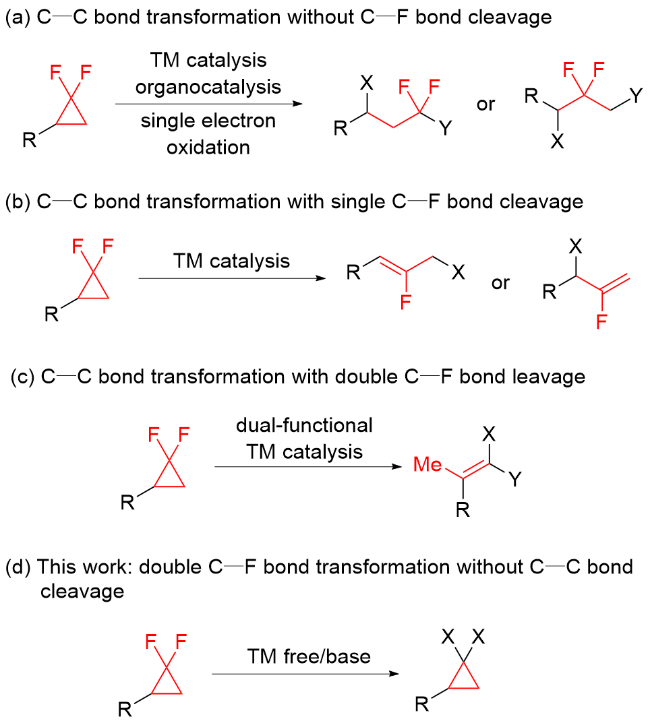
On the other hand, the transformation of C—F bond is certain challenging owing to its high bond energy and stability over common reaction conditions. For this reason, the fluorine-containing functional groups can serve as stable handles for the late-stage modifications of complex molecules and C—F bond transformations are becoming an intriguing aspect in modern organic synthesis.[13] Due to the intrinsic high ring-strain of gem-DFCPs, the selective defluorination of gem-DFCPs with the maintaining the integrity of fragile cyclopropane core structure poses much more challenges. Considering our research interest in gem-DFCPs[3,9] and based on our previous study,[12] we envisioned that the selective double C—F bond transformations without the cleavage of C—C bond might be achieved under transition-metal free conditions since the transition-metal catalysts are likely to promote the ring-opening of cyclopropanes in most cases. Therefore, we chose gem-DFCPs and alcohols as the coupling partners and implemented the conversion of the C—F bond to the C—O bond under basic conditions, thereby constructing gem-dialkoxyl cyclopropanes or cyclopropanone ketals in high yields with broad substrate scope (Scheme 1d). This reaction provides a new paradigm for C—F bond transformation especially in gem-DFCPs and offers a new approach for the synthesis of cyclopropanone ketals. It shows higher efficiency and better practicability compared to the alkoxylation of 1-fluoro-l-bromo-cyclopropanes in solvent amount alcohols.[14]
2 Results and discussion
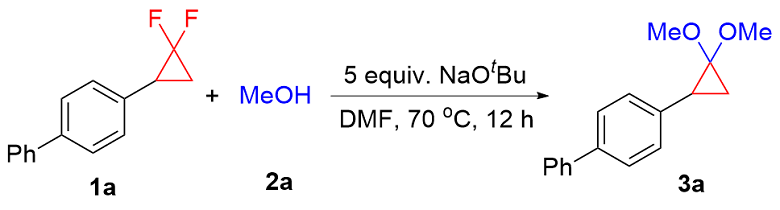
At the beginning, we carried out the investigation with 4-(2,2-difluorocyclopropyl)-1,1'-biphenyl (1a) and methanol (2a) as the model substrates (Table 1). After an extensive examination of reaction conditions, the target product 3a was generated in 90% yield with NaOtBu as the base and N,N-dimethylformamide (DMF) as the solvent at 70 ℃ for 12 h, which was recognized as the optimized reaction conditions (Entry 1). The yields dropped significantly when NaOtBu was replaced with LiOtBu or KOtBu (Entries 2 and 3), while the reaction was shut down with Cs2CO3 as the base (Entry 4). No improvement of yields was detected upon switching the solvents to tetrahydro-furan (THF) (Entry 5) and the desired product 3a was not formed when 1,2-dichloroethane (DCE) was utilized as the solvent (Entry 6). Next, a preliminary evaluation of temperature effect indicated that whether 60 or 80 ℃ all afforded inferior result (Entries 7 and 8). The further refinement of reaction conditions by decreasing the equivalents of methanol or NaOtBu resulted in the lower formation of expected product 3a (Entries 9 and 10).
Table 1 Optimization of reaction conditionsa
|
| Entry | Variation from the standard conditions | Yieldb/% |
|---|---|---|
| 1 | None | 90 |
| 2 | LiOtBu instead of NaOtBu | 21 |
| 3 | KOtBu instead of NaOtBu | 31 |
| 4 | Cs2CO3 instead of NaOtBu | Not detected |
| 5 | THF instead of DMF | 81 |
| 6 | DCE instead of DMF | Not detected |
| 7 | 60 ℃ instead of 70 ℃ | 88 |
| 8 | 80 ℃ instead of 70 ℃ | 77 |
| 9 | 2 equiv. MeOH instead of 3 equiv. MeOH | 80 |
| 10 | 4 equiv. NaOtBu instead of 5 equiv. NaOtBu | 82 |
a Reaction conditions: 1a (0.1 mmol), 2a (0.3 mmol) and NaOtBu (5 equiv.) in DMF (0.2 mL) under N2 atmosphere at 70 ℃ for 12 h. b Isolated yields. |
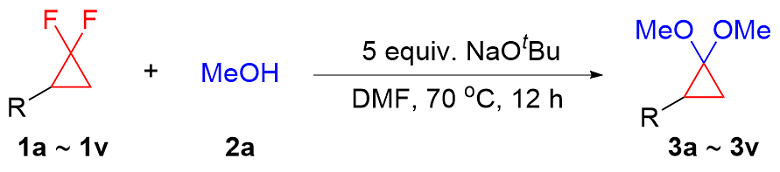
With the optimal conditions ascertained, we turned our attention to study the generality of the current transformation. First, the substrate scope of gem-DFCPs was scrutinized. As outlined in Table 2, a myriad of aryl gem-DFCPs decorated with several functional groups could be smoothly transformed into the desired products in good to excellent yields. The unmodified phenyl gem-DFCP (1b) and its para-substituted counterparts bearing electron-do-nating substituents such as alkyl (1c, 1d), alkoxyl (1e) and aryloxyl (1f) or electron-withdrawing groups represented by halogen (1g, 1h) and ester (1i) were totally compatible to access an assortment of cyclopropanone ketals (3b~3i) in 71%~96% yields. In addition to para-substituted pattern, the promising outcomes could also be upheld with mono meta-anchored cases, which furnished the corresponding products 3j~3m in 73%~97% yields. As anticipated, the double meta-substituted gem-DFCPs 1n and 1o served as competent coupling partners as well, permitting the synthesis of corresponding products 3n and 3o in 90% and 99% yields, respectively. Furthermore, multiple meth-oxyls, which situated on the meta- and para-positions of phenyl ring, did not hamper the reaction and delivered the desired products 3p and 3q in consistently good yields. The reactions kept excellent yields when ortho methyl-or chloro-functionalized gem-DFCPs 1r and 1s were subjected to the present reactions. As we all know, the halogens always serve as one of the most sought-after functional entities for further synthetic operations in transition metal-catalyzed cross-coupling reactions. Hence, the retaining of chlorine and bromine in examples 3h, 3l, 3m and 3s left useful and convenient handles for downstream functional group transformations. It is not surprising that the naphthyl-modified gem-DFCP 1t was amenable under optimal reaction conditions to reach the fabrication of product 3t in 81% yield. In addition, the replacement of phenyl group with heteroaryl group had a marginal effect on the outcome (3u). The substituents of gem-DFCPs were not restricted to (hetero)aryl group, and the alkenyl-modified gem-DFCP 1v was also proved to be the compatible substrate and resulted in the formation of the expected product 3v in 72% yield. Nevertheless, alkyl-substituted gem-DFCPs did not work in the current reaction under standard conditions.
Table 2 Substrate scope of gem-difluorinated cyclopropanes
|
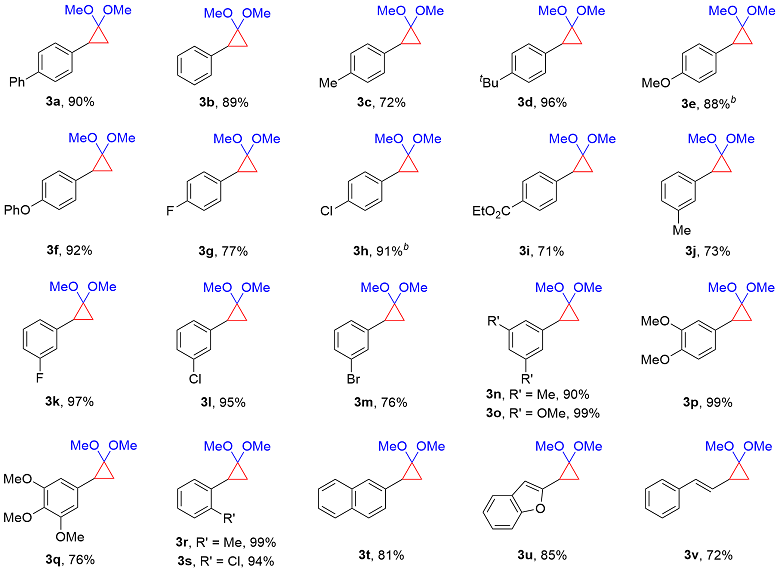 |
a Reactions were carried out on 0.1 mmol scale with isolated yields. b The reaction was carried out under 80 ℃. |
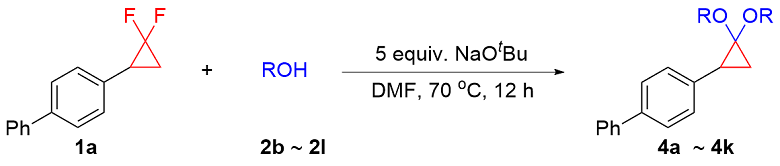
Next, the substrate scope of alcohols was elaborately examined. As regularly depicted in Table 3, a bunch of primary alcohols expressed good reactivity and were transformed into the anticipated products 4a~4e in good to excellent yields. The functional groups such as alkene and ether attached in alcohols did not perturb the reaction outcome as exemplified in 4d and 4e. The secondary alcohols including isopropanol (2g), cyclobutanol (2h), cyclohexanol (2i) and benzhydrol (2j) could smoothly couple with gem-DFCP 1a to provide cyclopropanone ketals 4f~4i in 77%~90% yields. It should be emphasized that the fragile cyclopropane and cyclobutane scaffolds simultaneously remained intact in the case of 4g, which is otherwise nevertheless difficult to be obtained via traditional manipulations. In addition, the substrate scope of alcohols could successfully expand to diols such as glycol and neopentyl glycol, which enabled the preparation of 4j and 4k in 88% and 60% yields, respectively. Unfortunately, tertiary alcohols, such as tert-butanol (4l), are incompatible with this transformation due to significant steric hindrance.
Table 3 Substrate scope of alcohols
|
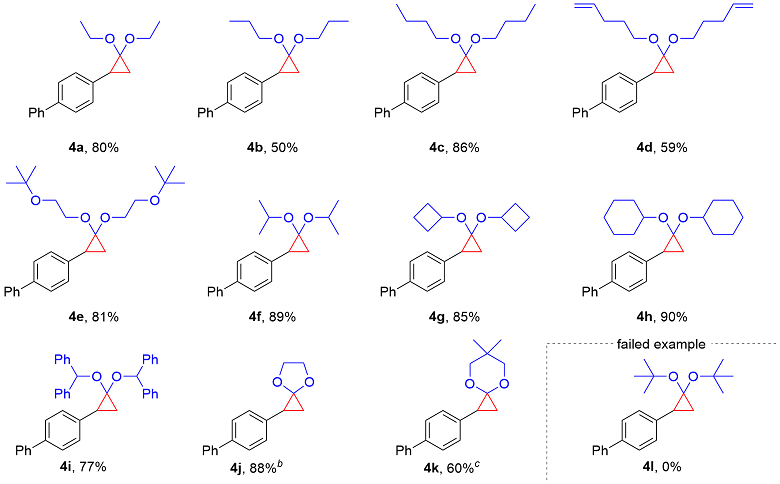 |
a Reactions were carried out on 0.1 mmol scale with isolated yields. b The reaction was carried out under 50 ℃. c The reaction was carried out under 80 ℃. |
To showcase the synthetic applications of present transformation, a scale-up reaction was carried out by employing substrates 1a and 2k as the reactants with the desired product 4j being isolated in 70% yield (Scheme 2a). The cyclopropanone ketal 4j can smoothly couple with benzaldehyde 5 via a formal [3+2] cycloaddition under Brønsted acid catalysis to form five-membered lactone 6 in 72% yield (Scheme 2b).[15] To figure out the reaction process, the enanotiopure gem-DFCP (S)-1a and methanol 2a were subjected to the optimal conditions, which gave rise to the product 3a in a racemic manner (Scheme 2c). This result indicates that the chiral carbon atom in gem-DFCPs participates in the reaction, which provides a compelling evidence that the C—F bond cleavage may be taken place through a base-promoted elimination process.

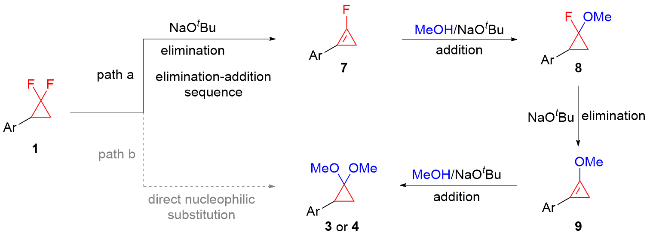
Based on the mechanistic experiments and our previous study,[12] a mechanistic scenario is proposed in Scheme 3. First, the fluorocyclopropene 7 is formed via a base-pro-moted HF elimination (path a). Of note, instead of the copper-catalyzed and base-promoted HF elimination reported in our previous investigation,[12] the HF elimination of gem-DFCPs can also be achieved under copper free conditions by increasing the amount of base and elevating the reaction temperature. Then, the in-situ generated meth-oxide attacked the highly reactive fluorocyclopropene 7 to result in the formation of mono-substituted intermediate 8. Next, a similar elimination and addition sequence occurs to access the cyclopropanone ketal as the final product. The alternative reaction pathway involving direct nucleophilic substitution is arguably excluded (path b).


3 Conclusions
In conclusion, a simple and practical method has been developed for the efficient synthesis of cyclopropanone ketals from gem-DFCPs and alcohols. This transformation represents the first example of C—F bond functionaliza-tion in the realm of gem-DFCPs with avoiding the cleavage of strained cyclopropane C—C bond. A plethora of gem-DFCPs and alcohols can effectively couple with each other to enable the fabrication of otherwise difficult accessing cyclopropanone ketals. The mechanistic studies support the reactions that proceeds via elimination and addition sequence rather than direct nucleophilic substitution. This new reaction model provides inspiration for the conversion of C—F bonds in small rings.
4 Experimental section
4.1 General information
All air-sensitive reactions were carried out under nitrogen atmosphere. Anhydrous solvents were purchased from Energy Chemical or Adamas in AcroSeal glass bottle (extra dry over molecular sieve) and used directly. NMR spectra were recorded on a JEOL JNM-ECZ400S (400 MHz for 1H NMR, 100 MHz for 13C NMR, 376 MHz for 19F NMR) with CDCl3 as the solvent and tetramethylsilane (TMS) as the internal standard. Unless otherwise noted, chemical shifts for 1H NMR are reported using tetramethylsilane (TMS, δ=0) as the internal standard and using CDCl3 as the solvent; Chemical shifts for 13C NMR spectra are reported with the center line of the triplet for chloroform-d set at δ 77.0. Enantiomeric excesses (ee) were determined by High Performance Liquid Chromatography (HPLC) analysis on a SHIMADZU LC-2030C with Daicel chiral columns. High-resolution mass spectra (HRMS) were recorded on a Q-Exactive Focus (Thermo Fisher Scientific) and reported for the molecular ion [M+H]+ or [M+Na]+. Melting points were determined using a digital melting point apparatus (JHX-4).
4.2 General procedure for product synthesis
In a nitrogen filled glove box, a 4 mL vial equipped with a stir bar was charged with NaOtBu (48.1 mg, 0.5 mmol, 5 equiv.), gem-difluorinated cyclopropane (0.1 mmol, 1 equiv.), alcohol (0.3 mmol, 3 equiv.) and DMF (0.2 mL). Then, the 4 mL vial was sealed, removed from the glove box and heated in pie-block at 70 ℃ for 12 h. The reaction mixture was cooled to room temperature and diluted with ethyl acetate, filtered through a fast column and concentrated in vacuo. The crude mixture was purified by silica gel column chromatography to obtain the corresponding product.
4-(2,2-Dimethoxycyclopropyl)-1,1'-biphenyl (3a): Yellow oil, 22.9 mg, 90% yield, Rf=0.65 [V(petroleum ether, PE)∶V(ethyl acetate, EA)=20∶1]. 1H NMR (400 MHz, CDCl3) δ: 7.58 (d, J=8.0 Hz, 2H), 7.52 (d, J=7.9 Hz, 2H), 7.42 (t, J=7.5 Hz, 2H), 7.34~7.25 (m, 3H), 3.46 (s, 3H), 3.26 (s, 3H), 2.43 (dd, J=10.3, 7.1 Hz, 1H), 1.49~1.45 (m, 1H), 1.33 (t, J=6.6 Hz, 1H); 13C NMR (101 MHz, CDCl3) δ: 141.0, 138.8, 136.4, 128.7, 127.9, 127.0, 126.9, 126.8, 93.4, 53.8, 53.4, 30.3, 19.3. HRMS (ESI) calcd for C17H19O2 [M+H]+ 255.1380, found 255.1379.
(2,2-Dimethoxycyclopropyl)benzene (3b):[16] Colorless oil, 15.8 mg, 89% yield, Rf=0.45 [V(PE)∶V(EA)=20∶1]. 1H NMR (400 MHz, CDCl3) δ: 7.30~7.26 (m, 2H), 7.21~7.17 (m, 3H), 3.44 (s, 3H), 3.21 (s, 3H), 2.40 (dd, J=10.3, 7.1 Hz, 1H), 1.43 (dd, J=10.3, 6.0 Hz, 1H), 1.31~1.28 (m, 1H); 13C NMR (101 MHz, CDCl3) δ: 137.2, 128.1, 127.5, 125.9, 93.3, 53.7, 53.4, 30.5, 19.1.
1-(2,2-Dimethoxycyclopropyl)-4-methylbenzene (3c): Yellow oil, 13.8 mg, 72% yield, Rf=0.45 [V(PE)∶V(EA)=20∶1]. 1H NMR (400 MHz, CDCl3) δ: 7.12~7.06 (m, 4H), 3.43 (s, 3H), 3.21 (s, 3H), 2.36 (dd, J=10.4, 7.1 Hz, 1H), 2.31 (s, 3H), 1.39 (dd, J=10.3, 6.0 Hz, 1H), 1.27~1.25 (m, 1H); 13C NMR (101 MHz, CDCl3) 135.5, 134.0, 128.8, 127.4, 93.2, 53.7, 53.3, 30.1, 21.0, 18.8. HRMS (ESI) calcd for C12H17O2 [M+H]+ 193.1223, found 193.1226.
1-(tert-Butyl)-4-(2,2-dimethoxycyclopropyl)benzene (3d): Yellow oil, 22.5 mg, 96% yield, Rf=0.55 [V(PE)∶V(EA)=20∶1]. 1H NMR (400 MHz, CDCl3) δ: 7.32~7.29 (m, 2H), 7.15~7.12 (m, 2H), 3.44 (s, 3H), 3.25 (s, 3H), 2.36 (dd, J=10.4, 7.1 Hz, 1H), 1.41 (dd, J=10.4, 5.9 Hz, 1H), 1.30 (s, 9H), 1.28~1.24 (m, 1H); 13C NMR (101 MHz, CDCl3) δ: 148.7, 134.1, 127.2, 125.0, 93.3, 53.8, 53.4, 34. 3, 31.4, 30.1, 19.1. HRMS (ESI) calcd for C15H23-O2 [M+H]+ 235.1693, found 235.1695.
1-(2,2-Dimethoxycyclopropyl)-4-methoxybenzene (3e): The reaction was carried out under 80 ℃. Colorless oil, 18.4 mg, 88% yield, Rf=0.55 [V(PE)∶V(EA)=5∶1]. 1H NMR (400 MHz, CDCl3) δ: 7.12 (d, J=8.3 Hz, 2H), 6.83 (d, J=8.7 Hz, 2H), 3.79 (s, 3H), 3.43 (s, 3H), 3.21 (s, 3H), 2.35 (dd, J=10.4, 7.1 Hz, 1H), 1.38 (dd, J=10.4, 5.9 Hz, 1H), 1.21 (t, J=6.5 Hz, 1H); 13C NMR (101 MHz, CDCl3) δ: 157.9, 129.2, 128.5, 113.6, 93.1, 55.2, 53.6, 53.3, 29.7, 18.8. HRMS (ESI) calcd for C12H17O3 [M+H]+ 209.1172, found 209.1173.
1-(2,2-Dimethoxycyclopropyl)-4-phenoxybenzene (3f): Yellow oil, 24.8 mg, 92% yield, Rf=0.55 [V(PE)∶V(EA)=5∶1]. 1H NMR (400 MHz, CDCl3) δ: 7.34~7.29 (m, 2H), 7.18~7.15 (m, 2H), 7.10~7.06 (m, 1H), 7.01~6.97 (m, 2H), 6.96~6.92 (m, 2H), 3.44 (s, 3H), 3.24 (s, 3H), 2.38 (dd, J=10.4, 7.1 Hz, 1H), 1.43 (dd, J=10.4, 6.0 Hz, 1H), 1.26~1.22 (m, 1H); 13C NMR (101 MHz, CDCl3) δ: 134.8, 133.4, 132.1, 127.54, 127.47, 126.2, 125.89, 125.85, 125.2, 93.5, 53.7, 53.5, 30.8, 19.2. HRMS (ESI) calcd for C17H19O3 [M+H]+ 271.1329, found 271.1331.
1-(2,2-Dimethoxycyclopropyl)-4-fluorobenzene (3g): Yellow oil, 15.0 mg, 77% yield, Rf=0.35 [V(PE)∶V(EA)=20∶1]. 1H NMR (400 MHz, CDCl3) δ: 7.19~7.11 (m, 2H), 7.00~6.94 (m, 2H), 3.43 (s, 3H), 3.21 (s, 3H), 2.37 (dd, J=10.4, 7.1 Hz, 1H), 1.42 (dd, J=10.4, 6.1 Hz, 1H), 1.24~1.21 (m, 1H); 13C NMR (101 MHz, CDCl3) δ: 161.4 (d, J=244.0 Hz), 132.8 (d, J=3.3 Hz), 128.9 (d, J=7.9 Hz), 114.9 (d, J=21.3 Hz), 93.0, 53.6, 53.4, 29.7, 19.2; 19F NMR (376 MHz, CDCl3) δ: -117.24 (t, J=7.6 Hz). HRMS (ESI) calcd for C11H14FO2 [M+H]+ 197.0972, found 197.0978.
1-Chloro-4-(2,2-dimethoxycyclopropyl)benzene (3h): The reaction was carried out under 80 ℃. Colorless oil, 19.3 mg, 91% yield, Rf=0.55 [V(PE)∶V(EA)=20∶1]. 1H NMR (400 MHz, CDCl3) δ: 7.25~7.23 (m, 2H), 7.12 (d, J=8.5 Hz, 2H), 3.43 (s, 3H), 3.20 (s, 3H), 2.35 (dd, J=10.3, 7.1 Hz, 1H), 1.45 (dd, J=10.3, 6.2 Hz, 1H), 1.25~1.24 (m, 1H); 13C NMR (101 MHz, CDCl3) δ: 135.8, 131.7, 128.8, 128.2, 93.15, 53.7, 53.4, 29.9, 19.4. HRMS (ESI) calcd for C11H14ClO2 [M+H]+ 213.0677, found 213.0680.
Ethyl 4-(2,2-dimethoxycyclopropyl)benzoate (3i): Yellow oil, 17.8 mg, 71% yield, Rf=0.45 [V(PE)∶V(EA)=20∶1]. 1H NMR (400 MHz, CDCl3) δ: 7.90~7.87 (m, 2H), 7.20~7.17 (m, 2H), 4.29 (q, J=7.1 Hz, 2H), 3.37 (s, 3H), 3.11 (s, 3H), 2.36 (dd, J=10.2, 7.1 Hz, 1H), 1.44 (dd, J=10.2, 6.1 Hz, 1H), 1.33~1.28 (m, 4H); 13C NMR (101 MHz, CDCl3) δ: 166.6, 142.9, 129.3, 128.1, 127.3, 93.5, 60.8, 53.7, 53.5, 30.7, 19.9, 14.3. HRMS (ESI) calcd for C14H19O4 [M+H]+ 251.1278, found 251.1281.
1-(2,2-Dimethoxycyclopropyl)-3-methylbenzene (3j): Yellow oil, 14.0 mg, 73% yield, Rf=0.45 [V(PE)∶V(EA)=20∶1]. 1H NMR (400 MHz, CDCl3) δ: 7.19~7.15 (m, 1H), 7.02~6.99 (m, 3H), 3.44 (s, 3H), 3.22 (s, 3H), 2.36 (dd, J=10.4, 7.3 Hz, 1H), 2.33 (s, 3H), 1.41 (dd, J=10.3, 6.0 Hz, 1H), 1.30~1.28 (m, 1H); 13C NMR (101 MHz, CDCl3) 137.6, 137.0, 128.4, 128.0, 126.8, 124.5, 93.3, 53.7, 53.4, 30.5, 21.4, 18.9. HRMS (ESI) calcd for C12H17-O2 [M+H]+ 193.1223, found 193.1225.
1-(2,2-Dimethoxycyclopropyl)-3-fluorobenzene (3k): Yellow oil, 19.0 mg, 97% yield, Rf=0.45 [V(PE)∶ V(EA)=20∶1]. 1H NMR (400 MHz, CDCl3) δ: 7.24~7.20 (m, 1H), 7.00~6.98 (m, 1H), 6.90~6.87 (m, 2H), 3.43 (s, 3H), 3.22 (s, 3H), 2.37 (dd, J=10.3, 7.1 Hz, 1H), 1.46 (dd, J=10.3, 6.1 Hz, 1H), 1.28~1.25 (m, 1H); 13C NMR (101 MHz, CDCl3) δ: 162.8 (d, J=244.0 Hz), 140.1 (d, J=7.9 Hz), 129.4 (d, J=8.6 Hz), 123.5 (d, J=2.8 Hz), 114.2 (d, J=22.0 Hz), 112.8 (d, J=21.2 Hz), 93.2, 53.7, 53.4, 30.2 (d, J=1.9 Hz), 19.6; 19F NMR (376 MHz, CDCl3) δ: -113.90. HRMS (ESI) calcd for C11H14FO2 [M+H]+ 197.0972, found 197.0974.
1-Chloro-3-(2,2-dimethoxycyclopropyl)benzene (3l): Yellow oil, 20.1 mg, 95% yield, Rf=0.55 [V(PE)∶ V(EA)=20∶1]. 1H NMR (400 MHz, CDCl3) δ: 7.22~7.15 (m, 3H), 7.09~7.07 (m, 1H), 3.43 (s, 3H), 3.23 (s, 3H), 2.35 (dd, J=10.3, 7.1 Hz, 1H), 1.46 (dd, J=10.3, 6.1 Hz, 1H), 1.29~1.26 (m, 1H); 13C NMR (101 MHz, CDCl3) δ: 139.5, 133.9, 129.2, 127.6, 126.1, 125.8, 93.2, 53.7, 53.5, 30.1, 19.5. HRMS (ESI) calcd for C11H14ClO2 [M+H]+ 213.0677, found 213.0676.
1-Bromo-3-(2,2-dimethoxycyclopropyl)benzene (3m): Yellow oil, 19.5 mg, 76% yield, Rf=0.45 [V(PE)∶ V(EA)=20∶1]. 1H NMR (400 MHz, CDCl3) δ: 7.35~7.31 (m, 2H), 7.17~7.11 (m, 2H), 3.43 (s, 3H), 3.23 (s, 3H), 2.34 (dd, J=10.3, 7.0 Hz, 1H), 1.46 (dd, J=10.3, 6.1 Hz, 1H), 1.29~1.27 (m, 1H); 13C NMR (101 MHz, CDCl3) δ: 139.8, 130.6, 129.5, 129.0, 126.2, 122.2, 93.2, 53.8, 53.5, 30.1, 19.5. HRMS (ESI) calcd for C11H14BrO2 [M+H]+ 257.0172, found 257.0171.
1-(2,2-Dimethoxycyclopropyl)-3,5-dimethylbenzene (3n):Colorless oil, 18.5 mg, 90% yield, Rf=0.55 [V(PE)∶V(EA)=20∶1]. 1H NMR (400 MHz, CDCl3) 6.83~6.81 (m, 3H), 3.43 (s, 3H), 3.24 (s, 3H), 2.35~2.30 (m, 1H), 2.29 (s, 6H), 1.40~1.36 (m, 1H), 1.29~1.26 (m, 1H); 13C NMR (101 MHz, CDCl3) δ: 137.5, 136.9, 127.8, 125.4, 93.3, 53.7, 53.3, 30.4, 21.3, 18.8. HRMS (ESI) calcd for C13H19O2 [M+H]+ 207.1380, found 207.1384.
1-(2,2-Dimethoxycyclopropyl)-3,5-dimethoxybenzene (3o): Yellow oil, 23.6 mg, 99% yield, Rf=0.55 [V(PE)∶V(EA)=5∶1]. 1H NMR (400 MHz, CDCl3) δ: 6.38 (d, J=2.3 Hz, 2H), 6.32 (t, J=2.3 Hz, 1H), 3.78 (s, 6H), 3.43 (s, 3H), 3.24 (s, 3H), 2.33 (dd, J=10.3, 7.1 Hz, 1H), 1.42 (dd, J=10.3, 6.1 Hz, 1H), 1.29~1.26 (m, 1H); 13C NMR (101 MHz, CDCl3) δ: 160.5, 139.7, 105.8, 98.0, 93.3, 55.2, 53.8, 53.4, 30.8 19.3. HRMS (ESI) calcd for C13H19O4 [M+H]+ 239.1278, found 239.1282.
4-(2,2-Difluorocyclopropyl)-1,2-dimethoxybenzene (3p): Yellow oil, 23.6 mg, 99% yield, Rf=0.55 [V(PE)∶V(EA)=5∶1]. 1H NMR (400 MHz, CDCl3) δ: 6.81~6.74 (m, 3H), 3.87 (s, 3H), 3.86 (s, 3H), 3.44 (s, 3H), 3.22 (s, 3H), 2.35 (dd, J=10.4, 7.1 Hz, 1H), 1.41 (dd, J=10.3, 6.0 Hz, 1H), 1.24~1.21 (m, 1H); 13C NMR (101 MHz, CDCl3) δ: 148.6, 147.4, 129.7, 119.6, 110.92, 110.85, 93.1, 55.83, 55.75, 53.6, 53.3, 30.1, 19.0. HRMS (ESI) calcd for C13H19O4 [M+H]+ 239.1278, found 239.1285.
5-(2,2-Dimethoxycyclopropyl)-1,2,3-trimethoxybenzene (3q): Yellow oil, 20.4 mg, 76% yield, Rf=0.35 [V(PE)∶ V(EA)=2∶1]. 1H NMR (400 MHz, CDCl3) δ: 6.44 (s, 2H), 3.85 (s, 6H), 3.83 (s, 3H), 3.44 (s, 3H), 3.25 (s, 3H), 2.33 (dd, J=10.3, 7.1 Hz, 1H), 1.44 (dd, J=10.4, 6.1 Hz, 1H), 1.25~1.22 (m, 1H); 13C NMR (101 MHz, CDCl3) δ: 152.9, 136.4, 133.0, 104.5, 93.2, 60.8, 56.0, 53.7, 53.4, 30.8, 19.5. HRMS (ESI) calcd for C14H21O5 [M+H]+ 269.1384, found 269.1389.
1-(2,2-Dimethoxycyclopropyl)-2-methylbenzene (3r): Colorless oil, 19.0 mg, 99% yield, Rf=0.60 [V(PE)∶V(EA)=20∶1]. 1H NMR (400 MHz, CDCl3) δ: 7.17~7.06 (m, 4H), 3.47 (s, 3H), 3.18 (s, 3H), 2.44~2.40 (m, 1H), 2.43 (s, 3H), 1.39 (dd, J=10.3, 5.9 Hz, 1H), 1.35~1.32 (m, 1H); 13C NMR (101 MHz, CDCl3) 137.5, 135.0, 129.7, 126.5, 126.1, 125.7, 93.6, 53.42, 53.38, 28.2, 20.2, 17.8. HRMS (ESI) calcd for C12H17O2 [M+H]+ 193.1223, found 193.1223.
1-Chloro-2-(2,2-dimethoxycyclopropyl)benzene (3s): Yellow oil, 19.9 mg, 94% yield, Rf=0.55 [V(PE)∶V(EA)=20∶1]. 1H NMR (400 MHz, CDCl3) δ: 7.36 (dd, J=7.7, 1.6 Hz, 1H), 7.22~7.13 (m, 2H), 7.09 (dd, J=7.6, 2.0 Hz, 1H), 3.51 (s, 3H), 3.23 (s, 3H), 2.72 (dd, J=10.2, 7.4 Hz, 1H), 1.45 (dd, J=10.2, 6.1 Hz, 1H), 1.40~1.36 (m, 1H); 13C NMR (101 MHz, CDCl3) δ: 135.3, 134.5, 129.1, 127.8, 127.3, 126.4, 93.4, 53.8, 53.7, 28.4, 17.8. HRMS (ESI) calcd for C11H14ClO2 [M+H]+ 213.0677, found 213.0679.
2-(2,2-Dimethoxycyclopropyl)naphthalene (3t): White solid, m.p. 85.5~87.2 ℃; 18.5 mg, 81% yield, Rf=0.45 [V(PE)∶V(EA)=20∶1]. 1H NMR (400 MHz, CDCl3) δ: 7.81~7.75 (m, 3H), 7.64 (s, 1H), 7.46~7.39 (m, 2H), 7.36 (dd, J=8.5, 1.8 Hz, 1H), 3.48 (s, 3H), 3.19 (s, 3H), 2.56 (dd, J=10.2, 7.1 Hz, 1H), 1.51 (dd, J=10.3, 6.0 Hz, 1H), 1.44 (dd, J=7.2, 6.1 Hz, 1H); 13C NMR (101 MHz, CDCl3) 134.8, 133.4, 132.1, 127.53, 127.46, 126.2, 125.9, 125.8, 125.2, 93.5, 53.7, 53.4, 30.7, 19.2. HRMS (ESI) calcd for C15H17O2 [M+H]+ 229.1223, found 229.1225.
2-(2,2-Dimethoxycyclopropyl)benzofuran (3u): Yellow oil, 18.5 mg, 85% yield, Rf=0.35 [V(PE)∶V(EA)=20∶1]. 1H NMR (400 MHz, CDCl3) δ: 7.48~7.41 (m, 2H), 7.22~7.15 (m, 2H), 6.42 (t, J=0.9 Hz, 1H), 3.47 (s, 3H), 3.30 (s, 3H), 2.49 (ddd, J=9.9, 6.8, 0.6 Hz, 1H), 1.54 (dd, J=10.3, 5.9 Hz, 1H), 1.46 (dd, J=7.0, 5.9 Hz, 1H); 13C NMR (101 MHz, CDCl3) δ: 155.2, 154.5, 128.9, 123.2, 122.5, 120.2, 110.8, 102.3, 92.9, 53.9, 53.7, 23.8, 18.9. HRMS (ESI) calcd for C13H15O3 [M+H]+ 219.1016, found 219.1020.
(E)-(2-(2,2-dimethoxycyclopropyl)vinyl)benzene (3v): Following the general procedure, product 3v was isolated as yellow oil, 14.7 mg, 72% yield, Rf=0.35 [V(PE)∶V(EA)=20∶1]. 1H NMR (400 MHz, CDCl3) δ: 7.35~7.26 (m, 4H), 7.20~7.16 (m, 1H), 6.52 (d, J=16.0 Hz, 1H), 5.93 (dd, J=16.0, 9.4 Hz, 1H), 3.41 (s, 3H), 3.40 (s, 3H), 2.09~2.03 (m, 1H), 1.35~1.31 (m, 1H), 0.99 (t, J=6.0 Hz, 1H); 13C NMR (101 MHz, CDCl3) δ: 137.5, 129.7, 128.5, 128.1, 126.8, 125.8, 93.7, 53.8, 53.3, 29.6, 20.5. HRMS (ESI) calcd for C13H17O2 [M+H]+ 205.1223, found 205.1227.
4-(2,2-Diethoxycyclopropyl)-1,1'-biphenyl (4a): Colorless oil, 22.5 mg, 80% yield, Rf=0.65 [V(PE)∶V(EA)=20∶1]. 1H NMR (400 MHz, CDCl3) 7.60~7.57 (m, 2H), 7.53~7.50 (m, 2H), 7.44~7.40 (m, 2H), 7.34~7.26 (m, 3H), 3.82~3.62 (m, 3H), 3.38~3.30 (m, 1H), 2.43 (dd, J=10.3, 7.1 Hz, 1H), 1.49 (dd, J=10.3, 6.0 Hz, 1H), 1.37~1.34 (m, 1H), 1.27 (t, J=7.1 Hz, 3H), 1.05 (t, J=7.1 Hz, 3H); 13C NMR (101 MHz, CDCl3) δ: 141.0, 138.6, 136.9, 128.7, 127.7, 127.0, 126.9, 126.6, 92.3, 62.2, 61.7, 30.4, 20.0, 15.3, 15.1. HRMS (ESI) calcd for C19H23O2 [M+H]+ 283.1693, found 283.1699.
4-(2,2-Dipropoxycyclopropyl)-1,1'-biphenyl (4b): Colorless oil, 15.5 mg, 50% yield, Rf=0.65 [V(PE)∶V(EA)=40∶1]. 1H NMR (400 MHz, CDCl3) δ: 7.58 (d, J=7.7 Hz, 2H), 7.51 (d, J=7.9 Hz, 2H), 7.42 (t, J=7.5 Hz, 2H), 7.33~7.25 (m, 3H), 3.69~3.60 (m, 2H), 3.57~3.51 (m, 1H), 3.30~3.25 (m, 1H), 2.43 (dd, J=10.2, 7.1 Hz, 1H), 1.69~1.60 (m, 2H), 1.50~1.42 (m, 3H), 1.36~1.33 (m, 1H), 0.97 (t, J=7.4 Hz, 3H), 0.79 (t, J=7.4 Hz, 3H); 13C NMR (101 MHz, CDCl3) δ: 141.1, 138.6, 136.9, 128.7, 127.9, 126.9, 126.6, 92.2, 68.1, 68.0, 30.5, 23.0, 22.8, 19.9, 10.8, 10.7. HRMS (ESI) calcd for C21H27O2 [M+H]+ 311.2006, found 311.2012.
4-(2-Butoxy-2-(pentyloxy)cyclopropyl)-1,1'-biphenyl (4c): Colorless oil, 29.1 mg, 86% yield, Rf=0.55 [V(PE)∶V(EA)=20∶1]. 1H NMR (400 MHz, CDCl3) δ: 7.58 (d, J=7.7 Hz, 2H), 7.50 (d, J=6.6 Hz, 2H), 7.42 (t, J=7.5 Hz, 2H), 7.33~7.26 (m, 3H), 3.73~3.63 (m, 2H), 3.58 (q, J=7.1 Hz, 1H), 3.32~3.26 (m, 1H), 2.42 (dd, J=10.3, 7.1 Hz, 1H), 1.64~1.56 (m, 2H), 1.49~1.33 (m, 6H), 1.25~1.20 (m, 2H), 0.95 (t, J=7.3 Hz, 3H), 0.79 (t, J=7.3 Hz, 3H); 13C NMR (101 MHz, CDCl3) δ: 141.1, 138.6, 136.9, 128.7, 127.8, 127.0, 126.9, 126.6, 92.2, 66.14, 66.05, 31.8, 31.7, 30.5, 19.8, 19.5, 19.3, 13.9, 13.8. HRMS (ESI) calcd for C23H31O2 [M+H]+ 339.2319, found 339.2320.
4-(2,2-Bis(pent-4-en-1-yloxy)cyclopropyl)-1,1'-biphenyl (4d): Colorless oil, 21.4 mg, 59% yield, Rf=0.30 [V(PE)∶V(EA)=20∶1]. 1H NMR (400 MHz, CDCl3) δ: 7.60~7.57 (m, 2H), 7.52~7.50 (m, 2H), 7.44~7.41 (m, 2H), 7.34~7.30 (m, 1H), 7.28~7.26 (m, 2H), 5.84 (ddt, J=16.9, 10.2, 6.6 Hz, 1H), 5.68 (ddt, J=16.9, 10.2, 6.6 Hz, 1H), 5.06 (dq, J=17.1, 1.7 Hz, 1H), 5.00 (dq, J=10.2, 1.4 Hz, 1H), 4.95~4.87 (m, 2H), 3.74~3.68 (m, 2H), 3.59 (dt, J=9.4, 6.7 Hz, 1H), 3.32 (dt, J=9.4, 6.4 Hz, 1H), 2.44 (dd, J=10.3, 7.0 Hz, 1H), 2.19~2.14 (m, 2H), 2.00~1.93 (m, 2H), 1.76~1.69 (m, 2H), 1.57~1.46 (m, 3H), 1.37~1.34 (m, 1H); 13C NMR (101 MHz, CDCl3) δ: 141.0, 138.7, 138.14, 138.09, 136.7, 128.7, 127.9, 127.0, 126.9, 126.7, 114.9, 114.6, 92.2, 65.8, 65.6, 30.4, 30.2, 28.8, 28.7, 19.7. HRMS (ESI) calcd for C25H31O2 [M+H]+ 363.2319, found 363.2321.
4-(2,2-Bis(2-(tert-butoxy)ethoxy)cyclopropyl)-1,1'-bi-phenyl (4e): Colorless oil, 34.5 mg, 81% yield, Rf=0.65 [V(PE)∶V(EA)=40∶1]. 1H NMR (400 MHz, CDCl3) 7.57 (d, J=7.6 Hz, 2H), 7.49 (d, J=8.0 Hz, 2H), 7.42 (t, J=7.5 Hz, 2H), 7.33~7.30 (m, 3H), 3.87~3.78 (m, 2H), 3.75~3.70 (m, 1H), 3.56~3.50 (m, 3H), 3.40~3.31 (m, 2H), 2.48 (dd, J=10.3, 7.2 Hz, 1H), 1.55 (dd, J=10.4, 5.9 Hz, 1H), 1.39 (t, J=6.7 Hz, 1H), 1.21 (s, 9H), 1.13 (s, 9H); 13C NMR (101 MHz, CDCl3) δ: 141.1, 138.6, 136.9, 128.7, 127.9, 126.9, 126.6, 92.2, 68.1, 68.0, 30.5, 23.0, 22.8, 19.9, 10.8, 10.7. HRMS (ESI) calcd for C27H39O4 [M+H]+ 427.2843, found 427.2845.
4-(2,2-Diisopropoxycyclopropyl)-1,1'-biphenyl (4f): Yellow oil, 27.6 mg, 89% yield, Rf=0.65 [V(PE)∶ V(EA)=40∶1]. 1H NMR (400 MHz, CDCl3) δ: 7.58 (d, J=7.7 Hz, 2H), 7.51 (d, J=7.9 Hz, 2H), 7.42 (t, J=7.6 Hz, 2H), 7.31 (t, J=7.4 Hz, 1H), 7.25 (d, J=9.9 Hz, 2H), 4.18~4.27 (m, 1H), 3.99~4.09 (m, 1H), 2.42 (dd, J=10.3, 7.2 Hz, 1H), 1.50 (dd, J=10.4, 6.0 Hz, 1H), 1.39~1.36 (m, 1H), 1.28~1.24 (m, 6H), 1.20 (d, J=6.3 Hz, 3H), 1.09 (d, J=6.2 Hz, 3H); 13C NMR (101 MHz, CDCl3) δ: 141.0, 138.6, 136.9, 128.7, 127.7, 127.0, 126.9, 126.6, 92.3, 62.2, 61.7, 30.4, 20.0, 15.4, 15.1. HRMS (ESI) calcd for C21H26NaO2 [M+Na]+ 333.1825, found 333.1823.
4-(2,2-Dicyclobutoxycyclopropyl)-1,1'-biphenyl (4g): Yellow oil, 28.4 mg, 85% yield, Rf=0.65 [V(PE)∶ V(EA)=20∶1]. 1H NMR (400 MHz, CDCl3) δ: 7.58 (d, J=7.7 Hz, 2H), 7.50 (d, J=8.0 Hz, 2H), 7.42 (t, J=7.5 Hz, 2H), 7.32 (t, J=7.4 Hz, 1H), 7.22 (d, J=7.9 Hz, 2H), 4.41 (p, J=7.7 Hz, 1H), 4.09 (p, J=7.7 Hz, 1H), 2.38 (dd, J=10.3, 7.1 Hz, 1H), 2.30~2.18 (m, 3H), 2.10~1.91 (m, 3H), 1.82~1.65 (m, 3H), 1.52~1.43 (m, 3H), 1.35~1.29 (m, 2H); 13C NMR (101 MHz, CDCl3) δ: 141.0, 138.6, 136.7, 128.7, 127.9, 127.0, 126.9, 126.6, 91.5, 71.8, 70.3, 32.2, 32.0, 31.7, 31.4, 29.7, 19.4, 13.2, 12.8. HRMS (ESI) calcd for C23H27O2 [M+H]+ 335.2006, found 335.2008.
4-(2,2-Bis(cyclohexyloxy)cyclopropyl)-1,1'-biphenyl (4h): Colorless oil, 35.1 mg, 90% yield, Rf=0.65 [V(PE)∶ V(EA)=40∶1]. 1H NMR (400 MHz, CDCl3) δ: 7.57 (d, J=7.6 Hz, 2H), 7.50 (d, J=7.9 Hz, 2H), 7.42 (t, J=7.6 Hz, 2H), 7.33~7.24 (m, 3H), 3.91~3.86 (m, 1H), 3.75~3.69 (m, 1H), 2.43 (dd, J=10.3, 7.2 Hz, 1H), 2.09~1.97 (m, 3H), 1.86~1.63 (m, 5H), 1.50 (dd, J=10.5, 5.8 Hz, 2H), 1.39~1.08 (m, 12H); 13C NMR (101 MHz, CDCl3) δ: 141.2, 138.6, 137.1, 128.7, 128.0, 127.0, 126.9, 126.6, 90.5, 74.9, 33.7, 33.3, 33.2, 31.0, 25.7, 25.5, 24.62, 24.59, 24.5, 19.6. HRMS (ESI) calcd for C27H34NaO2 [M+H]+ 413.2451, found 413.2458.
4-(2,2-Bis(benzhydryloxy)cyclopropyl)-1,1'-biphenyl (4i): Yellow oil, 43.0 mg, 77% yield, Rf=0.45 [V(PE)∶ V(EA)=20∶1]. 1H NMR (400 MHz, CDCl3) δ: 7.60~7.58 (m, 2H), 7.49~7.39 (m, 5H), 7.37~7.31 (m, 7H), 7.21~7.18 (m, 4H), 7.16~7.11 (m, 7H), 7.08~7.06 (m, 2H), 6.81 (d, J=8.3 Hz, 2H), 5.86 (s, 2H), 2.15~2.10 (m, 1H), 1.32 (dd, J=10.3, 6.2 Hz, 1H), 0.98 (dd, J=7.4, 6.1 Hz, 1H); 13C NMR (101 MHz, CDCl3) δ: 142.7, 142.52, 142.50, 142.4, 141.1, 138.5, 136.1, 130.1, 128.72, 128.69, 128.5, 128.4, 128.1, 128.03, 127.97, 127.7, 127.5, 127.4, 127.1, 126.9, 126.8, 126.7, 126.5, 126.2, 91.7, 80.9, 79.4, 29.6, 18.0. HRMS (ESI) calcd for C41H34NaO2 [M+H]+ 581.2451, found 581.2455.
1-([1'-Biphenyl]-4-yl)-4,7-dioxaspiro[2.4]heptane (4j): The reaction was carried out under 50 ℃. Yellow solid, m.p. 88.1~90.3 ℃; 22.4 mg, 89% yield, Rf=0.55 [V(PE)∶V(EA)=20∶1]. 1H NMR (400 MHz, CDCl3) δ: 7.59~7.56 (m, 2H), 7.54~7.50 (m, 2H), 7.44~7.39 (m, 2H), 7.34~7.30 (m, 1H), 7.28~7.25 (m, 2H), 4.12~4.02 (m, 3H), 3.92~3.83 (m, 1H), 2.38 (dd, J=11.0, 7.6 Hz, 1H), 1.63 (dd, J=10.9, 7.2 Hz, 1H), 1.45 (t, J=7.4 Hz, 1H); 13C NMR (101 MHz, CDCl3) δ: 141.0, 138.7, 136.6, 128.7, 127.8, 126.99, 126.95, 126.9, 96.6, 65.3, 64.9, 26.6, 15.0. HRMS (ESI) calcd for C17H17O2 [M+H]+ 253.1223, found 253.1226.
1-([1'-Biphenyl]-4-yl)-6,6-dimethyl-4,8-dioxaspiro-[2.5]octane (4k): The reaction was carried out under 80 ℃. White solid, m.p. 91.2~92.8 ℃; 17.6 mg, 60% yield, Rf=0.65 [V(PE)∶V(EA)=40∶1]. 1H NMR (400 MHz, CDCl3) δ: 7.60~7.58 (m, 2H), 7.53~7.51 (m, 2H), 7.44~7.40 (m, 2H), 7.34~7.28 (m, 3H), 3.63~3.62 (m, 2H), 3.37 (d, J=10.7 Hz, 1H), 3.18 (d, J=10.8 Hz, 1H), 2.41 (dd, J=10.4, 7.2 Hz, 1H), 1.56~1.53 (m, 1H), 1.40 (t, J=6.8 Hz, 1H), 1.14 (s, 3H), 0.83 (s, 3H); 13C NMR (101 MHz, CDCl3) δ: 140.9, 138.6, 136.7, 128.7, 127.6, 127.0, 126.9, 126.8, 90.8, 76.3, 76.0, 30.6, 29.7, 22.5, 22.1, 19.8. HRMS (ESI) calcd for C20H23O2 [M+H]+ 295.1693, found 295.1699.
Supporting Information Synthetic applications, mechanistic studies, gas chromatography (GC) and nuclear magnetic resonance (NMR) spectra. The NMR spectra of products 3a~3v, 4a~4k, 6. The Supporting Information is available free of charge via the Internet at http://sioc- journal.cn/.
(Lu, Y.)