



1 Introduction
Selective and direct oxygenation of benzylic C—H bonds is unarguably a fundamental and challenging transformation in modern organic chemistry and chemical industry. Due to the relatively high bond dissociation energy (BDE) of benzylic C—H bonds, classic thermodynamic oxidation procedure often needed harsh conditions,[1] along with inevitable generation of certain amount of undesirable by-products. Consequently, endless efforts have been devoted to the development of efficient and selective oxidation processes.[2] To this end, establishing mild chemical processes beyond the traditional oxidations is highly desirable, though still standing as a long-standing challenge. Over the past decades, visible light-driven photocatalysis has opened a new arena for molecular activation under mild conditions, revolutionizing the way for accessing new chemical transformations.[3]
Up to now, a plethora of photo-oxidations of benzylic C—H bonds have been well documented.[4] From 2000 to 2003, Fukuzumi’s group[4a-4b] exemplified this type of transformation, in which xylenes could be smoothly oxidized to the corresponding monooxygenation product in the presence of 10-methyl-9-phenylacridinium (Ph-Acr+), but with limited substrate scope. Thereafter, further efforts have been made by König’s,[4c] Wolf’s[4d-4e] and Pandey’s[4f] groups to improve the applicability and efficiency in the carbonylation of benzylic C—H bonds. However, the substrate scope of these photo-oxidation processes was generally limited to electron-rich arenes. In some cases, the selectivity issues were encountered with the generation of the malignant mixture of alcohol intermediate and the desired carbonyl product. In addition, other strategies relying on transition-metal catalysis or semiconductor-catalysis were also established, usually with cost issue, thus stumbling their practical applications in industrial field.[5] Notably, oxygen gas was necessitated as an oxidant in most cases of these photocatalytic benzyl oxidation transformations, although air is the desirable oxidant with higher cost-effectiveness (Scheme 1a). From a sustainability point of view, it is highly demanding to comprehensively explore a metal-free, sustainable, and efficient strategy for photocatalytic benzyl oxidation, especially under air conditions.

Mechanistically, photocatalyst with high excited oxidation potential is required to trigger a single electron transfer (SET) from aromatic substrates due to their positive oxidation potential, which severely limited the functional group tolerance.[6] Alternatively, photo-induced hydrogen atom transfer (HAT) process is not reliant on substrate redox potentials, offering a reliable pathway for activating benzylic C—H bonds.[7] Therefore, designing an effective HAT process would be critical to the facile generation of benzyl radicals in the benzyl oxidation. Particularly, rational selection of photocatalyst simultaneously serving as a HAT activator would significantly upgrade the practicality and efficiency of the transformation.[8] As part of our continued interest in photoredox catalysis,[9] we herein reported a convenient photochemical strategy for the oxidation of benzylic C—H bonds to the corresponding carbonyl products with high chemoselectivity under air conditions (Scheme 1b). Furthermore, the developed protocol was successfully extended to the allylic oxidation of biologically important scaffolds with satisfactory reaction efficiency and regioselectivity.
2 Results and discussion
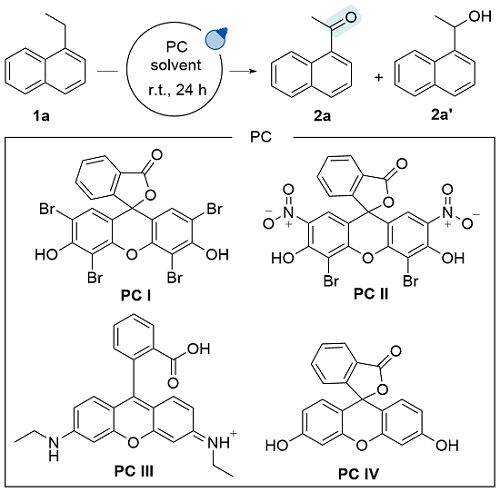
To validate our hypothesis, we initiated our investigations using commercially available 1-ethylnaphthalene (1a, $E_{1 / 2}^{\mathrm{red}}$=-0.78 V vs Ag/AgNO3 in MeCN) as the model substrate in the presence of a photocatalyst (Table 1). Pleasingly, the desired ketone product 2a was isolated in 36% yield, while using eosin Y (PC I) as photosensitizer, but along with 12% yield of alcohol 2a' as the byproduct (Table 1, Entry 1). Other organic photocatalyst gave inferior results (Table 1, Entries 2~4). Solvent screening showed that 1,4-dioxane was the optimal choice (Table 1, Entries 5~9). It was found that increasing the reaction concentration benefited this photo-reaction, yielding the desired ketone 2a in 61% yield (Table 1, Entry 10). Interestingly, lowering the illumination intensity dramatically improved the reaction efficiency (Table 1, Entry 11). In addition, control experiments further demonstrated that photocatalyst and light irradiation were requisite for this transformation (Table 1, Entries 12~13). Similar reaction results were observed while under O2 atmosphere, but no product was obtained while under Ar conditions.
Table 1 Investigation of the reaction conditionsa |
| Entry | Solvent | PC | Yield/% | ||
|---|---|---|---|---|---|
| 2a | 2a' | ||||
| 1 | 1,4-Dioxane (0.2 mol/L) | PC I | 36 | 12 | |
| 2 | 1,4-Dioxane (0.2 mol/L) | PC II | <10 | 0 | |
| 3 | 1,4-Dioxane (0.2 mol/L) | PC III | <10 | 0 | |
| 4 | 1,4-Dioxane (0.2 mol/L) | PC IV | <10 | 0 | |
| 5 | DMA (0.2 mol/L) | PC I | 30 | 0 | |
| 6 | CH3CN (0.2 mol/L) | PC I | 30 | 30 | |
| 7 | THF (0.2 mol/L) | PC I | Trace | Trace | |
| 8 | DCE (0.2 mol/L) | PC I | Complex | — | |
| 9 | DMSO (0.2 mol/L) | PC I | Trace | Trace | |
| 10 | 1,4-Dioxane (0.1 mol/L) | PC I | 61 | 0 | |
| 11c | 1,4-Dioxane (0.1 mol/L) | PC I | 90 | 0 | |
| 12 | 1,4-Dioxane (0.1 mol/L) | — | 0 | 0 | |
| 13d | 1,4-Dioxane (0.1 mol/L) | PC I | 0 | 0 | |
a Unless otherwise noted, all reactions were carried out by using 1a (0.2 mmol, 1.0 equiv.), solvent, photocatalyst (10 mol%), r.t., 30 W blue LEDs, under air conditions for the 24 h. b Isolated yield. c Photocatalyst (10 mol%). d 10 W blue LEDs were used. d The reaction took place in dark conditions. |
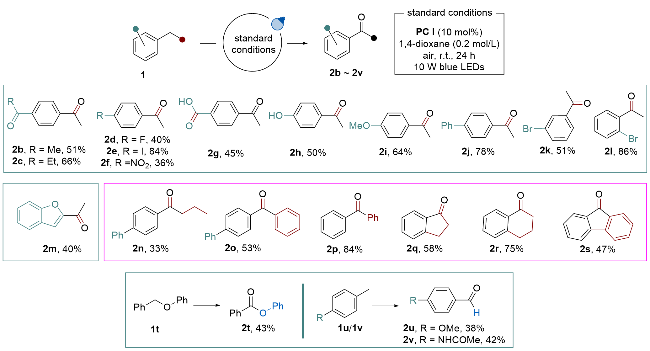
With the optimized reaction conditions in hand, the scope and limitation of this developed strategy were evaluated (Scheme 2). Ethylbenzenes bearing various functional groups, including ketone, halogen, NO2, carboxylic acid, hydroxyl group, phenyl group or methoxy group, were tolerated well, delivering the desired aromatic ketones 2b~2l in moderate to good yields. To our delight, heteroaromatic substrate 2-ethylbenzofuran was amenable to this photocatalyzed transformation, producing the corresponding product 2m in moderate yield. But other heteroaryl alkanes such as 4-ethylpyridine were incompatible. In the case of diphenylmethane, the desired diphenyl ketones 2o and 2p were obtained in 53% and 84% yields, respectively. Furthermore, cyclic substrates were explored, which were oxidized readily to furnish 2q~2s smoothly. Ether was able to be oxidized as well, giving the corresponding ester product 2s in 43% yield. Toluene derivatives underwent this photo-oxygenation smoothly, producing the aldehydes 1u and 1v in an acceptable yield, respectively. Toluene substrate with strong electron-withdrawing substituent such as 4-NO2-toluene exhibited quite low reactivity, only with 20% NMR yield of the corresponding aldehyde. Notably, in some cases, the overoxidized by- products were observed, thus resulting the low yield.
It is worth noting that this protocol was also applicable to the late-stage oxygenation of allylic C—H bonds in structurally complex biologically active steroids, affording the desired vinyl ketone 2w~2z in moderate yields (Scheme 3). It is worth noting that excellent regioselectivity and chemoselectivity were observed in these transfor-mations, although multiple reactive sites are involved in these substrates. However, alkyl alkynes such as but-1-yn- 1-ylbenzene were unable to give the desired product. Finally, the protocol was readily scaled up without loss in yield reaction efficiency, illustrating the synthetic potential of this protocol (Figure 1a).
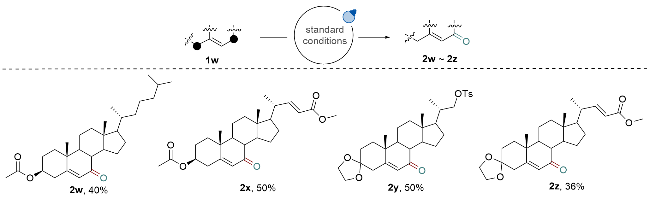
Scheme 3 Extension to allylic oxidation of biological active steroidsConditions: 1w (0.2 mmol, 1.0 equiv.), DMA (0.1 mol/L), Eosin Y (5 mol%), r.t., 30 W blue Led, under oxygen conditions for 24 h, isolated yield. |
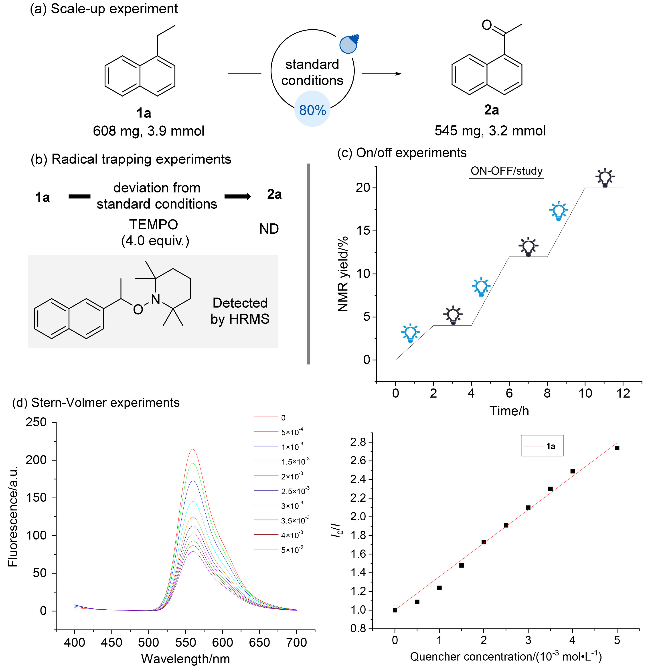
In attempt to gain insight into the reaction mechanism, a series of experimental studies were performed (Figures 1b~1d). Under the standard conditions, addition of free radical inhibitors such as 2,2,6,6-tetramethylpiperidine oxide (TEMPO) or butylhydroxytoluene (BHT) inhibited the formation of target product, and the corresponding radical adduct could be found by high-resolution mass spectrometry (HRMS) (Figure 1b). The on-off experiments demonstrated that the reaction only proceeded with light irradiation. The possibility of free radical chain pathway was presumably ruled out (Figure 1c). Stern-Volmer experiments showed that 1-ethylnaphthalene (1a) had obvious quenching effect on the photocatalyst (Figure 1d).
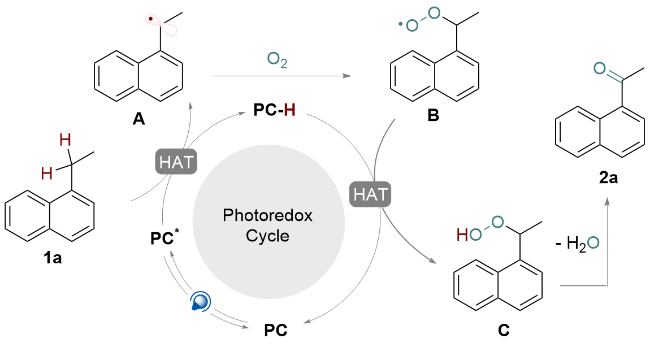
On the basis of the mechanistic studies and previous reports,[6-9] a photoinduced HAT process is proposed in Scheme 4. Initially, photocatalyst PC was excited to its excited state PC* under visible-light irradiation. Subsequently, a HAT process occurred between the excited state PC* and 1a, forming the benzyl radical A and PC-H. Capture of radical A by O2 delivered the peroxy radical B, which could abstract the H-atom from PC-H to yield the intermediate C with regeneration of the photocatalyst. Final elimination of water produced the ketone product 2a.


3 Conclusions
In conclusion, an efficient and sustainable strategy for photocatalyzed oxidation of benzylic C—H bonds with high chemoselectivity has been established, affording a range of value-added carbonyl-bearing compounds. The well-designed HAT process is the key to the success of this transformation, which features mild conditions, eco- friendliness, and good functional group tolerance. The synthetic utility of the developed approach is well demonstrated by late-stage oxidation of bioactive complex steroids.
4 Experimental section
4.1 General experimental information
Unless otherwise noted, all the reagents were purchased from commercial suppliers and used without further purification. The melting point was determined by using a WRS-4 microscopic melting point apparatus. NMR spectra was tested on a BRUKER ASCENG TM 400 MHz. The chemical shifts were recorded relative to tetramethylsilane and with the solvent resonance as the internal standard. 19F NMR data were collected at 376 MHz with complete proton decoupling. 13C NMR data were collected at 100 MHz with complete proton decoupling. Infrared spectra (IR) were measured by a FT-IR apparatus. High-resolution mass spectrometry (HRMS) was tested on a Bruker Q-TOF MS mass spectrometer and acetonitrile was used to dissolve the sample. Column chromatography was carried out on silica gel (200~300 mesh). Photochemical reactions were performed with a LED flow reactor WP-TEC-1020- HSL (WATTCAS, China).
4.2 Experimental method
1'-Acetonaphthone (2a)[10i]: Purified by flash column chromatography [V(petroleum ether, PE)∶V(ethyl acetate, EA)=97∶3], 30.5 mg, yellow oil, yield 90%. 1H NMR (400 MHz, Chloroform-d) δ: 8.74 (d, J=8.6 Hz, 1H), 7.99 (d, J=8.2 Hz, 1H), 7.93 (d, J=7.2 Hz, 1H), 7.87 (d, J=8.1 Hz, 1H), 7.63~7.57 (m, 1H), 7.55~7.47 (m, 2H), 2.74 (s, 3H); 13C NMR (100 MHz, Chloroform-d) δ: 201.9, 135.4, 134.0, 133.1, 130.2, 128.8, 128.4, 128.1, 126.5, 126.0, 124.4, 30.0.
1,4-Diacetylbenzene (2b): Purified by flash column chromatography [V(PE)∶V(EA)=97∶3], 16.5 mg, white solid, yield 51%. m.p. 110~112 ℃ (lit.[10m] 109.8~110.6 ℃); 1H NMR (400 MHz, Chloroform-d) δ: 8.06~8.02 (m, 4H), 2.65 (s, 6H); 13C NMR (100 MHz, Chloroform-d) δ: 197.5, 140.2, 128.5, 26.9.
1-(4-Acetylphenyl)-1-propanone (2c):[10d] Purified by flash column chromatography [V(PE)∶V(EA)=97∶3], 23.1 mg, white solid, yield 66%. m.p. 74~76 ℃; 1H NMR (400 MHz, Chloroform-d) δ: 8.05~8.02 (m, 4H), 3.04 (q, J=7.2 Hz, 2H), 2.65 (s, 3H), 1.25 (t, J=7.2 Hz, 3H); 13C NMR (100 MHz, Chloroform-d) δ: 200.2, 197.5, 140.1, 140.0, 128.5, 128.2, 32.3, 26.9, 8.1.
4'-Fluoroacetophenone (2d):[10m] Purified by flash column chromatography [V(PE)∶V(EA)=97∶3], 11 mg, yellow oil, yield 40%. 1H NMR (400 MHz, Chloroform-d) δ: 7.91 (dd, J=8.9, 5.4 Hz, 2H), 7.06 (t, J=8.6 Hz, 2H), 2.52 (s, 3H); 13C NMR (100 MHz, Chloroform-d) δ: 196.4, 165.8 (d, 1JC-F=254.7 Hz), 133.6 (d, 4JC-F=3.0 Hz), 130.9 (d, 3JC-F=9.3 Hz), 115.6 (d, 2JC-F=21.9 Hz), 26.5; 19F NMR (376 MHz, Chloroform-d) δ: -105.38.
4-Iodoacetophenone (2e): Purified by flash column chromatography [V(PE)∶V(EA)=97∶3], 41.6 mg, yellow solid, yield 84%. m.p. 83~85 ℃ (lit.[10m] 80.3~81.5 ℃); 1H NMR (400 MHz, Chloroform-d) δ: 7.83 (d, J=8.5 Hz, 2H), 7.66 (d, J=8.5 Hz, 2H), 2.58 (s, 3H); 13C NMR (100 MHz, Chloroform-d) δ: 197.3, 137.9, 129.7, 101.1, 26.5.
1-(4-Nitrophenyl) ethan-1-one (2f): 10 mg, yellow solid, yield 36%. m.p. 75~77 ℃ (lit.[10m] 77.9~79.1 ℃); 1H NMR (400 MHz, Chloroform-d) δ: 8.32 (d, J=8.8 Hz, 2H), 8.11 (d, J=8.8 Hz, 2H), 2.68 (s, 3H); 13C NMR (101 MHz, Chloroform-d) δ: 196.2, 150.4, 141.4, 129.3, 123.9, 27.0.
4-Acetylbenzoic acid (2g):[10c] Purified by flash column chromatography [V(PE)∶V(EA)=9∶1], 14.8 mg, white solid, yield 45%. m.p. 208~210 ℃; 1H NMR (400 MHz, DMSO-d6) δ: 8.06 (s, 4H), 2.63 (s, 3H); 13C NMR (100 MHz, DMSO-d6) δ: 198.2, 167.1, 140.3, 135.0, 130.0, 128.8, 27.5.
4'-Hydroxyacetophenone (2h):[10f] Purified by flash column chromatography [V(PE)∶V(EA)=9∶1], 13.6 mg, brown solid, yield 50%. m.p. 132~134 ℃; 1H NMR (400 MHz, Chloroform-d) δ: 7.91 (d, J=8.8 Hz, 2H), 6.90 (d, J=8.8 Hz, 2H), 2.57 (s, 3H); 13C NMR (100 MHz, Chloroform-d) δ: 197.3, 160.4, 131.0, 130.2, 115.3, 26.4
4'-Methoxyacetophenone (2i): Purified by flash column chromatography [V(PE)∶V(EA)=93∶7], 17.3 mg, white solid, yield 63%. m.p. 50~52 ℃ (lit.[10m] 36.6~37.1 ℃); 1H NMR (400 MHz, Chloroform-d) δ: 7.94 (d, J=8.8 Hz, 2H), 6.94 (d, J=8.8 Hz, 2H), 3.87 (s, 3H), 2.56 (s, 3H); 13C NMR (100 MHz, Chloroform-d) δ: 196.8, 163.5, 130.6, 130.3, 113.7, 55.5, 26.4.
4-Acetylbiphenyl (2j): Purified by flash column chromatography [V(PE)∶V(EA)=93∶7], 28.1 mg, brown solid, yield 78%. m.p. 152~154 ℃ (lit.[10m] 154.7~155.9 ℃); 1H NMR (400 MHz, Chloroform-d) δ: 8.03 (d, J=8.3 Hz, 2H), 7.68 (d, J=8.3 Hz, 2H), 7.62 (d, J=7.4 Hz, 2H), 7.46 (t, J=7.4 Hz, 2H), 7.40 (d, J=7.2 Hz, 1H), 2.63 (s, 3H); 13C NMR (100 MHz, Chloroform-d) δ: 197.8, 145.8, 139.9, 135.9, 129.0, 128.9, 128.3, 127.3, 127.2, 26.7.
3'-Bromoacetophenone (2k):[10m] Purified by flash column chromatography [V(PE)∶V(EA)=93∶7], 20.1 mg, brown oil, yield 51%. 1H NMR (400 MHz, Chloroform-d) δ: 8.09 (s, 1H), 7.88 (d, J=7.8 Hz, 1H), 7.69 (d, J=7.9 Hz, 1H), 7.35 (t, J=7.9 Hz, 1H), 2.60 (s, 3H); 13C NMR (100 MHz, Chloroform-d) δ: 196.66, 138.78, 135.97, 131.38, 130.21, 126.86, 122.95, 26.65.
2'-Bromoacetophenone (2l):[10m] Purified by flash column chromatography [V(PE)∶V(EA)=93∶7], 34.1 mg, yellow oil, yield 40%. 1H NMR (400 MHz, Chloroform-d) δ: 7.53 (dd, J=7.9, 1.0 Hz, 1H), 7.38 (dd, J=7.6, 1.8 Hz, 1H), 7.29 (td, J=7.5, 1.2 Hz, 1H), 7.21 (td, J=7.7, 1.7 Hz, 1H), 2.55 (s, 3H); 13C NMR (100 MHz, Chloroform-d) δ: 201.3, 141.5, 133.8, 131.8, 128.9, 127.4, 118.9, 30.3.
2-Acetylbenzofuran (2m):[10b] Purified by flash column chromatography [V(PE)∶V(EA)=93∶7], 16.6 mg, yellow oil, yield 52%. 1H NMR (400 MHz, Chloroform-d) δ: 7.71 (d, J=7.9 Hz, 1H), 7.58 (d, J=8.1 Hz, 1H), 7.52~7.45 (m, 2H), 7.34~7.28 (m, 1H), 2.61 (s, 3H); 13C NMR (100 MHz, Chloroform-d) δ: 188.7, 155.7, 152.7, 128.3, 123.9, 123.3, 113.0, 112.5, 26.5.
1-[1'-Biphenyl]-4-yl-1-butanone (2n):[10j] Purified by flash column chromatography [V(PE)∶V(EA)=93∶7], 14.7 mg, white solid, yield 33%. m.p. 76~78 ℃; 1H NMR (400 MHz, Chloroform-d) δ: 8.04 (d, J=8.4 Hz, 1H), 7.68 (d, J=8.4 Hz, 2H), 7.65~7.60 (m, 2H), 7.47 (t, J=7.5 Hz, 2H), 7.40 (t, J=7.3 Hz, 1H), 2.98 (t, J=7.3 Hz, 2H), 1.80 (h, J=7.4 Hz, 2H), 1.03 (t, J=7.4 Hz, 3H); 13C NMR (100 MHz, Chloroform-d) δ: 200.1, 145.6, 139.9, 135.8, 128.9, 128.6, 128.2, 127.3, 127.2, 40.6, 17.9, 13.9.
4-Phenylbenzophenone (2o): Purified by flash column chromatography [V(PE)∶V(EA)=93∶7], 30 mg, yellow solid, yield 53%. m.p. 100~102 ℃ (lit.[10a] 49.2~50.0 ℃); 1H NMR (400 MHz, Chloroform-d) δ: 7.89 (d, J=8.2 Hz, 2H), 7.83 (d, J=7.3 Hz, 2H), 7.70 (d, J=8.1 Hz, 2H), 7.64 (d, J=7.3 Hz, 2H), 7.59 (t, J=7.4 Hz, 1H), 7.51~7.45 (m, 4H), 7.40 (t, J=7.3 Hz, 1H); 13C NMR (100 MHz, Chloroform-d) δ: 196.4, 140.0, 137.8, 136.3, 132.4, 130.8, 130.0, 129.0, 128.4, 128.2, 127.3, 127.0.
Benzophenone (2p): Purified by flash column chromatography [V(PE)∶V(EA)=93∶7], 30.6 mg, white solid, yield 83%. m.p. 48~50 ℃ (lit.[10a] 42.0~42.6 ℃); 1H NMR (400 MHz, Chloroform-d) δ: 7.83~7.76 (m, 4H), 7.58 (t, J=7.4 Hz, 2H), 7.48 (t, J=7.6 Hz, 4H); 13C NMR (100 MHz, Chloroform-d) δ: 196.7, 137.6, 132.4, 130.1, 128.3.
1-Indanone (2q):[10i] Purified by flash column chromatography [V(PE)∶V(EA)=93∶7], 15.3 mg, brown oil, yield 58%. 1H NMR (400 MHz, Chloroform-d) δ: 7.69 (d, J=7.7 Hz, 1H), 7.51 (td, J=7.5, 1.2 Hz, 1H), 7.41 (d, J=7.7 Hz, 1H), 7.30 (t, J=7.4 Hz, 1H), 3.13~3.04 (m, 2H), 2.64~2.59 (m, 2H); 13C NMR (100 MHz, Chloroform-d) δ: 207.04, 155.15, 137.09, 134.58, 127.27, 126.69, 123.71, 36.22, 25.81.
1-Tetralone (2r):[10h] Purified by flash column chromatography [V(PE)∶V(EA)=93∶7], 21.9 mg, brown oil, yield 75%. 1H NMR (400 MHz, Chloroform-d) δ: 7.96 (dd, J=7.8, 1.4 Hz, 1H), 7.39 (td, J=7.5, 1.5 Hz, 1H), 7.23 (t, J=7.5 Hz, 1H), 7.19~7.15 (m, 1H), 2.89 (t, J=6.1 Hz, 2H), 2.61~2.56 (m, 2H), 2.07 (p, J=6.4 Hz, 2H); 13C NMR (100 MHz, Chloroform-d) δ: 198.40, 144.49, 133.39, 132.64, 128.76, 127.18, 126.63, 39.18, 29.72, 23.30.
9-Fluorenone (2s):[10l] Purified by flash column chromatography [V(PE)∶V(EA)=93∶7], 16.9 mg, brown solid, yield 47%. m.p. 80~82 ℃; 1H NMR (400 MHz, Chloroform-d) δ: 7.65 (d, J=7.4 Hz, 2H), 7.51 (d, J=7.3 Hz, 2H), 7.47 (td, J=7.3, 1.0 Hz, 2H), 7.28 (td, J=7.3, 1.3 Hz, 2H); 13C NMR (100 MHz, Chloroform-d) δ: 193.90, 144.44, 134.67, 134.16, 129.07, 124.31, 120.30.
Phenyl benzoate (2t):[10e] Purified by flash column chromatography [V(PE)∶V(EA)=93∶7], 17.0 mg, white solid, yield 43%. m.p. 70~72 ℃ (lit.[10e] 71.0~72.0 ℃); 1H NMR (400 MHz, Chloroform-d) δ: 8.23~8.18 (m, 2H), 7.64 (t, J=7.4 Hz, 1H), 7.51 (t, J=7.7 Hz, 2H), 7.43 (t, J=7.9 Hz, 2H), 7.28 (d, J=7.4 Hz, 1H), 7.25~7.20 (m, 2H); 13C NMR (100 MHz, Chloroform-d) δ: 165.21, 150.98, 133.60, 130.19, 129.60, 129.51, 128.59, 125.91, 121.74.
p-Anisaldehyde (2u):[10k] Purified by flash column chromatography [V(PE)∶V(EA)=93∶7], 10 mg, yellow oil, yield 38%. 1H NMR (400 MHz, Chloroform-d) δ: 9.89 (s, 1H), 7.85 (d, J=8.8 Hz, 2H), 7.01 (d, J=8.7 Hz, 2H), 3.90 (s, 3H); 13C NMR (100 MHz, Chloroform-d) δ: 190.8, 164.6, 132.0, 130.0, 114.3, 55.6.
4-Acetamidobenzaldehyde (2v):[10g] Purified by flash column chromatography [V(PE)∶V(EA)=1∶1], 13.7 mg, white solid, yield 42%. m.p. 148~150 ℃; 1H NMR (400 MHz, DMSO-d6) δ: 10.21 (s, 1H), 7.88 (d, J=8.7 Hz, 2H), 7.69 (d, J=8.7 Hz, 2H), 2.08 (s, 3H); 13C NMR (100 MHz, DMSO-d6) δ: 169.3, 167.4, 143.8, 130.8, 125.4, 118.6, 24.6.
(3S,10R,13R)-10,13-dimethyl-17-((R)-6-methylheptan- 2-yl)-7-oxo-2,3,4,7,8,9,10,11,12,13,14,15,16,17-tetradeca-hydro-1H-cyclopenta[a]phenanthren-3-methyl acetate (2w): Purified by flash column chromatography [V(PE)∶V(EA)=2∶1], 35.4 mg, white solid, yield 40%. m.p. 146~148; 1H NMR (400 MHz, Chloroform-d) δ: 5.70 (d, J=1.5 Hz, 1H), 4.71 (tt, J=11.4, 4.7 Hz, 1H), 2.58~2.51 (m, 1H), 2.46 (ddd, J=13.7, 11.5, 1.7 Hz, 1H), 2.23 (t, J=11.2 Hz, 1H), 2.05 (s, 3H), 2.04~2.00 (m, 1H), 1.99~1.92 (m, 2H), 1.92~1.85 (m, 1H), 1.63 (s, 2H), 1.56 (dd, J=10.5, 4.4 Hz, 4H), 1.52~1.46 (m, 2H), 1.38~1.35 (m, 3H), 1.35~1.32 (m, 3H), 1.31~1.29 (m, 1H), 1.28 (d, J=6.1 Hz, 2H), 1.26 (s, 2H), 1.21 (s, 2H), 1.15~1.11 (m, 4H), 1.10 (s, 2H), 1.03 (d, J=5.5 Hz, 1H), 0.92 (d, J=6.5 Hz, 2H), 0.87 (d, J=1.8 Hz, 3H), 0.86 (d, J=1.8 Hz, 3H), 0.68 (s, 2H); 13C NMR (100 MHz, Chloroform-d) δ: 201.9, 170.3, 163.8, 126.7, 72.2, 54.8, 50.0, 49.8, 45.4, 43.1, 39.5, 38.7, 38.3, 37.8, 36.2, 36.0, 35.7, 29.7, 28.5, 28.0, 27.4, 26.3, 23.8, 22.8, 22.6, 21.2, 18.9, 17.3, 12.0; IR (neat) ν: 2939 2870 1730 1669 1466 1374 1237 1181 1035 cm-1; HRMS (ESI) calcd for C29H46KO5 [M+K]+481.3079, found 481.3077.
Methyl (4R,E)-4-((3S,10R,13R)-3-acetoxy-10,13-dime-thyl-7-oxo-2,3,4,7,8,9,10,11,12,13,14,15,16,17-tetradeca-hydro-1H-cyclopenta[a]phenanthren-17-yl)pent-2-enoate (2x): Purified by flash column chromatography [V(PE)∶V(EA)=2∶1], 45.8 mg, yellow solid, yield 50%. m.p. 217~219 ℃; 1H NMR (400 MHz, Chloroform-d) δ: 6.85 (dd, J=15.6, 9.0 Hz, 1H), 5.78~5.66 (m, 3H), 4.81~4.63 (m, 1H), 3.72 (s, 3H), 2.56 (ddd, J=13.9, 5.1, 1.9 Hz, 2H), 2.47 (ddd, J=13.7, 11.6, 1.8 Hz, 2H), 2.33~2.20 (m, 4H), 2.05 (s, 3H), 2.03~1.98 (m, 4H), 1.96~1.94 (m, 1H), 1.78~1.73 (m, 2H), 1.72~1.66 (m, 5H), 1.62 (dd, J=6.1, 3.5 Hz, 2H), 1.57 (dd, J=11.6, 3.7 Hz, 3H), 1.39~1.30 (m, 3H), 1.30~1.25 (m, 10H), 1.25~1.23 (m, 2H), 1.21 (s, 3H), 1.10 (d, J=6.6 Hz, 3H), 0.71 (s, 3H); 13C NMR (100 MHz, Chloroform-d) δ: 201.5, 170.3, 167.4, 163.9, 154.7, 126.7, 118.8, 72.2, 53.7, 51.4, 49.79, 49.77, 45.3, 43.4, 39.5, 38.5, 38.3, 37.8, 36.0, 29.7, 28.2, 27.4, 26.3, 21.2, 21.1, 19.5, 17.3, 12.3; IR (neat) ν: 2944 2868 1733 1718 1663 1246 1232 1183 1038 cm-1; HRMS (ESI) calcd for C28H42KO5 [M+K]+ 497.2664, found 497.2674.
(2S)-2-((10R,13R)-10,13-dimethyl-7-oxo-1,2,4,7,8,9,10,11,12,13,14,15,16,17-tetradecahydrospiro[cyclopenta [a]phenanthrene-3,2'-[1,3]dioxolan]-17-yl)propyl 4-methylben- zenesulfonate (2y): Purified by flash column chromatography [V(PE)∶V(EA)=2∶1], 42.1 mg, white solid, yield 50%. m.p. 199~200 ℃; 1H NMR (400 MHz, Chloroform-d) δ: 7.78 (d, J=8.3 Hz, 1H), 7.35 (d, J=8.0 Hz, 1H), 5.65 (d, J=1.9 Hz, 1H), 4.04~3.95 (m, 1H), 3.95 (d, J=3.0 Hz, 1H), 2.67 (dd, J=14.7, 1.9 Hz, 1H), 2.45 (s, 2H), 2.34 (td, J=15.0, 4.7 Hz, 1H), 2.19 (t, J=11.0 Hz, 1H), 1.96 (dd, J=9.5, 6.5 Hz, 1H), 1.92~1.81 (m, 2H), 1.77~1.71 (m, 1H), 1.69 (dd, J=6.9, 3.5 Hz, 1H), 1.66~1.62 (m, 2H), 1.61 (s, 1H), 1.58 (d, J=5.3 Hz, 2H), 1.53 (dd, J=9.6, 4.7 Hz, 2H), 1.48 (d, J=4.1 Hz, 1H), 1.19 (s, 2H), 1.01 (d, J=6.6 Hz, 2H), 0.65 (s, 2H); 13C NMR (100 MHz, Chloroform-d) δ: 201.4, 164.6, 144.6, 133.1, 129.8, 127.9, 126.6, 108.9, 75.6, 64.6, 64.5, 50.6, 49.7, 49.5, 45.3, 43.3, 41.7, 38.4, 38.2, 36.2, 35.6, 31.0, 29.7, 27.8, 26.2, 22.7, 21.6, 21.1, 17.0, 16.9, 14.1, 11.9; IR (neat) ν: 2926 1667 1353 1187 1172 1104 1078 1066 925 cm-1; HRMS (ESI) calcd for C27H38NaO5 [M+K]+ 465.2611, found 465.2624.
Methyl (4R,E)-4-((10R,13R)-10,13-dimethyl-7-oxo- 1,2,4,7,8,9,10,11,12,13,14,15,16,17-tetradecahydrospiro[cyclopenta [a]phenanthrene-3,2'-[1,3]dioxolan]-17-yl)pent-2-enoate (2z): Purified by flash column chromatography [V(PE)∶V(EA)=2∶1], 31.8 mg, yellow solid, yield 50%. m.p. 202~204 ℃; 1H NMR (400 MHz, Chloroform-d) δ: 6.87 (dd, J=15.6, 9.0 Hz, 1H), 5.76 (d, J=15.4 Hz, 1H), 5.69 (d, J=1.7 Hz, 1H), 4.02~3.93 (m, 1H), 3.74 (s, 3H), 2.69 (dd, J=14.7, 1.9 Hz, 1H), 2.47~2.39 (m, 1H), 2.35 (dd, J=14.8, 2.9 Hz, 1H), 2.29~2.21 (m, 1H), 2.02 (dt, J=12.6, 3.1 Hz, 1H), 1.95~1.85 (m, 2H), 1.81~1.73 (m, 2H), 1.67~1.59 (m, 6H), 1.56~1.51 (m, 1H), 1.39~1.36 (m, 1H), 1.29 (d, J=6.9 Hz, 2H), 1.23 (s, 3H), 1.12 (d, J=6.6 Hz, 3H), 0.74 (s, 3H); 13C NMR (100 MHz, Chloroform-d) δ: 201.4, 167.4, 164.6, 154.7, 126.6, 118.7, 108.9, 64.6, 64.5, 53.8, 51.4, 49.9, 49.6, 45.3, 43.5, 41.7, 39.5, 38.6, 38.3, 35.6, 31.1, 28.2, 26.3, 21.2, 19.5, 17.0, 12.3; IR (neat) ν: 2951 2925 1725 1672 1166 1100 1077 1049 cm-1; HRMS (ESI) calcd for C24H35KO3 [M+K]+ 410.2218, found 410.2244.
Supporting Information 1H NMR spectra of compounds 2a~2z. The Supporting Information is available free of charge via the Internet at http://sioc-journal.cn.
(Cheng, F.)